When preschoolers bend a piece of string into a curve, it may look shorter—but has its length really changed? This simple investigation helps children compare, predict, and explain while building foundational measurement ideas. For practical strategies that connect measurement and other math concepts to play, explore ChildCareEd’s Early Mathematics Through Play Buy Now $24.00 course, which can strengthen your classroom practice with developmentally appropriate, hands-on approaches.
For a ready-to-use classroom experience, pair the investigation with ChildCareEd’s English math resources for Early Mathematics Through Play, including printable activities that can extend children’s exploration. Together, professional learning and purposeful materials can help you turn a child’s question into meaningful math talk.
Why investigate whether a bent string keeps the same length?
A child may see a straight string as “long” and a curved one as “short.” That intuitive impression is a productive starting point, not a misconception to dismiss. By making a prediction, testing it, and explaining what happened, children begin to distinguish an object’s length from the shape it takes in space.
Length is an attribute that can be compared even when an object changes position or shape. A string bent into a curve occupies less straight-line space from end to end, but bending alone does not remove material. Helping children explore this difference gives them a foundation for measurement, spatial reasoning, and careful observation.
Young children learn these ideas through meaningful, repeated comparisons. The Illinois Early Learning Project recommends using familiar nonstandard tools such as string and blocks, and inviting children to describe relationships with words like longer and shorter (Path to Math: Measurement with Young Children). The Early Math Collaborative likewise emphasizes that a fair comparison requires children to attend to the same attribute and use a consistent method (Big Ideas of Measurement).
For providers and directors, this investigation is valuable because it is inexpensive, adaptable, and easy to revisit. It supports #curiosity and #reasoning while showing children that mathematics begins with questions about everyday materials—not just numerals or worksheets.
What materials and setup make the investigation work?
Use a piece of thick, manageable string, yarn, or cord. Choose material that bends without stretching easily and is long enough for children to handle comfortably. Prepare a smooth table or floor area, a strip of paper or a tray to keep the work contained, and optional picture cards or drawing paper for recording ideas. Avoid very thin string for children who might wrap it around themselves, and supervise use closely.
Begin with one piece of string. Show it in a straight line, then invite children to bend it into a broad curve, a wave, or a loop. Ask them to keep track of the ends so the group can compare the same length before and after bending. Do not cut or pull the string during the investigation; those actions would alter its length and confuse the comparison.
- Invite children to look closely and share what they notice before making a prediction.
- Ask whether the curved string seems longer, shorter, or the same length as before.
- Keep the original string and its endpoints visible throughout the test.
- Offer a second string only after children have explored the first, reducing distractions.
Representations help make thinking visible. Children can draw the string straight and curved, place a finger at each endpoint, or describe the change using gestures. If your program uses the Straight, Curved, Same Length Investigation Mats, use them as a recording surface: children can place or sketch the string in each position and revisit their first prediction. The mat supports discussion; it does not replace the hands-on test.
How can teachers guide the investigation without giving away the answer?
Use a simple inquiry cycle: predict, test, compare, and explain. First, invite each child to state or show a prediction. Some may say the string gets shorter because the curve looks compact; others may expect it to stay the same. Accept each idea warmly and make clear that the group will investigate rather than vote on who is right.
Next, establish a fair comparison. Straighten the string gently and compare it with the same string in its curved form. Children might trace the path with a finger or lay the string along a line on the mat. Emphasize that they are following the entire string, not just comparing how far apart the endpoints appear. This distinction is the heart of the investigation: the curve changes the space between endpoints, while the amount of string remains constant.
Use brief, open prompts and allow time for children to think:
- “What do you predict will happen when we bend it?”
- “What changed? What stayed the same?”
- “How could we check whether it is the same length?”
- “What do you notice about the ends of the string?”
As children respond, echo and extend their language: “You noticed the ends moved closer together. Let’s follow the string from one end to the other.” Avoid turning the exchange into a quiz or correcting a prediction before the test. This respectful approach strengthens #language and invites children to treat evidence as useful information.
What does the investigation teach about measurement and fair comparison?
The central finding is that bending a string changes its shape, not its length, as long as the string is neither stretched nor cut. However, preschoolers may use “length” to refer to different things: the amount of string along its path, or the straight-line distance between its endpoints. Name the distinction clearly and concretely. You might say, “The string follows a longer curved path than the space from end to end. The string itself is still the same piece.”
Fair comparison is an important measurement idea. Children need to compare the same attribute, use the same object, and attend to both endpoints. If one child compares the curve’s endpoint distance while another traces the entire string, they are answering different questions. Make those approaches visible rather than labeling one child as wrong.
Measurement becomes more precise through repeated, meaningful experiences. In a related activity, children can use string to represent the heights of different objects and line the strings up at one end to compare them (Becoming a Math Family). That comparison illustrates how string can serve as an informal measuring tool even when objects cannot be placed side by side.
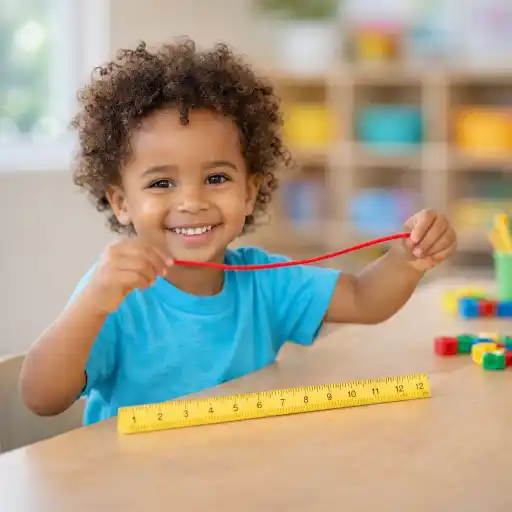
Extend the investigation by comparing a curved string with a straight piece cut to the same length, or by using two equal strings bent in different ways. Ask children to describe which comparison feels fair and why. Keep the focus on observation, not formal units; for preschoolers, concrete language and careful placement are more useful than premature ruler work.
How can the activity include different learners and extend into play?
Children can demonstrate their ideas in many ways. Some may explain verbally, while others point, gesture, draw, or move the string. Provide multiple ways to participate and allow children to work with a partner or watch a demonstration before handling materials. For multilingual learners, pair key words—straight, curved, same, longer, shorter—with gestures and visual examples; welcome children’s home-language explanations.
Offer adaptations according to children’s motor and sensory needs. A thicker cord may be easier to grasp; a high-contrast mat can make the path clearer; a peer or adult can help hold an endpoint steady. Keep the experience collaborative so that children can contribute through observing, predicting, arranging, or describing.
Playful extensions can connect the concept to classroom routines:
- Make a “string path” on the floor, first straight and then curved, and compare the path with the space between its endpoints.
- Use yarn to outline a familiar shape, then straighten it and notice how its form changes.
- Invite children to find two different shapes they can make with one piece of string.
- Ask children to sketch the investigation and dictate one observation for a classroom display.
🎨 Try a shape challenge: Invite children to create a circle, a zigzag, and a gentle curve with one piece of yarn, then explain what changed and what stayed the same. Keep materials age-appropriate and actively supervise. State requirements vary - check your state licensing agency.
What common pitfalls should providers avoid?
A few small teaching choices can make the investigation clearer and more inclusive. First, avoid comparing only the straight-line distance between endpoints with the entire curved path without naming the difference. Children need to know what attribute is under discussion. Say, “We are comparing the amount of string,” or, “Now we are looking at the space between the ends.”
Second, do not stretch the string while straightening it. Stretching may change its length, making the test unfair. Handle the material gently and show children that the same piece is being compared. Likewise, do not cut the string between trials unless the goal is explicitly to explore how cutting changes length.
Other helpful reminders:
- Do not announce the answer before children have made and tested predictions.
- Do not treat a child’s first impression as a failure; it is a useful starting idea.
- Do not require every child to explain aloud; accept pointing, drawing, and demonstration.
- Do not overemphasize standard units when the learning goal is comparing attributes.
Document a concise observation, such as: “After bending the string, Sam traced the curve with a finger and said, ‘It’s still all there.’” Such notes help staff plan the next experience and show families how purposeful play supports mathematical thinking. Directors can strengthen consistency by encouraging staff to use common comparison language and share children’s observations during planning.
Conclusion: Does bending a string change its length?
No—bending a string changes its shape, not its length, as long as it is not stretched or cut. The investigation helps children distinguish the full path of a string from the straight-line space between its endpoints, while practicing prediction, observation, comparison, and explanation.
- Use the same string and keep its endpoints in view for a fair test.
- Invite children to predict, manipulate, compare, and describe what they notice.
- Clarify whether the group is discussing the string’s full length or endpoint distance.
- Adapt materials and response options so every child can participate meaningfully.
When educators welcome children’s ideas and make room to test them, a simple piece of yarn becomes a rich mathematical investigation. To deepen your broader approach to playful math—including measurement, patterns, geometry, and reasoning—consider exploring ChildCareEd’s Early Mathematics Through Play Buy Now $24.00 course.
- CDA Home Visitor Subject Area 3 Part 3 Birth to 5
- CDA Preschool Credential with Portfolio Review
- 45 Hour Preschool Methods and Materials
- Using AI Language Models for Trainers
- CDA Bridge Bundle: Preschool
- CDA Bridge Bundle: Family Child Care without Portfolio Review
- CDA Bridge Bundle: Infant/Toddler without Portfolio Review
- CDA Bridge Bundle: Preschool without Portfolio Review
- Emergent Learning & Development
- CDA Certification en Español: Recursos y Consejos para Educadores Bilingües
- Cómo Abrir Una Quardería En Casa Sin Dinero?
- Cómo usar tu certificación de 90 horas en Maryland para completar tu CDA
- ¿Qué es la certificación de 90 horas para preescolar en Maryland y cómo la obtengo?
- ¿Qué preguntas aparecen en el examen CDA para preescolar?
- Normas de Licenciamiento de Cuidado Infantil en Virginia para Centros Diurnos Infantiles y Hogares Diurnos Familiares
- Lista para Abrir una Guardería en Casa en Virginia: Cómo Empezar
- Cómo Ser Maestra de Preescolar en Dakota del Norte
- Cómo Ser Maestra de Preescolar en Illinois
- Cómo Ser Maestra de Preescolar en Wisconsin
- Cómo Ser Maestra de Preescolar en California
- Cómo Ser Maestra de Preescolar en Maryland
- Capacitación Previa al Servicio para Proveedores de Cuidado Infantil en Texas
- Calabazas, hojas y manzanas: actividades de otoño para preescolares
- School-Age Lesson Plan Ideas: STEM, Art, Movement, Reading, and More
- Why Does the Same Object Have Different Measurements?
- Why Does Measuring Start at Zero, and How Can We Teach Ruler Alignment Through Play?
- Does Bending a String Change Its Length? A Preschool Measurement Investigation
- How Can You Build a Plant Growth Timeline With String Instead of Numbers?
