A growing plant offers children a living lesson in change, patience, and measurement—but a row of numbers is not the only way to make growth visible. With string, a journal, and a simple observation routine, providers can help children compare plant heights and tell a story of growth over time. For a deeper foundation in playful measurement and other early math concepts, explore Early Mathematics Through Play Buy Now $24.00; the course offers practical strategies for bringing meaningful mathematics into classroom routines and hands-on activities.
Why use string to document plant growth?
String turns an abstract idea—“the plant is taller”—into something children can see, touch, and compare. Instead of focusing first on numerals, children can lay one piece beside another and notice which is longer, shorter, or about the same length. This kind of nonstandard measurement makes the unit tangible and invites conversation about how we know a plant has changed.
A repeated observation also connects mathematics with science. Children look closely, make predictions, compare evidence, and revisit earlier ideas. A plant journal supports this process: children can draw what they see, dictate a description, or add a photo alongside each string sample. As the Plant Journal activity suggests, documenting observations over time helps children notice similarities and changes as plants develop.
The activity need not produce perfectly precise measurements. Its purpose is to help children reason, communicate, and build confidence as observers. Providers can extend children’s thinking with open questions: “What do you notice about today’s string?” “How could we compare it with last week’s?” and “What do you think we might see next time?”
What materials and preparation make the activity manageable?
Keep the setup simple so the routine is easy to repeat. Choose a plant that children can observe safely and regularly, such as a classroom seedling or a pot near a window. Gather string, child-safe scissors for adult use or supervised use as appropriate, tape or paper labels, a journal or folded pages, and crayons or markers. A clipboard or storage envelope can keep string samples and journal pages together.
- Choose one plant, or a small number of plants that are easy to distinguish.
- Decide how often the group will observe—weekly is often manageable, while faster-growing seedlings may invite more frequent visits.
- Label each sample with the date or visit number so children can put the pieces in order.
- Establish a consistent starting point for comparing plant height, such as the soil surface and the tallest stem.
- Place the journal and materials where staff can readily find them for the next observation.
Before inviting children to take part, identify the plant and review the space for hazards. Keep soil, tools, and plant materials within the program’s supervision and safety practices. The classroom garden guide offers useful planning ideas for making plant care part of an intentional learning environment. State requirements vary - check your state licensing agency.
How do you create and compare the string timeline?
Begin by inviting children to look closely at the plant. Ask what they notice before introducing the measuring task. Then model how to compare the string with the plant without pulling or bending the stem. An adult can hold the string from the agreed starting point to the top of the plant, mark or pinch the endpoint, and cut the sample to match. Label it with the date and place it on a journal page or in a timeline envelope.
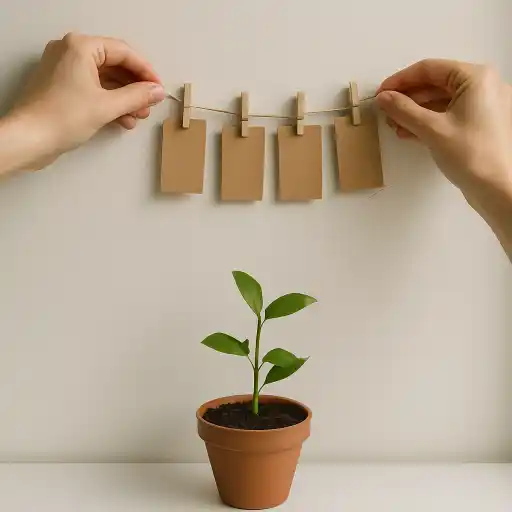
At the next observation, repeat the same process. Lay the new piece beside the earlier one, aligning the starting ends. Invite children to describe the difference. If a plant’s stem branches or curves, explain that the class is comparing height rather than tracing the stem’s path. Consistency matters more than elaborate equipment.
- 🌱 Ask children to predict whether the next sample will be longer, shorter, or about the same.
- Arrange the dated strings from earliest to latest to create a visual growth timeline.
- Invite children to point to the longest and shortest samples and explain how they decided.
- Record children’s words, drawings, or predictions beside the matching sample.
Comparing a plant with a string sample is a child-friendly form of nonstandard measurement. The outdoor string-measuring activity emphasizes modeling how to use string before children begin, which is helpful here too. As children gain familiarity, providers can introduce linking cubes or a ruler as additional ways to represent the same height.
What math and science learning can the timeline support?
The timeline helps make several important ideas visible at once. Children practice comparison language—longer, shorter, equal, taller, and smaller—and begin to understand that a measurement is useful only when people use a consistent starting point and method. When they line up samples and notice that one extends farther, they are using evidence to support a claim.
The routine also supports early data and time concepts. Children can put samples in chronological order, count how many observations the group has made, and notice whether growth appears steady or uneven. A journal combines the string evidence with drawings, dates, and children’s own explanations. As described in the plant-measuring lesson, revisiting predictions and comparing recorded measurements over several sessions can help children discuss change over time.
- Ask, “Which sample came first? How can we tell?”
- Invite children to compare the newest string with the previous one.
- Record a child’s prediction and later revisit it without treating an inaccurate guess as failure.
- Use words such as stem, leaf, sprout, observe, compare, and growth in context.
Keep discussion open-ended and responsive. If a child says the plant “grew a lot,” invite them to show what they noticed. The goal is not to rush children toward formal units; it is to nurture their #curiosity, #observation, #measurement, #journal, and #growth through meaningful, hands-on experiences.
How can you adapt the activity and avoid common pitfalls?
Children can participate in different ways. Toddlers may point to a plant feature, choose between “longer” and “shorter,” or contribute a dictated phrase while an adult manages the string. Preschoolers may mark a starting point, estimate which sample will be longer, draw the plant, or help organize dated samples. Children who prefer not to handle materials can observe, describe, select a picture, or help document the group’s ideas. The Plant Journal guidance similarly recommends using photographs and adult dictation when drawing or writing is not yet accessible to a child.
A few practical adjustments prevent confusion:
- Use the same plant, starting point, and measuring approach at each visit.
- Do not stretch or tug string tightly against a delicate stem; an adult can measure beside the plant.
- Label samples immediately. Unlabeled strings can turn a useful timeline into a guessing game.
- Choose a schedule staff can sustain; a brief weekly routine is better than an ambitious plan that disappears.
- Do not promise that every plant will grow quickly. Weather, light, water, and other conditions affect visible change.
Keep safety and access in view. Supervise the use of scissors and small materials, wash hands after gardening, and follow program procedures for allergies and outdoor learning. Children can participate through looking, talking, drawing, or dictating—even when touching the plant or soil is not appropriate.
Summary: How does a string timeline make plant growth understandable?
A string timeline makes plant growth concrete without requiring children to begin with numbers. By measuring a plant at regular intervals, labeling each sample, and comparing the pieces in order, providers help children see change and express what they notice. The process also brings together early math, science inquiry, language, and documentation in an activity that can fit into an ordinary classroom routine.
- Choose an accessible plant and use a consistent method.
- Make and label one string sample at each observation.
- Invite children to predict, compare, describe, draw, and revisit their ideas.
- Adapt participation to children’s ages, interests, abilities, and safety needs.
The central question—how can you build a plant growth timeline with string instead of numbers?—has a practical answer: observe, measure with a consistent string sample, record the date, and compare over time. Children’s explanations matter as much as the samples themselves. For a broader set of strategies for supporting playful measurement and mathematical reasoning, consider the Early Mathematics Through Play course Buy Now $24.00.
Further course options

- 45 Hour Child Growth and Development
- 45 Hour Preschool Methods and Materials
- What Makes Me Special: An Overview of Autism and ADHD
- 45 Hour Infant and Toddler Methods and Materials
- 45 Hour School Age Methods and Materials
- CDA Bridge Bundle: Family Child Care without Portfolio Review
- CDA Bridge Bundle: Infant/Toddler without Portfolio Review
- CDA Bridge Bundle: Preschool without Portfolio Review
- CDA Certification en Español: Recursos y Consejos para Educadores Bilingües
- 💛🧩 ¿Cómo puedo hacer que mi enseñanza sea inclusiva para los niños con autismo?
- Cuáles Son las Señales de Alerta en el Desarrollo Infantil que Todo Educador Debe Conocer?
- 👶 ¿Cuáles son las proporciones y grupos requeridos en Dakota del Norte? 🏫
- Cómo Abrir Una Quardería En Casa Sin Dinero?
- Recursos en Español sobre el Sueño Seguro del Bebé
- Curso de Comunicación de 9 Horas de Maryland
- 10 Ejemplos de Cómo la Cultura Influye en el Desarrollo Infantil
- Cómo Empezar una Guardería en Casa: Requisitos y Pasos
- Proporciones de Cuidado Infantil y Tamaños de Grupo por Edad en Maryland (Guía Rápida para Centros y Hogares)
- Proporciones de Cuidado Infantil y Tamaños de Grupo por Edad en Nueva Jersey (Guía Rápida para Centros y Hogares)
- Proporciones de Cuidado Infantil y Tamaños de Grupo por Edad en Virginia (Guía Rápida para Centros y Hogares)
- Lista para Guardería en Casa en Illinois: Cómo Iniciar una Guardería en el Hogar
- Cómo Trabajar en el Cuidado Infantil en Carolina del Norte: Requisitos y Pasos
- Cómo Ser Maestra de Preescolar en Dakota del Norte
- Celebrando la amistad en el cuidado infantil durante el Día de los Mejores Amigos
- Canciones, juegos y preguntas de círculo para niños
- Cómo simplificar la capacitación para sus empleados de daycare
- How can I start a small garden project with New York preschoolers?
- How Can You Build a Plant Growth Timeline With String Instead of Numbers?
