A disagreement over a toy can become more than a disruption: it can be a chance for children to practice thinking, communicating, and choosing a safe response. Use puppet scenarios to rehearse those skills before real tensions rise, and explore You're Not My Friend Anymore: Learning Conflict Resolution  Buy Now $16.00 for practical ways to guide preschoolers through peer conflicts. For a broader foundation in classroom relationships and problem-solving, Supporting Social Learning: Creating Classrooms that Care Buy Now $24.00 offers another relevant professional learning opportunity.
In a busy room, stepping in quickly can feel like the kindest or safest choice. Sometimes it is necessary; children always need adults to stop unsafe behavior and provide support. But when a situation is safe and manageable, pausing to coach rather than immediately deciding the solution gives children valuable practice. A puppet can make that practice feel playful, predictable, and low-pressure.
Why does problem-solving practice matter before a conflict happens?
Preschoolers are still developing the language, emotional regulation, perspective-taking, and flexible thinking needed to work through everyday challenges. They may know that grabbing is not acceptable without yet knowing what to do instead when they both want the same truck. Practice helps turn an abstract expectation—“solve it together”—into actions a child can try: name the problem, consider options, choose one, and see what happens.
Rehearsing in a calm moment also reduces the cognitive load of a real conflict. When children are frustrated, it can be harder to listen, find words, or consider another person’s point of view. They may draw on familiar phrases and routines if those have been practiced repeatedly. The CSEFEL training materials identify problem-solving as a teachable social-emotional skill, alongside emotional literacy and friendship skills.
This is not a request for adults to withdraw. It is an invitation to move from automatic fixing to responsive coaching. Adults can protect safety, acknowledge feelings, and offer just enough help while leaving age-appropriate choices to children. That balance can nurture #independence and #confidence without asking preschoolers to manage situations beyond their abilities.
How can puppets make everyday social problems easier to explore?
Puppets create a little distance between children and a difficult situation. Rather than asking a child to explain a personal disagreement in front of peers, an educator can present a puppet who has a relatable problem: two characters want the same toy, one friend is left out, or a character does not know how to ask for a turn. Children can offer ideas without feeling that they are being blamed or tested.
A puppet can also invite participation from children who prefer to watch first, communicate nonverbally, or are still learning the classroom language. Children might speak, point to a picture, use a familiar communication support, gesture, or simply observe. This reflects the practical approach in ChildCareEd’s puppet problem-solving playbook Buy Now $1.75, which uses a fictional dilemma, safe choices, and adaptable ways to participate.
Keep the scene brief and familiar. For example, one puppet reaches for a block another puppet is using. Pause before the conflict is resolved and ask, “What is the problem?” or “What could the puppet try?” The goal is not a polished performance; it is to make thinking visible and give children a chance to contribute.
- Choose ordinary situations children recognize, such as waiting, asking to join play, or getting help.
- Show the puppet’s feelings through its words, face, posture, or movement.
- Offer two safe choices at first, while welcoming children’s own reasonable ideas.
- 🌟 Let children decide how to participate: talk, point, act out an option, or watch.
What steps help children move from noticing a problem to trying a solution?
A short, repeatable routine helps children know what to do. Use language that is concrete and consistent, and practice the steps with puppets during calm parts of the day. One useful sequence is: notice the problem, name feelings, think of safe choices, choose and try one, then check whether it helped. This offers structure without implying there is always one perfect answer.
- Notice: “Both puppets want the red truck.” Invite children to describe what is happening without assigning blame.
- Name feelings: “How might each puppet feel?” Accept words, gestures, or picture choices.
- Generate options: “What could they try?” Possible choices include taking turns with a timer, choosing another truck, or asking an adult for help.
- Choose and act: Have the puppets try the child-selected idea so children can see what it looks like.
- Reflect: “Did that work for both puppets? What could they try next?”
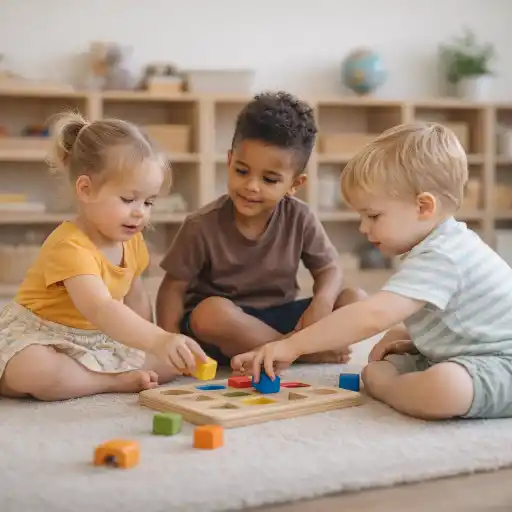
Ask open-ended prompts and then wait. A pause gives children time to think, process language, and contribute in their own way. If the group needs support, narrow the options to two safe, reasonable choices rather than supplying the answer immediately. The NAEYC discussion of scaffolding thinking emphasizes thoughtful questions, time to reflect, and respect for children’s ideas. Those practices fit puppet problem-solving well.
When should an adult step in, and how much help is enough?
Children need practice, but they also need attentive adults. Step in promptly when someone may be hurt, a child is distressed or overwhelmed, or the situation is beyond what the children can safely manage. Set clear limits, separate children if needed, and help everyone regain calm. Problem-solving instruction is more useful after immediate safety and emotional needs are addressed.
When a conflict is safe and children are ready, try a deliberate pause. Observe what they are doing; they may already be negotiating, waiting, or seeking a solution. If they are stuck, offer a small prompt: “What could you say?” “Would you like a turn after Sam, or would you rather choose another toy?” Then give the children time to respond. The aim is to provide enough scaffolding for success and gradually reduce prompts as their skills grow.
Use puppets to model help-seeking as a positive choice, not a failure. A character can say, “I tried asking, but we still need help deciding.” Children should know that getting an adult is an appropriate strategy whenever they feel unsafe, cannot resolve the problem, or need assistance communicating. Adults remain responsible for supervision, boundaries, and equitable participation.
As the Manitoba guidance on guiding children’s behaviour emphasizes, adults can model appropriate behavior, use realistic expectations, and give children consistent opportunities to practice. Protecting children and supporting their agency are complementary responsibilities—not competing goals.
How can educators make puppet practice inclusive and useful in real life?
For practice to transfer into the classroom, scenarios should reflect children’s real routines, relationships, languages, and interests. Invite children to help choose a character, name a problem, or suggest the ending. Use puppets that are appealing and respectful of the group’s varied identities, while avoiding stereotypes or making a child’s personal experience the subject of a public skit without their agreement.
Adapt how children participate. Pair spoken words with picture choices, objects, gestures, signs, or communication devices. Keep the group small if a large audience feels uncomfortable, and allow children to watch before joining. Puppetry can invite children to communicate without requiring a spoken answer or public performance; Edutopia describes how puppets may provide a less intimidating way for children to share ideas and explore social situations.
After the skit, connect the practice gently to the day. If two children reach for the same toy, a teacher might say, “This is like the puppet’s problem. What choices did we practice?” Avoid demanding that children use the exact script or resolve every conflict alone. Children vary in development and temperament, and some moments call for more direct adult guidance.
Directors can support consistent use by sharing a brief routine across the team, setting aside accessible puppets and visual solution cards, and discussing observations in staff meetings. Notice strategy use—such as asking, waiting, or seeking help—not only whether children reach the adult’s preferred outcome.
What common pitfalls should providers avoid?
Puppet play is most helpful when children experience it as a chance to think, not as a hidden test of obedience. A few common habits can unintentionally limit that learning. One is resolving the puppet’s dilemma too quickly; children need a real pause in which they can offer ideas. Another is presenting too many options at once, which may overwhelm young learners. Start with a small number of safe choices and add complexity as children become comfortable.
Be careful not to turn the puppet into a tool for shame or control. Avoid making it scold children, label someone as “bad,” or pressure a child to reveal private feelings. Keep the focus on actions, needs, and possible repairs: “The puppet grabbed the toy. What could it do now?” When children disagree with one another’s suggestions, help them consider whether each option is safe and fair.
Finally, do not expect a one-time activity to create independent problem-solvers. Skills develop through repetition and supportive experiences across routines. Educators can model language, practice the scenario again, and use specific feedback such as, “You asked for a turn instead of grabbing.” If documentation or staff training is relevant, state requirements vary - check your state licensing agency.
- Do not make children share personal conflicts in front of the group.
- Do not treat verbal answers as the only evidence of participation.
- Do not praise only the outcome; recognize the strategy and effort.
- Do not delay intervention when safety or significant distress is involved.
Conclusion: How can puppet scenarios help preschoolers practice safe problem-solving?
Puppet scenarios give preschoolers a low-pressure way to notice a problem, identify feelings, consider safe choices, and rehearse a response before a similar situation arises in real play. Adults can make that practice effective by using familiar dilemmas, allowing different forms of participation, asking open questions, and leaving enough time for children’s ideas.
The central goal is not to make children solve every problem without help. It is to help them build skills while adults continue to ensure safety and offer responsive support. Start with one brief puppet dilemma this week—perhaps a turn-taking challenge—and repeat the same problem-solving steps in calm moments and everyday routines. Each thoughtful attempt helps children see themselves as capable members of a caring classroom community.
Professional learning to continue your practice
- Social Foundations and Responsive Classrooms Buy Now $24.00 — explores social-emotional development, positive guidance, conflict resolution, and age-appropriate problem-solving.
- Supporting Children's Independence Buy Now $24.00 — offers strategies for fostering independence, self-regulation, and children’s conflict-resolution skills.
- From Tantrums to Triumphs: Equipping Preschoolers with Self-Regulation Skills Buy Now $25.00 — focuses on supporting preschoolers as they manage emotions and navigate challenges.
- Capacitación en Salud y Seguridad Preventiva en Línea para Proveedores de Cuidado Infantil
- Capacitación Previa al Servicio para Proveedores de Cuidado Infantil en Dakota del Norte
- Cómo simplificar la capacitación para sus empleados de daycare
- How can child care programs support cognitive development through problem-solving activities?
- How Can Preschool Teachers Help Children Build Problem-Solving Skills?
- How Can Educators Teach Problem-Solving Without Always Solving the Problem?
- Why Is My Preschool Classroom So Chaotic? 7 Classroom Management Fixes to Try
- Why Are Coping Skills Important for Preschoolers?
- What Are Simple Ways to Build Emotional Regulation in Preschoolers?
- How Can Child Care Providers Teach Children to Solve Conflicts With Each Other?
- How Can Child Care Providers Create Classroom Rules That Children Understand and Use?
- How Can You Make Addition Practice More Engaging Without Losing the Learning Goal?
- How Can Patterned Practice Help Young Children Master Subtraction Facts?
- How Can School-Age Children Disagree Without Adults Taking Over the Discussion?
- How Can a Preschool Community-Helpers Theme Respond to Real Local Needs?
- When a Preschool Rule Expects More Self-Control Than Children Can Manage, What Should Educators Do?
- How Can Preschool Teachers Build Confidence in Children Who Are Afraid to Make Mistakes?
- How Can Preschool Teachers Encourage Children to Use Words During Conflict?
- How Can Fall Classroom Activities Teach Positive Behavior?
- Why Do Preschoolers Need Practice Solving Problems Before Adults Step In?
