When a shared project turns into competing ideas, grabbing materials, or one child doing all the work, educators can turn the moment into a meaningful lesson in cooperation. The course Supporting Social Learning: Creating Classrooms that Care  Buy Now $24.00 offers practical ways to strengthen peer problem-solving and classroom relationships, helping you build on the strategies below.
Why is difficulty collaborating a learning opportunity?
Working together asks young children to coordinate several developing skills at once: communicating an idea, listening to another person, waiting, regulating frustration, and adapting a plan. A child who resists a peer’s suggestion or holds tightly to a material is not necessarily being uncooperative by nature. The child may need more practice, clearer language, a predictable role, or a task suited to their current developmental abilities.
Peer interactions provide authentic opportunities to learn these skills. CSEFEL’s guidance on promoting positive peer social interactions describes how educators can teach and rehearse social skills, then support children as they use them during play. Likewise, the ECE Resource Hub explains that problem-solving with others is learned over time and benefits from adult support to identify a problem, consider another perspective, and try a solution.
It helps to focus on the process rather than whether children finish a project or agree immediately. A group mural with different ideas, for instance, can offer more learning than a polished product created by one child. When adults notice each child’s contribution and make participation accessible, children can build #cooperation, communication, and a sense of belonging.
How can educators prepare a task so children can succeed together?
Good collaboration starts with thoughtful planning. Choose a task with a shared purpose that genuinely benefits from multiple contributions, but leave room for children’s ideas. “Let’s make one road that connects both buildings” gives children a common goal without dictating what the road must look like. Keep directions brief and materials accessible.
- Start with a small group—often two to four children—so each child has a reasonable opportunity to contribute.
- Offer open-ended materials such as blocks, large paper, loose parts, or dramatic-play props.
- Break the task into manageable steps: plan, gather materials, create, and review.
- Offer flexible roles, such as builder, materials helper, idea sharer, or photographer. Rotate roles so children can try different contributions.
- Use visual cues, role cards, or a simple picture sequence when they help children understand what comes next.
Plan for different ways to participate. A child may speak, point, demonstrate, observe before joining, or take a brief helper role. These are meaningful entry points, not lesser forms of involvement. Consider children’s languages, interests, sensory needs, and abilities when selecting materials and groupings. An accessible task gives children a stronger chance to collaborate without requiring everyone to participate in exactly the same way.
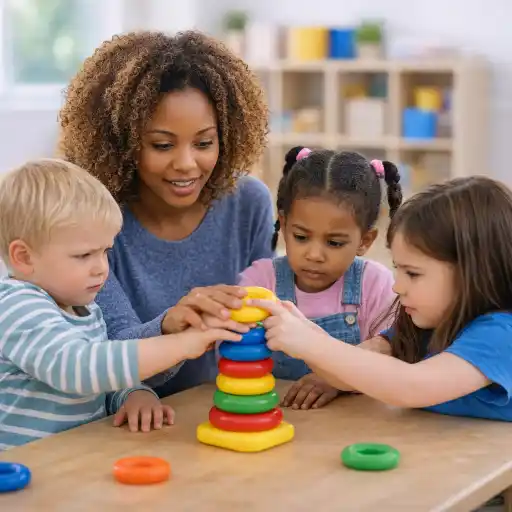
What should teachers do when children disagree or get stuck?
First, pause and observe. If children are safe and still engaged, allow time for them to work through a minor disagreement. Hovering too closely or deciding every detail for them can interrupt problem-solving before it begins. If frustration rises or a child is excluded, move close, keep your voice calm, and offer just enough support to get the interaction moving again.
Use neutral descriptions instead of blame: “You both want to put the blue block on top.” Acknowledge feelings and state a clear safety limit when needed. NAEYC’s three-step approach to helping children navigate conflict suggests naming the behavior and feelings, explaining the impact, then guiding children toward an appropriate next action.
- Ask a focused question: “What is the group trying to make?”
- Invite children’s ideas: “How could both ideas fit?”
- Offer a short script if needed: “Can I help?” or “What do you think?”
- Suggest a few workable options: try each idea, take turns, combine materials, or divide the task into roles.
- Notice the effort: “You listened to Maya’s idea and found a way to add it.”
Give children time to think before adding another prompt. If they cannot yet agree, make a temporary plan or help them choose between safe options. The aim is not to make conflict disappear, but to help children practice a next step. A calm adult presence communicates that disagreement can be handled safely and respectfully.
How can educators include children who need more support?
Some children need extra help entering play, understanding a group plan, or communicating an idea. Language differences, disability, sensory sensitivities, temperament, and prior experiences can all affect participation. Avoid assuming that watching quietly means a child is uninterested. Observe what the child attends to and offer a low-pressure invitation that builds on that interest: “Would you like to choose the next block, or watch until you’re ready?”
Make participation clearer with picture choices, gestures, visual steps, adapted tools, or a smaller group. Model useful phrases during calm moments, then prompt them briefly during the activity. For example, a teacher might say, “You can point to the role you want,” or “Show Leo where you want the bridge to go.” The study Nurturing Social Experience in Three Early Childhood Special Education Classrooms highlights how teacher adaptations and responsive support can help promote positive peer engagement.
Be thoughtful about peer-buddy arrangements. Children can learn from one another, but no child should be assigned ongoing responsibility for managing a peer. Rotate partners and roles, and make sure every child has opportunities both to contribute and to receive support. Share objective observations with colleagues and families, focusing on what helped the child participate. State requirements vary - check your state licensing agency.
How can providers strengthen these skills through everyday practice?
Children benefit from short, repeated opportunities to work toward a shared goal. Collaboration does not need to be a special event: it can happen during cleanup, snack preparation, outdoor play, or a familiar classroom routine. Predictable practice gives children a chance to use social language and problem-solving skills without having to learn a new activity each time.
- 🧱 Invite a small group to build one structure, testing and revising their ideas together.
- Create a group mural where children choose a theme, share space, and decide how their contributions connect.
- Set up dramatic play, such as a restaurant or animal clinic, with roles that depend on one another.
- Try a movement game in which children coordinate their actions to keep a soft ball moving safely.
- Use a shared puzzle or class story so children take turns contributing to one outcome.
During and after activities, name specific cooperative actions: inviting a peer, passing a material, asking for an idea, waiting, or trying a different plan. Brief observations can help staff see progress and identify barriers. If the same task repeatedly leads to difficulty, consider whether the group is too large, the directions are unclear, materials are limited, or the project does not allow meaningful roles. Repeating a familiar activity with one thoughtful adjustment can be more effective than introducing a new lesson every day.
Conclusion: What should educators do when children struggle with a shared task?
When children have difficulty working together, educators can prepare an inviting task, provide clear but flexible roles, observe before intervening, and coach children through disagreement with calm language and practical choices. Adapt materials and communication supports so every child has a meaningful way to participate. Focus on the small steps—listening, offering an idea, waiting, or trying again—rather than expecting immediate agreement or a perfect finished product.
These skills grow through repeated experiences, responsive adult support, and a classroom culture where each child’s contribution matters. Start with one short shared task, notice what helps the group cooperate, and use that information to plan the next opportunity. For a deeper professional learning experience, explore Supporting Social Learning: Creating Classrooms that Care Buy Now $24.00, You’re Not My Friend Anymore: Learning Conflict Resolution Buy Now $16.00, The Best Promotion is Play Buy Now $24.00, Teach with Respect ONLINE Buy Now $24.00, and From Play to Planning: Building Culturally Competent, Child-Centered Curriculum Buy Now $55.00.
- 45 Hour Child Growth and Development
- Moving About the Classroom: Effective Transitions for Everyday
- Bienvenido! Welcoming All Families
- CDA Bridge Bundle: Preschool
- 45 Hour School Age Methods and Materials
- CDA Bridge Bundle: Family Child Care
- CDA Bridge Bundle: Infant/Toddler
- Creating Environments that Nurture Growth and Community
- Texas Director Credential
- CDA Certification en Español: Recursos y Consejos para Educadores Bilingües
- How Can You Create an Individual Behavior Support Plan That Staff Can Follow?
- How Can Providers Create a Calm-Down Corner That Actually Works?
- How Can Child Care Leaders Help Staff Feel Heard Beyond the Suggestion Box?
- What Makes Task Cards a Great Tool for Mixed-Age Classrooms?
- How Can Child Care Providers Help Young Children Follow Directions?
- How Can Cleanup Time Become a Lesson in Sorting, Counting, and Teamwork?
- How Can You Increase Maze Difficulty Without Frustrating Young Learners?
- How Can Low-Prep Christmas Activities Build Preschoolers’ Visual Planning?
- How Can You Adapt Classroom Activities for Mixed-Age Groups?
- How Can Children Restore a Montessori Activity Before Choosing Another?
- How Can Preschool Teachers Encourage Children to Clean Up Without Turning It Into a Battle?
- Does a Teacher Need More Training or a More Manageable Workload?
- How Can Child Care Providers Show Parents Progress Toward a Shared Learning Goal?
- What Are Effective Ways to Teach Children to Care for Classroom Materials?
- What Should Educators Do When a Child Has Trouble Following Classroom Expectations?
- What Should Teachers Consider When a Classroom Activity Is Too Easy or Too Difficult?
- Can AI Help Teachers Recognize When an Activity Is Too Easy or Too Difficult?
- How Can Teachers Encourage Cooperative Play Among Children of Different Abilities?
- What Should Educators Do When Children Have Difficulty Working Together on a Shared Task?
