Why it matters
1) Early noticing helps children get support before challenges grow. The sooner a child gets the right help, the better the results. See the CDC milestone pages for clear age-based examples: 3 years, 4 years, 5 years.
2) Regular observation helps your team plan learning that matches each child’s strengths. State requirements vary - check your state licensing agency.
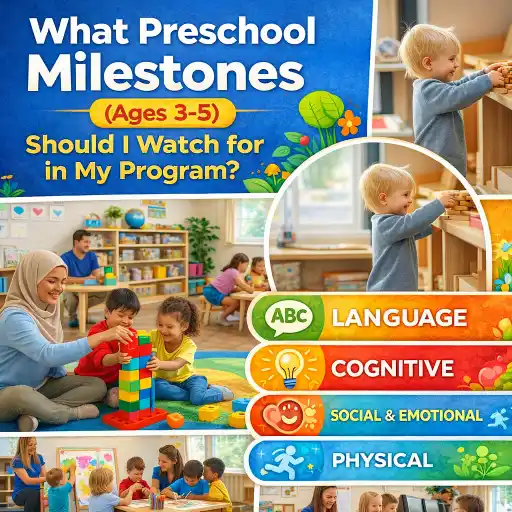
What skills should children ages 3–5 be doing in my group?
Here are common, easy-to-watch skills by age. Use them as a guide, not a list to judge.
- 3-year signs (examples): speaks in short conversations, asks who/what/where questions, joins other children to play, draws a circle, uses a fork. See CDC 3-year milestones.
- 4-year signs (examples): uses 4+ word sentences, pretends in play, names colors, catches a large ball, unbuttons some buttons. See CDC 4-year milestones.
- 5-year signs (examples): tells short stories, counts to 10, writes some letters, hops on one foot, follows rules in simple games. See CDC 5-year milestones.
Also consult trusted checklists and classroom resources like the Developmental Milestones Checklist Buy Now $0.00 from ChildCareEd and the ChildCareEd article on language skills Language Development. Use the CDC pages to share specific examples with families.
How can I observe and track these skills without adding too much work?
Use a simple weekly habit and rotate focus across domains (language, social, cognitive, motor). ChildCareEd’s Milestone Monday idea shows how a 15–30 minute routine can pay off: Milestone Monday.
- 😊 Pick one skill per child each week (e.g., uses 2–3 word sentences, stacks 6 blocks).
- 📝 Record 1–2 short notes: date, what you saw, where, and who else was present. Use the checklist Buy Now $0.00 for templates.
- 📆 Rotate skills so you check language, play, movement, and thinking over a month.
- 🔁 Review monthly summaries and flag children with repeated concerns.
Common mistakes and how to avoid them:
- 🔎 Waiting too long — fix: review notes monthly and take small steps early. See AAFP on screening timing and benefits: Developmental Delay: When and How to Screen.
- 🙊 Relying on one day’s observation — fix: collect a few notes, photos, or short videos across days.
- 📑 Vague notes — fix: use simple checklists or the CDC Milestone Tracker.
For practical tracking tools, check ChildCareEd resources on observation and the CDC Milestone Tracker app linked on the CDC milestones pages.
When should I be concerned and what steps should I take?
Watch for red flags like loss of skills, very unclear speech, little interest in others, or not following simple instructions. Help Me Grow lists age red flags and referral steps: Red Flags by Age.
- 📌 If you see a repeated concern, share strengths first, then your observation with the family. Use notes to show examples (dates, what you saw).
- 👉 Suggest they speak with the child’s doctor and offer your documentation. If the family and doctor remain concerned, suggest a formal screening (ASQ) or early intervention referral. The CDC recommends acting early if a child is not meeting milestones.
- ☎️ Offer to help with referrals or to share screening summaries. Keep conversations kind and factual.
FAQ (short):
- Q: How often should we screen formally? A: Follow AAP guidance (screen at 9, 18, and 24–30 months) or screen sooner if concerns arise; Milestone Monday is ongoing observation. See AAFP and CDC guidance.
- Q: What if the family disagrees? A: Keep documenting, share strengths, ask about home observations, and offer resources.
- Q: Should we test hearing first? A: Yes — hearing issues affect speech. Recommend a hearing check if speech seems delayed.
- Q: Who pays for evaluations? A: Many early intervention programs are free; help families find local contacts. See CDC Act Early and local Help Me Grow links.
How can daily classroom activities support milestone growth?
Use playful, small steps that fit your routine. Here are practical ideas you can try tomorrow:
- 🎵 Language boosters: read daily, ask open questions, narrate routines, and sing rhymes. ChildCareEd’s language article has simple strategies.
- 🧩 Cognitive play: puzzles, sorting games, and sequence activities (first, next, last) help thinking and memory.
- 🤝 Social play: plan short cooperative games, role play, and sharing routines to practice turns and empathy.
- 🏃 Physical play: obstacle courses, hopping, throwing and catching large balls build gross motor skills.
- ✂️ Fine motor: threading beads, cutting with safety scissors, and drawing help writing readiness.
Use small groups, follow each child’s lead, and celebrate steps. For curriculum and training, ChildCareEd offers courses like How Preschoolers Develop  Buy Now $32.00 and the 45-Hour Preschool Curriculum Buy Now
 $399.00$275.00.
Summary
1) Watch for simple age signs from the CDC and ChildCareEd checklists. 2) Use a short weekly routine (Milestone Monday) to collect facts and track progress. 3) Share strengths first, then concerns with families and suggest next steps when needed. 4) Support growth with playful language, social, thinking, and motor activities. Remember: your careful #observation and kind partnerships with families help children meet important #milestones in their #development, especially in #language and play as #preschoolers.
- Watch Me Grow: School Age Development ONLINE
- 45 Hour Child Growth and Development
- 45 Hour Preschool Methods and Materials
- 45 Hour Infant and Toddler Methods and Materials
- Pediatric RSV First Aid & CPR/AED
- Watch Me Grow: School Age Development
- 45 Hour School Age Methods and Materials
- CDA Bridge Bundle: Preschool without Portfolio Review
- Texas Director Credential
- Actividades de Motricidad Gruesa que Desarrollan el Equilibrio, la Coordinación y la Fuerza
- Retraso del Habla en la Guardería: Cómo Pueden Ayudar los Proveedores
- What Are Developmental Milestones and How Can We Track Them in Early Childhood?
- How Typical and Atypical Development Differ in Preschoolers
- What Signs of Developmental Delays Should Michigan Childcare Workers Watch For?
- Baby Development by Week: Signs, Growth, and Red Flags
- What Should Texas Child Care Providers Watch for in Preschool Development?
- What are developmental milestones and how can child care providers use them?
- How can I design age-appropriate lesson plans that really work?
- What are the basics of child growth and development?
- How Can Child Care Providers Recognize Signs of Developmental Delays?
- Child Growth and Development Classes Online
- How Can Child Care Providers Understand and Use Developmental Milestones from Birth to Age Eight?
- How can childcare providers support fine motor development with simple activities?
- How can I build gross motor skills indoors and outdoors for the children in my program?
- How Can Child Care Providers Understand Typical and Atypical Child Development?
- What Should Child Care Providers Expect: Developmental Milestones From Birth to Five?
- How can child care providers recognize early signs of developmental delays?
