Have you noticed how a simple game of peekaboo can stop a baby in their tracks? Peekaboo isn’t just charming—it taps core infant learning systems like attention, memory, and social engagement. To deepen your practice and connect play to measurable developmental gains, consider enrolling in Baby Play: Planning Infant and Toddler Activities  Buy Now $16.00, a short course that helps caregivers turn everyday interactions into purposeful learning opportunities and classroom-appropriate activity plans. For providers who want the neuroscience behind those moments, the course CDA Infants/Toddlers: Brain Development and Gene Expression Buy Now $16.00 explains how early experience shapes brain circuits—useful for curriculum planning and strengthening professional knowledge.
What cognitive systems make peekaboo a reliable learning moment?
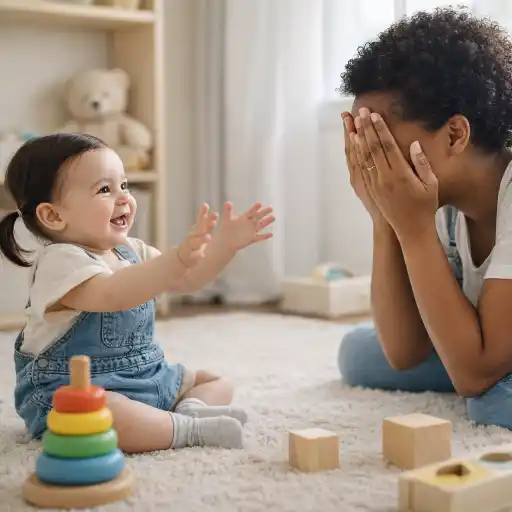
Peekaboo activates multiple infant learning mechanisms simultaneously. The game’s rhythm and predictable surprise engage attention systems in the infant #infantbrain: repeated exposures increase sustained attention and release neuromodulators that support memory encoding. From a Piagetian and contemporary perspective (sensorimotor stage), peekaboo scaffolds the emergence of representational thought: infants begin to form internal images of the hiding person or toy rather than treating it as vanished. Behavioral studies and milestone guides (for example, the CDC milestone list noting that babies often "smile or laugh when you play peek-a-boo") show that social smiling and expectancy are observed by about 6–9 months, coinciding with object search behaviors (see CDC: Milestones by 9 Months).
Neuroscientifically, repeated social play strengthens circuits linking sensory input (faces, voices) with reward and prediction systems—this supports early statistical learning and improves infants' ability to anticipate events. The combination of social cues, temporal predictability, and small surprise produces a potent learning signal: infants both learn that people persist (object permanence) and that their actions can influence outcomes (cause-effect). Use these moments intentionally to prime later skills such as imitation, joint attention, and early language.
How does peekaboo support object permanence and causal learning?
Peekaboo is a simple, developmentally appropriate way to practice the idea that things continue to exist when out of sight. Piaget described the sensorimotor stage as the period when object permanence emerges; modern research refines this as a graded competence rather than an all-or-none milestone. Games that temporarily hide a face or toy create repeated opportunities for infants to form and test mental representations (object files) and to track whether outcomes match expectations. Research summarized in object permanence reviews (Baillargeon and others) shows that infants demonstrate surprise at impossible outcomes, revealing that internal models about object continuity form early.
- Benefits for cognition: better memory retrieval and search strategies, early scaffolds for symbolic thought and language mapping (words can stand for absent objects).
- Practical cues: vary the hiding delay and location to challenge the infant’s tracking—start with short delays and the same hiding spot, then increase complexity.
- 👶 Keep it social: pair hiding with exaggerated vocal cues, waiting for the infant to look or vocalize before revealing. This supports turn-taking and contingency detection.
Object permanence and causal inference are tightly linked: when infants see that lifting a blanket reveals a toy, they link action to outcome and form expectations about agents and objects—foundations for problem solving and later pretend play.
How does peekaboo support social-emotional growth and attachment?
Peekaboo is a social ritual that fosters synchronous interaction, affect sharing, and predictable routines—ingredients of secure relationships. Infants learn not just about objects but about people: that caregivers return, respond, and share positive affect. Secure attachment theory emphasizes that predictable, contingent responses support infants’ emotion regulation and social trust; lacking these responses can be concerning (see secure attachment in early childhood). When caregivers play peekaboo with warm, responsive signaling, infants experience controlled surprise in a safe context, which supports emotional resilience and social engagement.
Practically, peekaboo episodes are short windows for modeling empathy and labeling feelings—"You looked surprised!"—which strengthens infants’ social cognition and early emotion language. For infants at risk (sensory differences, early social-communication delays), clinicians and educators often observe reduced responsivity to peekaboo; such observations can flag the need for screening (state requirements vary - check your state licensing agency). Thoughtful use of peekaboo—sensitive timing, varied cues, and responsive pauses—builds both attachment and the infant’s expectation that interactions are predictable and rewarding.
How can caregivers use peekaboo intentionally in the classroom?
Peekaboo can be adapted into intentional, evidence-based interactions that support classroom goals. Use the game as a learning micro-routine embedded into diapering, dressing, transition times, or reading. Aim for short, predictable episodes that follow this pattern: 1) signal (voice/face), 2) hide (gentle cover, brief delay), 3) wait for infant response, 4) reveal with positive affect, 5) narrate the event. This sequence reinforces contingency learning and builds communicative turns.
- Design variations: hide toys under scarves, use lift-the-flap books, or include multi-sensory elements (soft sound on reveal) to train multiple sensory channels.
- Differentiate by age: for younger infants keep delays and hiding spots constant; for older infants add movement and multiple hiding locations.
- Link to curriculum: document observations in lesson plans (who initiated, visual tracking, search behaviors) and use them for individual planning and assessment.
- Training suggestion: combine peekaboo practice with courses such as Early Learning with Infants and Toddlers Buy Now $24.00 and Playful Spaces for Infants & Toddlers Buy Now $24.00 to align environment, pedagogy, and observation practice.
What are common mistakes and how can providers avoid pitfalls?
Peekaboo is deceptively simple; common implementation errors reduce its learning value. Avoid these pitfalls:
- Overuse without variation — repeating the same short routine without scaffolding limits challenge and learning.
- Too-fast timing — not allowing infants time to look, process, or respond removes contingency learning.
- Using surprises that alarm rather than delight — ensure gestures and vocal tone remain warm and predictable so infants feel safe.
- Ignoring individual differences — some infants (sensory sensitivities, early social-communication differences) need slower pacing or alternative cues (touch, visual supports).
How to avoid these pitfalls: observe, wait, and narrate. Record short notes after play: Did the infant search? Did they smile or look away? Use these notes to adjust delay and complexity. If you notice limited social responsiveness, consult colleagues or suggest screening—early identification improves outcomes.
Summary
Peekaboo is a compact, high-return teaching tool: by combining predictable rhythm, social contingency, and small surprise, it strengthens #objectpermanence, builds early #learning circuits in the #infantbrain, and supports #attachment and communicative development. For classroom-ready practice, embed short peekaboo sequences in routines, observe and document infant responses, and tailor the game to each child’s developmental profile. If you want to expand your skill set, the ChildCareEd courses linked above (Playful Learning: Infant & Toddler Activities; CDA Infants/Toddlers: Brain Development and Gene Expression; Early Learning with Infants and Toddlers; Playful Spaces for Infants & Toddlers; Tomorrow's Einsteins: Infant and Toddler Science Buy Now $16.00 provide practical lesson plans, observation strategies, and the science needed to support professional learning. Remember: state requirements vary - check your state licensing agency. Use peekaboo intentionally, and you’ll turn a beloved game into measurable learning moments for every infant in your care. #peekaboo #learning
FAQ
- Q: At what age does peekaboo become meaningful? A: Infants show social responses early; by 4–9 months they typically begin to anticipate and search—milestone timing varies.
- Q: Can peekaboo help infants with delayed social skills? A: It can be supportive when slowed and paired with sensitive prompting; persistent concerns should prompt screening.
- Q: How long should each peekaboo episode be? A: Keep interactions brief (20–60 seconds), with multiple repetitions across the day embedded in routines.
- Q: Is peekaboo appropriate for group settings? A: Yes—use small-group variations or parallel play, ensuring each infant receives contingent, responsive interaction.
- Q: Should parents be coached to use peekaboo at home? A: Yes—share simple scripts and the rationale so families can reinforce learning consistently.
Latest Jobs
- Bienvenido! Welcoming All Families
- Pediatric RSV First Aid & CPR/AED
- CDA Bridge Bundle: Infant/Toddler without Portfolio Review
- Potty Training Made Simple
- CDA Bridge Bundle: Infant/Toddler
- CDA Infants/Toddlers: Brain Development and Gene Expression
- Texas Director Credential
- Montessori Cultural Activities: Exploring the World Through Play and Learning
- 45-Hour Infant and Toddler Curriculum
- CDA Infants/Toddlers: Stages of Development
- CDA Certification en Español: Recursos y Consejos para Educadores Bilingües
- 🤯 ¿Por qué este niño está teniendo un comportamiento difícil de repente?
- 🏡🗣️ ¿Cómo hablo con los padres sobre los comportamientos que su hijo aprendió en casa?
- 🥺👋 ¿Por Qué la Despedida de la Mañana es Tan Emocional?
- 👶😴¿Es Normal que los Niños Griten o Lloren al Despertarse?
- 😫🧸 ¿Qué hacer cuando un bebé no quiere dormir la siesta en el aula?
- 🍑 ¿Qué capacitación requiere DECAL cada año para el personal de cuidado infantil en Georgia?
- 🚨 Reporte Obligatorio en Nevada
- Cómo Abrir Una Quardería En Casa Sin Dinero?
- Recursos en Español sobre el Sueño Seguro del Bebé
- ¿Cómo afecta la dopamina a los niños: señales, efectos e influencias diarias?
- Regulaciones de Licenciamiento de Cuidado Infantil en California para Centros y Hogares de Cuidado Infantil Familiar
- Normas de Licenciamiento de Cuidado Infantil en Virginia para Centros Diurnos Infantiles y Hogares Diurnos Familiares
- Proporciones de Cuidado Infantil y Tamaños de Grupo por Edad en Virginia (Guía Rápida para Centros y Hogares)
- Lista para Abrir una Guardería en Casa en Virginia: Cómo Empezar
- Lista para Guardería en Casa en Illinois: Cómo Iniciar una Guardería en el Hogar
- Ejemplos de Crianza Respetuosa vs. Crianza Permisiva
- Capacitación Previa al Servicio para Proveedores de Cuidado Infantil en Maryland
- What Does the Science of Peekaboo Reveal About Infant Learning?
