Small oversights can become serious risks when young children are learning through movement, exploration, and relationships. This guide helps providers and directors identify predictable safety mistakes and replace them with practical routines; for deeper preparation, explore Creating Safe & Healthy Child Care Environments  Buy Now $55.00 to strengthen hazard recognition, supervision, and risk-management practices while building relevant professional knowledge.
Why do common safety mistakes deserve focused attention?
Child care safety is not about creating a risk-free childhood. Children need appropriate opportunities to climb, run, manipulate materials, and test ideas. The professional responsibility is to distinguish developmental risk from preventable danger and to design environments in which adults can anticipate problems before they become injuries.
The CDC emphasizes that early care providers can reduce serious harm through playground and water safety, poisoning prevention, healthy environments, and intentional teaching. Head Start similarly frames safety as a shared responsibility involving hazard-free spaces, active supervision, nurturing care, and communication. These principles shift safety from an occasional inspection to a daily organizational practice.
Providers are also working under pressure: staffing changes, transitions, documentation demands, and children’s differing developmental abilities can make small gaps more likely. A supportive response is more effective than blame. Use near misses as information, coach staff in observable behaviors, and make the safer action the easiest action to complete.
- Review the environment from a child’s physical perspective.
- Assign supervision responsibilities before high-risk routines.
- Practice emergency responses instead of relying on memory.
- Document corrections so improvements remain visible.
How does passive supervision increase preventable injuries?
One of the most common mistakes is assuming that being physically present equals supervising. Passive supervision occurs when an adult is in the room but distracted by conversation, paperwork, a phone, or a task that compromises sight and sound. It also occurs when staff meet required ratios but do not position themselves to see and reach every child.
Active supervision is a continuous process of positioning, scanning, listening, counting, anticipating, and engaging. Head Start resources and ChildCareEd’s active supervision guidance emphasize that these behaviors should be visible, teachable, and practiced across classrooms, transitions, meals, playgrounds, and transportation.
Directors can make supervision more reliable by creating zone maps and assigning an adult to each zone. Before outdoor play or a transition, hold a brief huddle identifying staff positions, children needing closer proximity, the person carrying first aid, and the required head-count points.
- 👀 Position adults for unobstructed sightlines and rapid access.
- Scan near-to-far and left-to-right rather than staring at one activity.
- Count children before and after every transition.
- Move closer when behavior, equipment, or water creates elevated risk.
- Use engagement to teach safe choices instead of relying only on prohibitions.
After a near miss, ask what made the hazard difficult to see or reach. Correct the system, not merely the individual.
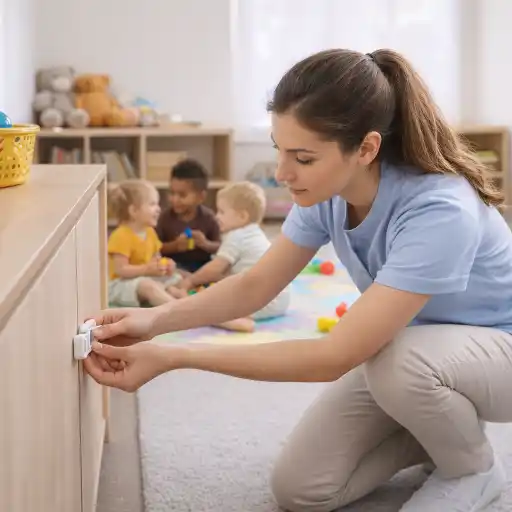
Which environmental hazards are most often overlooked?
Many injuries arise from ordinary objects used without a deliberate safety review. A room can appear orderly while still containing accessible chemicals, unstable furniture, small objects, cords, hot surfaces, or blocked exits. The Virtual Lab School recommends examining spaces at a child’s eye level—kneel, look under and alongside furniture, and consider what a mobile infant or climbing toddler can reach.
Common mistakes include storing cleaning products in an unlocked cabinet, leaving teacher materials within reach, using unstable shelving, overlooking slippery rugs, and failing to remove broken toys. The indoor checklist also calls attention to protruding hardware, peeling paint, accessible cords, unsafe crib conditions, and water containers that children can reach.
Poison prevention requires more than placing products on a high shelf. The National Pesticide Information Center advises storing chemicals in original containers, locked and out of sight, following labels, never mixing chemicals, and contacting Poison Control at 800-222-1222 when exposure is suspected.
- Conduct a brief room walk before children arrive and after major activities.
- Secure medicines, chemicals, purses, plastic bags, and small supplies.
- Anchor furniture and remove climbable arrangements near hazards.
- Check toys for loose parts, sharp edges, cracks, and choking hazards.
- Keep exits, fire equipment, and pathways clear.
Document the hazard, the corrective action, the responsible person, and the date completed. A checklist becomes meaningful when it leads to repair or removal.
How can programs prevent sleep, choking, water, and playground mistakes?
High-risk routines require specialized procedures because young children’s developmental abilities change rapidly. Safe sleep is a particularly important example. The Child Care Technical Assistance Network notes that sleep-related infant deaths remain a serious concern and that many states include safe-sleep standards in licensing requirements. Infants should be placed on their backs in an approved crib with a firm, flat mattress and fitted sheet; loose blankets, pillows, toys, and soft objects should not be present.
Mealtimes require age-appropriate preparation and direct supervision. Providers should identify food hazards such as whole grapes, hard vegetables, popcorn, whole nuts, hard candy, large pieces of food, and thick spoonfuls of nut butter. Children should sit while eating, and staff should remain attentive rather than completing unrelated tasks.
Playgrounds and water areas need layered protection. Head Start identifies playgrounds as a frequent location for injuries, making daily inspections, protective surfacing, developmentally appropriate equipment, boundaries, and active supervision essential. Water hazards include pools, buckets, toilets, tubs, and containers that seem harmless because they are shallow.
- Use a written safe-sleep policy and train substitutes as well as permanent staff.
- Prepare food according to children’s ages, abilities, and individualized plans.
- Inspect outdoor equipment, surfacing, gates, debris, heat, and blind spots before use.
- Assign a dedicated water watcher whenever children are near water.
- Tag unsafe equipment out of service until it is repaired or replaced.
State requirements vary - check your state licensing agency before revising policies or training plans.
Why do weak emergency systems make ordinary incidents worse?
Even excellent prevention cannot eliminate every injury or medical event. A frequent mistake is having an emergency plan that exists on paper but has not been practiced. Staff may then hesitate about who calls 911, who provides care, who supervises the remaining children, who retrieves medication, or who contacts the family.
An effective plan is short, accessible, role-based, and specific to the program. It should address fire, severe weather, lockdown, missing children, serious injury, allergic reactions, poisoning, transportation incidents, and reunification. The plan should also account for infants, children with disabilities, chronic health conditions, language needs, and emergency medication.
Training should include drills and tabletop scenarios. After each practice, ask: What worked? Where did communication slow down? Was the emergency kit accessible? Did staffing ratios remain safe? Record one or two improvements and assign deadlines.
- Post emergency numbers, including Poison Control, near phones and in staff areas.
- Maintain current emergency contacts, attendance records, medication plans, and consent forms.
- Check first-aid supplies, alarms, extinguishers, and emergency kits on a schedule.
- Practice evacuation, shelter-in-place, missing-child, and medical-response procedures.
- Complete incident reports factually and notify families according to policy.
For a structured next step, consider Emergency and Disaster Preparedness Buy Now $55.00$45.00, which addresses protocols, evacuation, communication, and emergency planning for child care settings.
How can directors build a culture that prevents recurring mistakes?
Safety improves when it is treated as a learning system rather than a compliance event. Directors establish the tone by making expectations clear, providing adequate tools, welcoming reports of near misses, and following up consistently. Staff should understand that reporting a concern is a professional contribution, not an admission of failure.
Begin with a manageable improvement cycle. Choose one high-risk routine, observe current practice, identify the gap, test a change, and review the result. For example, a program might introduce a five-point morning checklist: staffing and ratios, room hazards, medication storage, first-aid readiness, and outdoor conditions. Keep the checklist short enough to complete and require initials so accountability is visible.
- Schedule monthly facility walk-throughs in addition to daily checks.
- Use brief coaching observations with one strength and one actionable suggestion.
- Maintain training, drill, incident, maintenance, and medication records.
- Review trends in injuries and near misses at staff meetings.
- Provide refresher training when procedures, equipment, or children’s needs change.
Helpful ChildCareEd options include Active Supervision: A Strategy That Works Buy Now $35.00, Safe Supervision in Child Care: Birth to School Age Buy Now $24.00, and Pediatric Blended First Aid & CPR/AED Buy Now $85.00$80.00. Confirm local requirements and whether a particular format is accepted before enrolling.
Summary: What should child care teams do first?
The most common safety mistakes are rarely caused by a lack of caring. They usually emerge when supervision is passive, hazards are not viewed from a child’s perspective, high-risk routines lack consistent procedures, emergency plans are unpracticed, or documentation does not lead to follow-up. The answer is a layered system that combines thoughtful environments, active supervision, specialized safeguards, emergency readiness, and continuous improvement.
- Complete a five-minute safety walk and correct one hazard today.
- Assign supervision zones and require head counts during transitions.
- Audit cribs, meals, water areas, playgrounds, chemicals, and furniture.
- Practice one emergency scenario and record the improvement needed.
- Use training and coaching to make safe practice consistent across the whole team.
When safety routines are clear and shared, children gain freedom to explore and staff gain confidence in their decisions. Directors can reinforce this culture with practical resources such as ChildCareEd’s Pillars of Health and Safety resources. State requirements vary - check your state licensing agency.
- Positive Attention: Interactions and Supervision of Infants and Toddlers: For Workforce Solutions
- Reducing the Risk of Sudden Infant Death Syndrome
- Health and Nutrition
- Positive Attention: Interactions & Supervision for Infants & Toddlers
- Sensitive Periods in Montessori: Guiding Natural Learning
- Risk Reduction: Infants and Toddlers in Family Child Care
- Texas Director Credential
- Preventative Health and Safety
- Safeguarding Young Lives: A Comprehensive Guide to Child Care Safety
- Keeping Them Safe: Infants & Toddlers
- Capacitación en Salud y Seguridad Preventiva en Línea para Proveedores de Cuidado Infantil
- Proporciones de Cuidado Infantil y Tamaños de Grupo por Edad en Maryland (Guía Rápida para Centros y Hogares)
- What are training bundles in Pennsylvania and how do they help child care providers?
- Daycare Teacher Certification Requirements in Georgia
- How can childcare programs protect young children in North Dakota from West Nile, ticks, and extreme heat?
- How Can Michigan Providers Prevent Summer Learning Loss in Young Children?
- How can New York child care providers use active supervision to keep children safe around water this summer?
- How did a backyard pool change water safety at California family child care homes?
- How can child care programs keep playgrounds safe every day?
- Alaska Home Daycare Standards: What Providers Need to Know
- How can childcare providers and families keep children safe around water?
- CDA Practice Test Questions Explained: How to Choose the Best Answer
- How Can You Start a Daycare With Little Money? 10 Ways to Lower Startup Costs
- What Is the Difference Between Babysitting, Child Care at Home, and a Licensed Home Daycare?
- Which Texas Daycare License Do You Need: Center, Licensed Home, or Registered Home?
- Active Supervision Examples: 10 Real Classroom Scenarios—Safe or Unsafe?
- How Can Child Care Providers Help Young Children Follow Directions?
- How Should Child Care Providers Respond When Preschoolers Lie?
- What Are the Most Common Child Care Safety Mistakes—and How Can Providers Prevent Them?
- How Can Child Care Programs Prevent Common Playground Injuries?
