Young children solve problems every day—when a block tower falls, a friend takes a toy, or a puzzle piece refuses to fit. To strengthen these moments into intentional learning, explore From Play to Planning: Building Culturally Competent, Child-Centered Curriculum  Buy Now $55.00, which offers practical guidance on play, scaffolding, inquiry, and problem-solving while supporting professional learning. For social conflicts specifically, You’re Not My Friend Anymore: Learning Conflict Resolution Buy Now $16.00 can help you teach children constructive ways to communicate, negotiate, and repair relationships.
Why do problem-solving skills matter in early childhood?
Problem-solving is more than finding a correct answer. It involves noticing a challenge, identifying a goal, generating possibilities, testing an idea, evaluating what happened, and trying again. These processes support reasoning, language, executive function, persistence, self-regulation, and social competence.
Illinois Early Learning Project describes problem-solving as children’s attempts to use varied strategies to overcome obstacles and complete tasks. Even infants begin developing this capacity when they discover that crying, reaching, or vocalizing can influence a responsive caregiver. As children mature, they move from repeated trial and error toward more purposeful experimentation and communication.
Play offers particularly powerful conditions for this growth. NAEYC explains that playful learning combines meaningful content with children’s agency, active engagement, social interaction, and iterative thinking. When educators protect time for play rather than treating it as separate from learning, children gain repeated opportunities to plan, adapt, and collaborate.
- 🧠 Cognitive growth: Children practice prediction, memory, logic, and flexible thinking.
- 🤝 Social development: Children negotiate roles, share materials, and repair disagreements.
- 🌱 Emotional growth: Children build confidence by experiencing effort and revision as productive.
How can educators recognize problem-solving across ages?
Expectations should be developmentally appropriate. Infants may repeat actions, communicate a need for help, or discover cause-and-effect relationships. Toddlers may imitate adults, use objects in new ways, and attempt several physical strategies to reach a goal. Preschoolers increasingly plan, compare alternatives, explain their reasoning, and ask for assistance after attempting a solution.
Observation is more useful than judging whether a child succeeds immediately. Notice the strategy, not only the outcome:
- Does the child pause and observe before acting?
- Does the child try another approach when the first fails?
- Can the child describe the problem or communicate a need?
- Does the child persist, collaborate, or seek appropriate help?
- Can the child reflect on what worked?
For example, a toddler who cannot use tweezers to pick up a pom-pom may change position, use fingers instead, and repeat the successful method. That sequence demonstrates persistence, flexibility, fine-motor coordination, and emerging logic. Acknowledge the thinking: “You tried the tweezers, noticed they were difficult, and found another way.”
Children develop at different rates, and disability, temperament, language background, stress, and prior experience influence performance. Adapt materials, visuals, language, and time without lowering expectations for participation.
How do open-ended play and loose parts encourage thinking?
Loose parts—blocks, tubes, fabric, stones, cardboard, connectors, and other open-ended materials—can be combined and reused in many ways. Research published in the Early Childhood Education Journal identifies loose-parts play as a context in which children observe, experiment, collaborate, and encounter authentic construction problems.
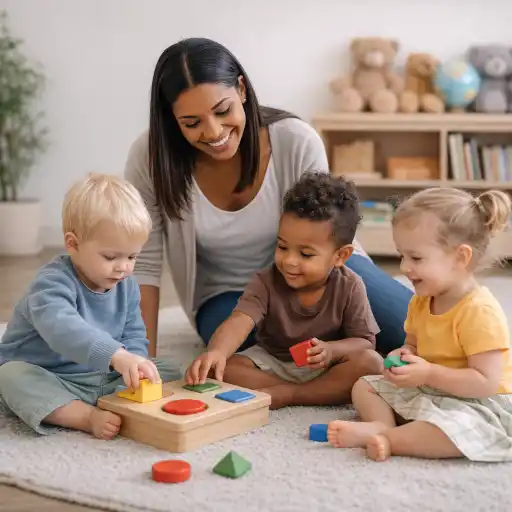
The educator’s role is not to provide a model that must be copied. Instead, create an inviting challenge and remain available as a thoughtful partner. A bridge that collapses, a ramp that is too steep, or a dramatic-play store without enough containers creates a meaningful reason to think.
- Offer materials with different weights, shapes, textures, and levels of stability.
- Protect uninterrupted play so children can revise projects over time.
- Rotate a small number of materials rather than overwhelming children with choices.
- Invite children to document ideas with drawings, photographs, gestures, or words.
- Connect play to children’s cultures, interests, homes, and community experiences.
Guided play can add intentionality while preserving agency. For example, say, “Can you build a road that reaches both houses?” rather than “Build this road exactly like mine.” The first prompt establishes a goal while leaving room for multiple solutions.
Which questions scaffold problem-solving without taking over?
Questions can function as cognitive support when they encourage children to observe, predict, compare, and reflect. Open-ended questions generally invite more thinking than questions requiring a yes-or-no response, but timing and tone matter. Ask one question, wait, and listen carefully.
- Notice: “What do you see happening?”
- Define: “What are you trying to make happen?”
- Brainstorm: “What could you try?”
- Predict: “What might happen if we move this piece?”
- Compare: “Which way seems stronger? Why?”
- Reflect: “Did that work? What could you change?”
Use a gradual-release sequence. First, model a calm think-aloud: “The tower fell. I wonder whether the base is wide enough.” Next, solve a similar problem together. Then offer a prompt or two choices. Finally, step back so the child or peer group owns the process.
During social conflict, regulate before coaching. A child who is overwhelmed may not be able to reason productively. Connect, help the child become calm, name the problem, and then teach a short script such as “Can I have a turn?”, “Please stop,” or “Let’s trade.” The National Center for Pyramid Model Innovations identifies problem-solving as a core social-emotional skill and provides practical supports such as scripted stories and solution tools.
How can directors and teachers embed practice into daily routines?
Problem-solving does not require a separate daily lesson. Directors can support consistency by identifying one observable goal for the week, coaching staff on shared language, and reviewing brief evidence during team meetings.
- Arrival: Invite children to choose where materials belong or solve a small organization challenge.
- Construction: Pose a purpose-based task, such as building a shelter for an animal figure.
- Science: Ask children to predict which container will fill first and explain how to test the idea.
- Art: Provide open-ended materials and invite children to solve a design problem.
- Routines: Ask children how to distribute plates, organize cleanup, or make space for everyone.
- Conflict: Use visual solution cards showing waiting, trading, joining play, or asking for help.
Documentation should be brief and objective. Record what the child did and said, such as: “Maya tried two bases for the bridge, asked Leo to hold one side, and said, ‘This one stays up.’” Use observations to decide whether to add a visual, simplify the task, provide more time, or fade adult prompts.
Families can extend the same process through cooking, sorting laundry, planning a route, or repairing a loose button. Share strengths rather than presenting problem-solving as a deficit.
What common mistakes should programs avoid?
Well-intentioned adults sometimes reduce learning by helping too quickly. The goal is not to leave children frustrated; it is to provide the least amount of support that keeps the challenge productive.
- Fixing immediately: Pause, observe, and offer a prompt before demonstrating.
- Overusing closed questions: Replace “Did it work?” with “How do you know?” or “What else could work?”
- Confusing struggle with failure: Treat revision as evidence of learning.
- Offering too many choices: Present two or three meaningful options.
- Praising only the result: Name the strategy, persistence, collaboration, or reflection.
- Ignoring regulation: Help children become calm before expecting verbal negotiation.
Safety remains non-negotiable. Intervene immediately for dangerous behavior, unsafe materials, or escalating aggression. Problem-solving instruction should never replace active supervision or individualized support. State requirements vary - check your state licensing agency regarding training hours, documentation, supervision, and required procedures.
For further professional development, consider Supporting Social Learning: Creating Classrooms that Care Buy Now $24.00, Staying Positive: Guidance for Preschoolers Buy Now $24.00, and The Best Promotion is Play Buy Now $24.00. Together, these courses can help providers connect problem-solving with responsive relationships, positive guidance, and purposeful play.
Conclusion: How can educators build confident problem-solvers?
Young children become stronger problem-solvers through repeated, meaningful experiences—not through adults supplying every answer. Offer open-ended materials, protect time for experimentation, ask questions that extend thinking, teach practical communication scripts, and gradually reduce support as competence grows.
A manageable action plan is to choose one target, such as “try two solutions before asking for help.” Introduce it during a playful challenge, model the language, observe one example per child, and share the strategy during a staff reflection. When classrooms treat mistakes as information and persistence as a strength, children learn that problems are not emergencies; they are invitations to think, connect, and try again.
- CDA Home Visitor Subject Area 3 Part 3 Birth to 5
- CDA Home Visitor Subject Area 2 Part 3 Birth to 5
- Pediatric RSV First Aid & CPR/AED
- Mysteries of Challenging Behavior Solved
- Emergent Learning & Development
- Sensitive Periods in Montessori: Guiding Natural Learning
- Texas Director Credential
- Supporting Families and Caregivers in Language and Literacy
- Building Social Foundations
- CDA Certification en Español: Recursos y Consejos para Educadores Bilingües
- 🔍 ¿Qué ves cuando observas a un niño aprender?
- Team-Building Activities for Daycare: Helping Children Learn Together
- Celebrando la amistad en el cuidado infantil durante el Día de los Mejores Amigos
- Canciones, juegos y preguntas de círculo para niños
- How can child care programs support cognitive development through problem-solving activities?
- How Does Play Support Children’s Physical, Cognitive, and Social Growth?
- How Can Preschool Teachers Help Children Build Problem-Solving Skills?
- How Can School-Age Programs Teach Conflict Resolution That Actually Works?
- How can I use simple STEM activities to spark curiosity in preschoolers?
- Why do children need more boredom and less constant entertainment?
- How Can Educators Teach Problem-Solving Without Always Solving the Problem?
- How can we develop leadership skills in young children?
- How Can Child Care Programs Strengthen Executive Function in Young Children?
- How Can Child Care Programs Build Meaningful School Readiness?
- How Can Child Care Providers Support Healthy Child Growth and Development?
- How Can Child Care Providers Create Effective Learning Centers in Small Spaces?
- How Can Patterned Practice Help Young Children Master Subtraction Facts?
