A choking episode, severe allergic reaction, or serious fall can unfold before a teacher has time to consult a handbook. Choosing the right pediatric first aid format helps you build practical #confidence while meeting professional training expectations; explore ChildCareEd’s Pediatric Blended First Aid & CPR/AED course Buy Now $85.00$80.00 for self-paced learning followed by hands-on skills verification. If your team learns best through direct coaching, the Pediatric In-Person First Aid & CPR/AED course Buy Now $95.00 offers instructor-led practice.
Both formats can support meaningful professional development, but neither should be selected casually. The best choice depends on your learning preferences, schedule, program requirements, access to equipment, and the level of coaching your staff needs.
Why does pediatric first aid training matter in early childhood settings?
Young children are active, curious, and dependent on adults to recognize danger and initiate help. A routine day can change quickly when a child chokes during lunch, falls on the playground, develops breathing difficulty, or experiences an allergic reaction. Pediatric training prepares teachers to assess the scene, recognize urgent symptoms, activate emergency services, and provide care within the limits of their training.
Children are not simply small adults. Infants and children differ in anatomy, communication, physiology, and appropriate response techniques. A pediatric-focused course should address age-specific CPR, choking response, injury care, breathing emergencies, anaphylaxis, seizures, and AED use when applicable.
Training also strengthens the whole classroom response. While one adult assists the child, another must supervise the remaining children, retrieve supplies, call 911, meet responders, and communicate with families. Shared training creates clearer roles and reduces hesitation.
- Current certification supports documentation and program readiness.
- Hands-on practice helps connect knowledge with physical action.
- Team rehearsal clarifies communication and supervision responsibilities.
- Regular refreshers support #preparedness rather than one-time compliance.
State requirements vary - check your state licensing agency before registering, especially when comparing online, blended, remote, and in-person delivery.
What is included in a blended pediatric first aid course?
Blended learning divides training into two connected components. First, the learner completes online instruction independently. This portion commonly introduces emergency recognition, response priorities, pediatric CPR concepts, choking protocols, first aid for injuries, allergic reactions, diabetic emergencies, and communication with emergency personnel. Learners can pause, review, and schedule study around work and family responsibilities.
The second component is a live skills session. Participants demonstrate required techniques with an instructor, receive feedback, and practice the physical sequence of care. The blended format therefore offers flexibility without eliminating hands-on verification.
For many teachers, this structure is practical because it moves information-heavy learning away from the classroom while reserving instructor time for application. A provider can complete theory during several shorter sessions and then attend a focused skills appointment.
- Online content can be completed at your own pace.
- Skills verification provides an opportunity for coached practice.
- Digital course records may simplify professional documentation.
- Participants must complete every required component, not just the online portion.
Blended learning is not the same as online-only learning. An online-only course may provide useful knowledge but may not satisfy workplace or licensing expectations when a hands-on evaluation is required. Read the course description carefully and confirm acceptance with your employer or licensing agency.
 When is in-person training the stronger choice?
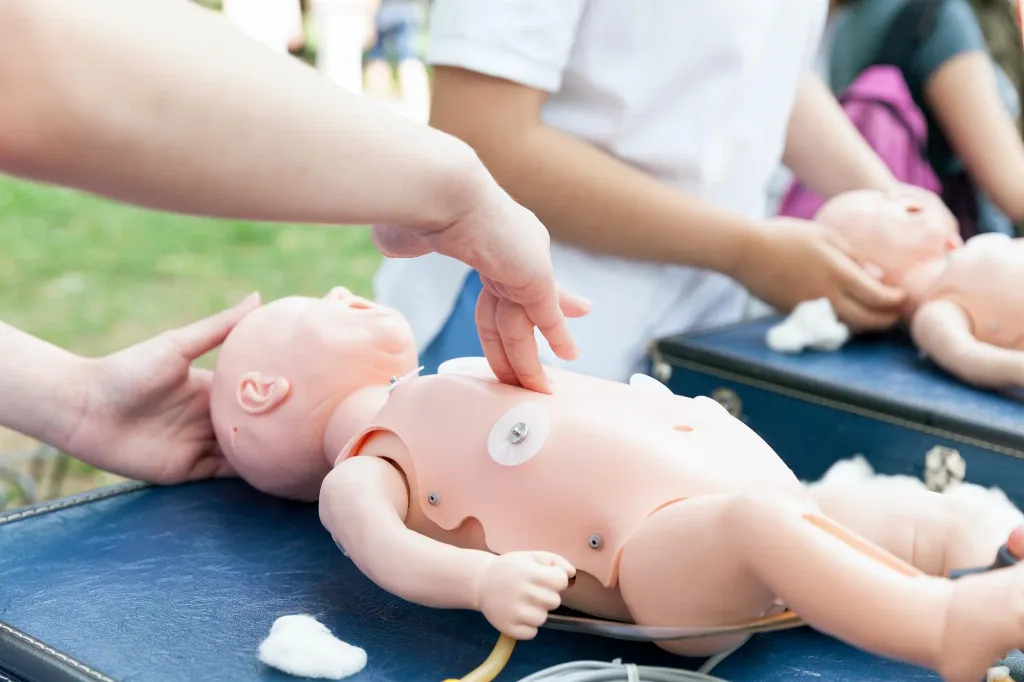
In-person instruction is often the better fit for learners who value immediate feedback, physical demonstration, and a structured classroom experience. A teacher can ask questions in real time, observe an instructor model a skill, practice on pediatric manikins, and correct technique before leaving the session.
This format can be especially valuable for staff who feel anxious about emergencies, have limited experience with CPR, or learn more effectively through guided repetition. It may also benefit directors training several employees together because the group can develop shared language and coordinated roles.
In-person training requires a larger uninterrupted time commitment. Child care programs may need coverage, transportation planning, and schedule adjustments. Those costs are operational considerations, not evidence that the format is inferior.
- Choose in-person training when staff need substantial coaching.
- Use it when a team benefits from practicing together.
- Prioritize it when employees are uncomfortable with physical skills.
- Confirm class length, location, equipment, and attendance policies in advance.
How should teachers compare blended and in-person options?
A thoughtful comparison begins with requirements rather than convenience alone. Review your employer’s policy, certificate expectations, renewal date, and the specific ages served. Confirm that the course covers infants and children if your program includes them; adult-only training is not an adequate substitute for pediatric preparation.
Next, consider how you learn. Blended training may work well if you are organized, comfortable studying independently, and need flexibility. In-person training may be more effective if you benefit from a live instructor, repeated demonstrations, or accountability.
Ask these practical questions before enrolling:
- Does the course include infant, child, and adult content?
- Is hands-on skills verification required and clearly described?
- Will the certificate be accepted by my employer and licensing agency?
- Can I complete the training before my current certification expires?
- Does the format match the needs of my entire staff?
How can directors turn certification into daily readiness?
A certificate is an important record, but reliable emergency response requires an ongoing system. Directors should maintain a training matrix showing each employee’s course type, completion date, expiration date, role, and classroom assignment. Keep certificates accessible while protecting children’s confidential health information. For more on why keeping CPR certification current is critical, see this overview.
Pair formal training with brief, low-stakes practice. Monthly checks can confirm that first aid kits, emergency contacts, medications, gloves, CPR barriers, and AED supplies are present and current. Quarterly tabletop scenarios can help staff rehearse responsibilities without frightening children.
- At onboarding: review the emergency plan, supplies, health records, and staff roles.
- Monthly: inspect kits, medication storage, contact information, and communication devices.
- Quarterly: practice one scenario and document lessons learned.
- Before expiration: schedule renewal early and verify format acceptance.
- After an incident: debrief compassionately, replace supplies, and revise procedures.
Include infants, children with disabilities, chronic conditions, communication differences, and mobility needs in planning. A strong system also accounts for playgrounds, field trips, transportation, substitutes, staff breaks, and situations in which a teacher is alone with a group.
🩹 Remember: first aid is supportive care and does not replace professional medical evaluation. When a situation is life-threatening, worsening, or uncertain, call emergency services and follow dispatcher instructions.
What common mistakes should teachers and directors avoid?
The most common mistake is treating certification as proof that skills will remain fresh forever. Knowledge and performance can fade when they are not practiced. A second mistake is selecting a course based only on price or convenience without checking whether it includes pediatric content and an acceptable skills evaluation.
- Choosing adult-only training: Verify that infants and children are included.
- Assuming online-only equals certification: Confirm workplace and licensing expectations.
- Ignoring expiration dates: Enroll early enough to prevent a coverage gap.
- Failing to practice roles: Rehearse calling, caregiving, supervision, and family communication.
- Overlooking supplies: Check expiration dates and replace used or missing items.
- Using blame during debriefs: Ask what support, clarification, or system change is needed.
Directors can also avoid inequity by offering staff more than one pathway when feasible. A blended course may help an employee with transportation or scheduling barriers, while in-person coaching may better support another employee’s learning needs. The goal is not to promote one format universally; it is to create dependable competence across the team.
Conclusion: Which pediatric first aid format should you choose?
Choose blended pediatric first aid when you need scheduling flexibility and are comfortable completing online theory before a live skills verification. Choose in-person training when immediate instructor feedback, structured practice, or team-based learning is the priority. Neither format is automatically superior: the strongest choice is the one that provides pediatric content, required hands-on practice, acceptable documentation, and a realistic plan for maintaining skills.
Before enrolling, verify course scope, delivery requirements, renewal timelines, and local acceptance. Then reinforce training through drills, equipment checks, clear emergency roles, and supportive debriefing. For teachers and directors, the central question is not merely “Which format is easier?” but “Which format will help our team respond calmly and effectively when a child needs us?”
References
- Pediatric First Aid for Teachers
- First Aid and CPR
- Pediatric Blended First Aid & CPR/AED Buy Now
$85.00$80.00 - Pediatric In-Person First Aid & CPR/AED Buy Now $95.00
- American Red Cross Adult and Pediatric Blended Learning
- Health and Safety Training Resources for Child Care Providers
Additional ChildCareEd courses to explore

- Adult Only CPR AED and Adult First Aid Blended
- Adult/Child CPR AED and Adult First Aid Blended
- Birth to Five CDA Credential with Portfolio Review
- Pediatric Blended First Aid & CPR/AED Adult, Child, Infant
- Pediatric RSV First Aid & CPR/AED
- Pediatric In-Person First Aid & CPR/AED Adult, Child, Infant
- Adult First Aid Only - Blended
- Texas Director Credential
- First Aid and CPR Certification: What to Expect from Your Training Course
- A Lifeline for Little Ones: Why First Aid and CPR Training is Essential for Teachers and Parents
- 10 Reasons this Summer to Take Pediatric First Aid and CPR with ChildCareEd
- Getting Ready for the New School Year: Prioritizing Safety with First Aid and CPR Training
- Pediatric First Aid and CPR Training with ChildCareEd - Empower Yourself!!
- ¿Cuáles son las mejores actividades de primeros auxilios para adultos?
- ¿Cómo pueden los equipos de cuidado infantil practicar habilidades rápidas de primeros auxilios en situaciones reales?
- How can DC early childhood classrooms stay ready with CPR and AEDs?
- What are Child Care Certification Programs and How Can They Help My Team?
- First Aid Scenarios for Child Care Staff: 10 “What Would You Do Next?” Challenges
- Pediatric First Aid for Teachers: Are Your Skills Still Fresh When an Emergency Happens?
- Help or Step Back? First Aid Scenarios That Teach Students Their Safety Limits
- Pediatric First Aid for Teachers: Blended or In-Person—Which Should You Choose?
- Which First Aid Course Do Child Care Providers Need for Licensing?
- How Often Should Child Care Staff Complete CPR and First Aid Training?
