Children can learn to help without being expected to become rescuers. By using carefully designed scenarios, child care providers can teach when to offer comfort, when to find an adult, and when to step back; staff who want stronger emergency-response preparation can explore Pediatric Blended First Aid & CPR/AED Buy Now $85.00$80.00 to develop practical infant, child, and adult first-aid skills through online learning and hands-on verification.
Why does teaching safety limits matter?
Young children are naturally willing to help, but willingness is not the same as readiness. A preschooler may notice that a friend is crying, bring a teacher, or place a pretend bandage on a stuffed animal. That same child should not be expected to assess a serious injury, move an injured peer, administer medication, or perform CPR. The educational goal is not to create miniature medical providers; it is to build sound judgment, empathy, communication, and respect for adult responsibility.
The CDC notes that early care and education professionals can teach foundational safety skills while reducing injury risks through safe environments and attentive supervision. Scenario-based learning makes these ideas concrete. It gives children language for uncertainty: “I need a grown-up,” “I will stay back,” or “I can help by getting the teacher.”
- Builds #confidence without encouraging unsafe risk-taking.
- Strengthens #empathy and calm communication.
- Clarifies the boundary between helping and intervening.
- Supports a shared #safety culture among children, staff, and families.
Which first aid skills are appropriate for children?
Children’s responsibilities should be matched to development, language, and supervision. For preschoolers, the most meaningful skills are recognition and communication. They can learn to identify that someone may need help, move away from danger, and tell a trusted adult what they observed. Older school-age children may practice a supervised emergency call or basic bandaging on a doll, but even then, adults remain responsible for assessment and care.
A useful framework is “Check, Call, Care,” adapted to children’s limits. “Check” means noticing whether the area is safe—not touching an injured person. “Call” means finding an adult or using a pretend phone to communicate essential information. “Care” means offering calm words or retrieving a safe prop only when directed.
- ✅ Check: Stop, look for danger, and keep a safe distance.
- 📞 Call: Tell a teacher, caregiver, or emergency dispatcher as instructed.
- 🫶 Care: Comfort, encourage stillness, or bring supplies with adult permission.
Use the First Aid for Young Children guidance to keep lessons age-appropriate. Avoid teaching children to diagnose, lift peers, give medicine, touch blood, or practice airway procedures.
How can providers design scenarios that teach “help or step back”?
Begin with situations children recognize: a teddy bear falls, a peer has a pretend scrape, or someone feels worried near the playground. State the scenario in simple language, then pause before giving the answer: “What could you do? What should you not do?” This invites reasoning rather than memorization.
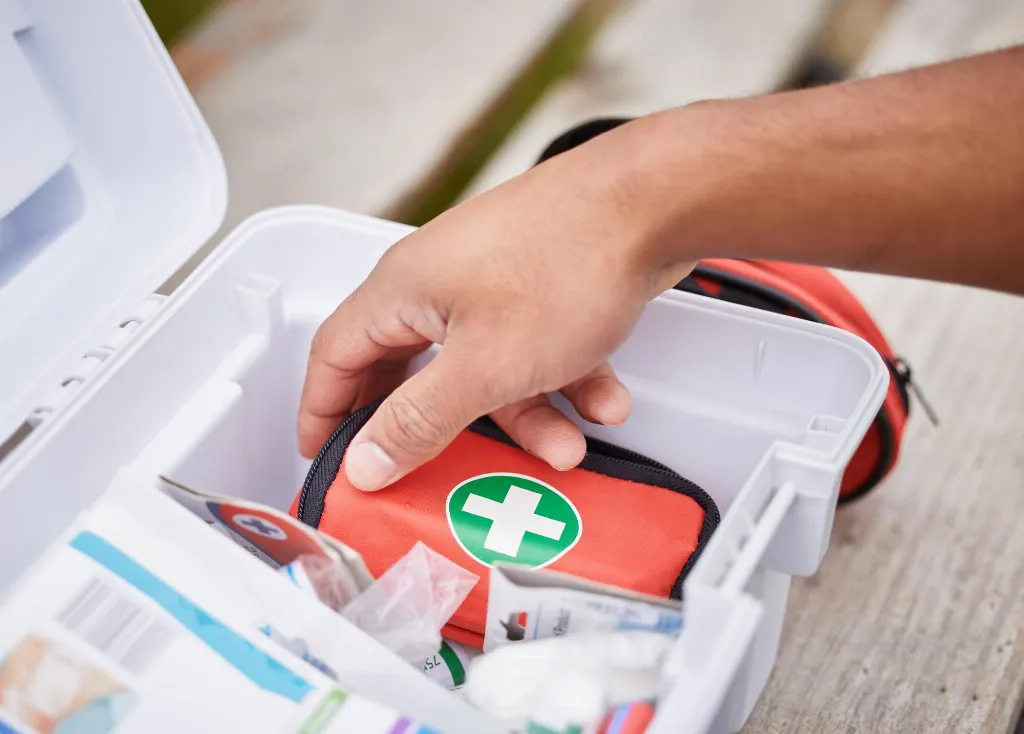
Use soft toys, paper bandages, toy phones, picture cards, and role badges. Never use real food to simulate choking, sharp objects, medications, needles, or realistic injury effects. A child can pretend to call for help without dialing emergency services. If a phone is used, disconnect it or use a toy device, and explain that real emergency calls are for genuine emergencies.
Rotate roles, but keep the “adult responder” role with a trained provider. Role cards can include:
- Observer: notices the problem and stays back.
- Messenger: tells the teacher what happened.
- Comforter: uses calm words without touching unless invited.
- Safety checker: points out a pretend hazard from a safe distance.
The ChildCareEd article on first aid role-play scenarios emphasizes short, repeated practice, safe props, and teach-back. These principles help children experience competence without confusing pretend play with actual medical care.
What should children do in common scenarios?
Minor scrape: A child can stop playing, tell an adult, and offer comfort. The adult cleans and covers the injury. Children should not handle blood or apply medication independently.
Fall or possible head injury: Children should not move the peer or encourage them to stand. They should step back, alert an adult, and keep other children from crowding the area. Staff assess the child according to current training and policy.
Breathing difficulty or choking: The child’s role is to get an adult immediately and keep the area clear. Children should not give food or water, reach into a mouth, or attempt abdominal thrusts. Staff trained in pediatric first aid and CPR respond while another adult supervises the group. Educators can review updates on pediatric CPR guidance to keep their response knowledge current.
Allergic reaction: Children should alert staff if they notice swelling, hives, or breathing trouble. They should never share food or touch medication. Authorized adults follow the child’s individualized health plan and call emergency services when indicated. Because seizures can also occur in early learning settings, staff may find this guide to handling seizures and classroom emergencies useful when reviewing calm, safety-focused response procedures.
Water emergency: Teach “reach or throw, don’t go.” A child should shout for help and alert a responsible adult, never enter the water to rescue someone. The American Red Cross stresses close supervision and layers of protection around water.
- Ask: “Is it safe for me to go closer?”
- Ask: “Who is the nearest trusted adult?”
- Practice: “I see a problem. I need help now.”
How can staff reinforce boundaries without discouraging helpfulness?
Children may interpret “step back” as “do nothing,” so providers should frame boundaries positively: “You are helping by getting an adult,” or “Keeping yourself safe is part of helping.” Praise accurate decisions rather than dramatic action. A child who notices danger and seeks assistance has demonstrated an important safety skill.
Debrief with open-ended questions:
- What did you notice?
- What made it unsafe to touch or move the person?
- Who could help?
- What words could you use?
- How did you keep yourself and others safe?
Use teach-back: ask children to demonstrate one safe response with a puppet. If a child repeatedly wants to perform advanced techniques, acknowledge the interest while clearly explaining that trained adults handle those actions. Directors can reinforce this message through staff modeling: adults remain calm, assign specific roles, and avoid asking children to carry sensitive information or equipment.
Staff readiness matters. The Effective Supervision in Child Care Buy Now $25.00 course can support providers in strengthening active supervision, monitoring, and prevention practices. State requirements vary - check your state licensing agency before selecting training or planning drills.
How can programs avoid common mistakes and measure learning?
The most common mistake is presenting emergency scenarios as entertainment without clarifying real-life boundaries. Keep scenarios brief, predictable, and emotionally safe. Do not surprise children with simulated injuries, loud alarms, fake blood, or stories that resemble a child’s recent trauma. Inform families about the purpose and content of activities and offer alternatives when needed.
Other pitfalls include using adult medical language, rewarding risky behavior, allowing unsupervised role play, and assuming one lesson is enough. Instead, repeat a small scenario every two to four weeks and change only one variable at a time.
Document learning through observations rather than medical performance tests:
- Identifies a safe adult to contact.
- Uses a clear help-seeking statement.
- Maintains distance from a possible hazard.
- Offers comfort appropriately.
- Explains one action they should not attempt.
Keep a simple drill log with the date, scenario, participating group, strengths, and one improvement. If an actual incident occurs, provide care first, supervise the remaining children, notify families according to policy, and write objective documentation. The ChildCareEd resource on injury reporting recommends recording what was observed, what care was given, and when communications occurred.
Conclusion: Can children help while knowing when to step back?
Yes—when first aid education focuses on judgment rather than heroic action. Children can notice concerns, protect their own safety, get a trusted adult, communicate clearly, and offer comfort. They should step back from situations involving blood, serious injury, choking, breathing difficulty, medication, water rescue, or any danger they cannot understand.
For child care providers and directors, the strongest approach combines developmentally appropriate role play, safe materials, active supervision, family communication, current staff training, and repeated reflection. The central lesson is simple: helping often means getting help. When children learn that boundary with confidence and compassion, they become safer members of the classroom community.
Which ChildCareEd courses can support this work?
- Pediatric Blended First Aid & CPR/AED Adult, Child, Infant Buy Now
$85.00$80.00 — combines online learning with hands-on skills verification for pediatric emergencies. - Pediatric In-Person First Aid & CPR/AED Adult, Child, Infant Buy Now $95.00 — provides instructor-led practice for caregivers who prefer an in-person format.
- Pediatric RSV First Aid & CPR/AED Buy Now
$115.00$95.00 — offers online learning with remote live skills verification; confirm local acceptance before enrolling. - Effective Supervision in Child Care Buy Now $25.00 — focuses on active supervision and injury prevention.
- Creating an Emergency and Disaster Preparedness Plan
 Buy Now $16.00 — helps directors organize roles, communication, and response procedures.
- 45 Hour Child Growth and Development
- Diversity, Equity, and Inclusion in Education: For Workforce Solutions
- Birth to Five CDA Credential with Portfolio Review
- Pediatric RSV First Aid & CPR/AED
- 45 Hour School Age Methods and Materials
- Diversity, Equity, and Inclusion in Education
- Diversity, Equity, and Inclusion in Education
- Texas Director Credential
- Every Moment Matters: Schedules and Transitions
- Keeping Our Youngest Students Safe: The Vital Importance of Pediatric First Aid and CPR Training for Teachers
- Summer Fun Meets Summer Safety: The Importance of Pediatric First Aid and CPR Training
- CDA Certification en Español: Recursos y Consejos para Educadores Bilingües
- ¿Cómo puedo usar escenarios de juego de roles de primeros auxilios en mi aula?
- ¿Cómo pueden los equipos de cuidado infantil practicar habilidades rápidas de primeros auxilios en situaciones reales?
- Cómo Crear Tu Portafolio CDA Paso a Paso
- Lista para Abrir una Guardería en Casa en Dakota del Norte: Cómo Empezar
- Cómo Trabajar en el Cuidado Infantil en Carolina del Norte: Requisitos y Pasos
- Cómo Trabajar en el Cuidado Infantil en Maryland: Requisitos y Pasos
- Cómo Ser Maestra de Preescolar en Illinois
- Cómo Ser Maestra de Preescolar en Maryland
- Capacitación Previa al Servicio para Proveedores de Cuidado Infantil en Nevada
- Can Superhero Day Capes and Pretend Play Teach Children to Help Others?
- Online Babysitting Classes: Learn the Skills to Care for Children Safely
- Help or Step Back? First Aid Scenarios That Teach Students Their Safety Limits
- What Should You Do When Older Children Say After-School Rules Are for Babies?
