Child care certification programs teach and prove the skills that early childhood workers need. This short guide helps directors and providers understand common certificates, how to earn them, and how they help your #program and team. You will find clear steps, helpful links, and tips to avoid common mistakes. State requirements vary - check your state licensing agency.
What are child care certification programs?
Child care certification programs are trained courses and tests that show a person knows how to care for young children. They include short training certificates (like a 90-hour program), longer credentials (like the CDA Credential), and safety training such as CPR and first aid. Certifications make skills official and show families and employers you are ready to keep children healthy, learning, and safe. Many of these programs are offered online and in person; you can find many course options at ChildCareEd online courses. For a curated list of flexible, self-paced options specifically for early childhood professionals, see our child care courses online.
- 1) Who offers them? Many training providers, community colleges, and online sites.
- 2) What they cover: health, guidance, lesson planning, and classroom safety.
- 3) Who needs them: lead teachers, assistant teachers, family child care providers, and home visitors.
These programs help you meet state rules and improve daily teaching. For example, the CDA is a nationally recognized credential explained in detail by ChildCareEd. If you want a quick start, ChildCareEd also offers free intro courses to see what the training looks like (free courses).
Why do certifications matter — and why should you care?
Why it matters: Certifications help children get better care and help your staff succeed. Research and reviews show that higher training and better staff interactions help children learn more and behave better. Good training also builds trust with families and supports quality across your program, as described in studies about child care quality (Canada quality review).
- 1) Better care: Trained teachers use strong routines, thoughtful activities, and safe practices.
- 2) Staff confidence: Training gives teachers clear ideas they can use every day.
- 3) Program reputation: Certified staff make parents feel safer and more confident.
Also, some jobs require certain certificates. For example, many employers want a CDA for lead teachers. The ChildCareEd article explains why certification matters. Remember: state requirements vary - check your state licensing agency before you sign up for training.
How do I earn the most common certificates (step-by-step)?
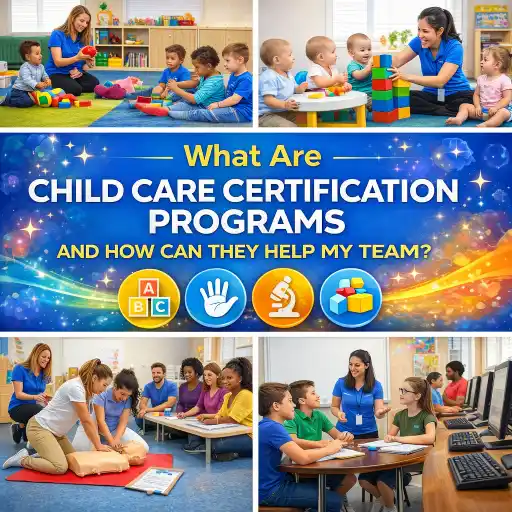
Below are clear steps for three common paths: the CDA, a 90-hour certificate, and CPR/First Aid. Use these steps as a checklist when planning staff training.
- 📘 CDA (Child Development Associate) — big picture:
- a) Complete required training hours (usually 120 hours). See CDA training details from ChildCareEd.
- b) Log 480 hours of work experience in the right age group.
- c) Build a professional portfolio and practice reflective statements — find portfolio help at Creating the CDA Professional Portfolio Buy Now $0.00.
- d) Schedule the CDA exam through Pearson VUE after you get your Ready to Schedule notice (Pearson VUE CDA exam).
- 📝 90-Hour Child Care Certificate — quick path:
- a) Complete about 90 hours of coursework that covers child development, health and safety, curriculum, and professionalism. ChildCareEd outlines steps for 90-hour training (90-hour guide).
- b) Document required work experience and any required paperwork for your state.
- c) Submit application to the state or credentialing body and renew every few years as required.
- ⛑️ CPR & First Aid — essential safety:
- a) Take an approved pediatric CPR/First Aid course with skills check (many states require blended or in-person skills verification). ChildCareEd offers a blended First Aid/CPR course (ChildCareEd First Aid & CPR Buy Now
$85.00$80.00). - b) Keep the certification current (often every 2 years).
- a) Take an approved pediatric CPR/First Aid course with skills check (many states require blended or in-person skills verification). ChildCareEd offers a blended First Aid/CPR course (ChildCareEd First Aid & CPR Buy Now
Other supports: ChildCareEd has many course options and free tools to help staff stay organized (online courses and free resources). Also consider free public trainings like CDC’s "Watch Me!" for developmental milestones (CDC Watch Me!).
Tip: Plan training as a team. Make a timeline, assign who finishes which course, and keep certificates in one folder. State requirements vary - check your state licensing agency.
How do I avoid common mistakes and keep staff certified (FAQs included)?
Common mistakes happen, but they are easy to avoid with a simple plan. Below are typical problems and fixes for directors and providers.
- 1) 😕 Losing certificates — Fix: create a digital folder and a paper file for each staff member.
- 2) ⏳ Waiting too long to track hours — Fix: log work hours weekly and back up logs in two places.
- 3) 🧾 Starting the portfolio too late (for CDA) — Fix: build the portfolio during training. ChildCareEd’s portfolio samples help (CDA Portfolio Sample Buy Now $0.00).
- 4) 🔁 Forgetting renewals — Fix: set calendar reminders for renewals and CEU needs.
How to avoid pitfalls: 1) Use a training tracker for your whole team (ChildCareEd has Group Admin options). 2) Choose courses that match state rules. 3) Pair online learning with short in-person practice sessions for better skills transfer.
FAQ (short answers):
- Q: How long does a CDA take? A: It varies. Training is 120 hours plus 480 hours experience; many finish in months to a year depending on schedule (CDA details).
- Q: Is CPR required? A: Many states and programs require child-focused CPR; check your state. ChildCareEd and other providers offer approved blended courses (CPR course Buy Now
$85.00$80.00). - Q: Can online courses meet state rules? A: Some can, some cannot. State requirements vary - check your state licensing agency.
- Q: Where do I schedule the CDA exam? A: The exam is scheduled through Pearson VUE after the Council sends a Ready to Schedule notice (Pearson VUE).
Summary
Certifications help your staff grow, keep children safe, and make your program stronger. Start with a plan, use trusted providers like ChildCareEd for training and portfolio help, and keep simple tracking systems for hours and renewals. Small steps—like logging hours each week and saving certificates in one place—make a big difference.
- 45 Hour Child Growth and Development
- Birth to Five CDA Credential with Portfolio Review
- CDA Family Child Care Credential with Portfolio Review
- CDA Bridge Bundle: Family Child Care without Portfolio Review
- CDA Bridge Bundle: Infant/Toddler without Portfolio Review
- CDA Bridge Bundle: Preschool without Portfolio Review
- Texas Director Credential Renewal
- Texas Director Credential
- CDA Certification en Español: Recursos y Consejos para Educadores Bilingües
- What are training bundles in Pennsylvania and how do they help child care providers?
- Which Minnesota training bundle is right for my child care team?
- How to Get an ECE Certificate in California
- Daycare Teacher Certification Requirements in Georgia
- Nevada Child Care Center Director: Requirements and Training
- Daycare Jobs in Maryland: How Old Do You Have to Be?
- New Child Care Regulations in Georgia for 2026
- Online Early Childhood Education Courses in Canada with Certificates
- How can infant and toddler care training help my program?
- What are Child Care Certification Programs and How Can They Help My Team?
- How to Become Certified to Work in Before and After School Care
- What Certification Do You Need to Teach Pre-K? Public School vs. Child Care Requirements
- Pediatric First Aid for Teachers: Are Your Skills Still Fresh When an Emergency Happens?
- How to Become a Kindergarten Teacher in Texas: Which Certification Path Should You Choose?
- Pediatric First Aid for Teachers: Blended or In-Person—Which Should You Choose?
