Classroom observations and developmental screening offer different kinds of information about a child, and understanding their purposes can help you communicate more clearly with families. Use the Parent Conference Notes Buy Now $0.99 form to organize observations of a child’s strengths and progress, record family concerns, and document agreed next steps. The Developmental Screening in Early Childhood  Buy Now $16.00 course explores the distinctions between screening, observation, and assessment, while Observing & Assessing in Child Care Buy Now $16.00 offers a broader look at observation methods and their classroom use. Read on to understand how these approaches work together to inform responsive care and family collaboration.
Why does the distinction matter for children and families?
Educators see children across play, routines, transitions, and relationships. This gives providers a valuable view of how children communicate, solve problems, move, and participate in daily life. But watching a child in the classroom is not the same as administering a developmental screening. Knowing which process you are using protects families from confusing informal impressions with structured findings and helps ensure each type of information is used appropriately.
Observation supports responsive teaching: it can show that a child persists with puzzles, seeks particular peers, or needs support during transitions. Screening, by contrast, is a brief, structured check that can indicate whether more in-depth evaluation may be warranted. Neither process alone diagnoses a disability. NAEYC notes that screening identifies possible concerns for further examination, while observations and assessments can inform learning plans and teaching.
These practices work best as complementary parts of a thoughtful system. The CDC explains that developmental monitoring over time and formal screening can help identify potential concerns and connect children and families with support as early as possible. For providers, the practical goal is not to label or compare children; it is to understand each child more accurately and plan respectful support.
What is classroom observation, and what can it tell us?
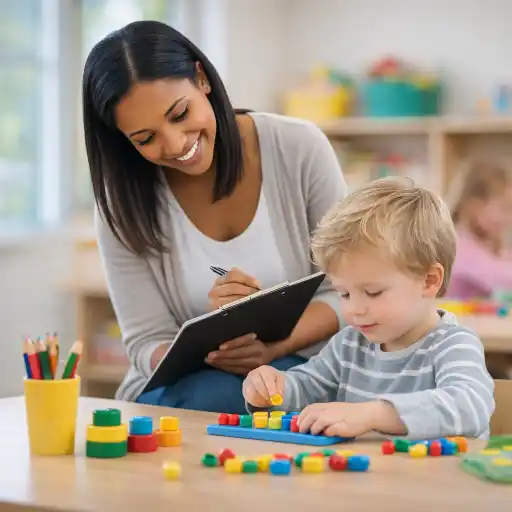
Classroom observation is the intentional, ongoing act of watching and listening to learn about a child in context. Educators may observe during child-directed play, conversations, meals, outdoor time, or transitions. They record concrete evidence—what the child did or said, where it happened, who was present, and what occurred before or after—then use that information to reflect and plan.
Observation answers questions such as: How does the child approach a new material? What helps them join peer play? In which routines do they communicate most comfortably? A running record may capture a sequence of actions; an anecdotal note may describe a significant moment; a checklist or work sample may help track selected skills over time. Choose a method that matches the question rather than collecting notes without a clear purpose.
Objectivity is central. “Leo stacked five blocks, watched them fall, and began again” describes observable evidence. “Leo is careless” is an interpretation and may introduce bias. Document across different contexts and days, and include strengths as well as areas where support may help. As Head Start’s explanation of screening, assessment, evaluation, and observation emphasizes, observation is part of ongoing assessment and helps educators learn about children’s interests, strengths, and needs. It is not, by itself, a formal screening result.
What is developmental screening, and what does it do?
Developmental screening is a brief, structured process using a research-based tool, such as a standardized questionnaire or checklist, to identify whether a child may need a closer look at development. Depending on the tool and program, information may come from family members, educators, or a trained professional. Screening tools commonly consider areas such as communication, movement, thinking, behavior, and social-emotional development.
A screening provides a limited snapshot, not a complete account of a child’s abilities and not a diagnosis. A result suggesting possible concern means that follow-up may be appropriate; a result without flagged concerns does not replace ongoing observation or family and professional judgment. The CDC describes screening as more formal than developmental monitoring, and the Head Start overview of screening from birth to age five explains that screening helps families and programs decide whether to seek further evaluation.
Programs should use tools that are appropriate for the child’s age, development, culture, and language, and ensure that trained, qualified personnel follow the tool’s directions. For children who use more than one language, consider communication and skills across languages with family input and qualified bilingual support or interpretation when available. Screening should be conducted with required consent and in partnership with families. State requirements vary - check your state licensing agency; Head Start programs also have specific timelines and standards.
How do observation and screening differ in everyday practice?
The simplest distinction is purpose: observation helps educators understand behavior and learning in context; screening helps identify whether a child may benefit from further examination. Their methods, timing, and interpretation differ, even though both contribute useful information.
- Observation: Usually ongoing and embedded in everyday routines; can be informal or systematic; informs teaching, relationships, and individualized planning.
- Screening: A brief, structured process using a tool designed for screening; often conducted at defined points or when concerns arise; helps determine whether follow-up evaluation should be considered.
- Evaluation: A more comprehensive process conducted by qualified professionals to understand development and determine eligibility or support needs, as applicable.
For example, a teacher may notice over several weeks that a child uses gestures more often than words during classroom play. The teacher can document when communication occurs, what the child communicates, and how familiar peers or adults respond. This record can support a respectful conversation with the family. A screening, if appropriate and conducted under program procedures with consent, uses a selected tool and information from people who know the child. If concerns remain, the family may be connected with a qualified professional or early intervention pathway.
Use more than one source of information; no single classroom moment or screening score should define the child. Keep records confidential, distinguish evidence from interpretation, and avoid using screening data to diagnose, rank, or exclude children.
How can providers partner with families and decide on next steps?
Family partnership begins before any concern is raised. Explain the purpose of observation and screening in plain, strengths-based language, invite families to share what they see at home, and make room for their questions. A screening is not a pass-or-fail test; it is one source of information to help decide whether additional support or evaluation may be useful.
When discussing an observation, share a specific example and ask for the family’s perspective: “During group stories, Sam often watches and points to pictures, but we hear fewer spoken words. What communication do you notice at home?” This approach avoids conclusions and recognizes that children may show skills differently across settings, relationships, languages, or activities.
If a screening indicates possible concern, communicate the result carefully and explain that screening does not provide a diagnosis. Follow your program’s consent, documentation, and referral procedures. With family permission, providers can help identify the appropriate local early intervention or school-system contact and continue everyday supports while the family considers next steps. IDEA’s Part C monitoring, screening, and referral resource describes how multiple people, including early childhood educators and families, may refer children when development is a concern.
- 🔎 Describe observable evidence and the context in which it occurred.
- Invite family observations and preferred language for communication.
- Clarify who is qualified to administer or interpret a screening tool.
- Agree on practical classroom supports and a plan to revisit progress.
- Protect privacy and follow program procedures for records and referrals.
How can teams avoid common observation and screening pitfalls?
One common mistake is treating a screening result as a diagnosis. Screening tools flag possible areas for closer attention; qualified professionals conduct more comprehensive evaluation. Another pitfall is interpreting one observation as a stable trait. Children may behave differently depending on sleep, health, familiarity, language, sensory conditions, peers, and the demands of the activity. Gather information over time and consider context before drawing conclusions.
Subjective labels can also distort records. Replace “aggressive” with a description of the specific action, what happened beforehand, and how adults and peers responded. Balance concern-focused notes with evidence of the child’s interests, abilities, relationships, and progress. This makes records more useful for planning and less likely to stigmatize a child.
Teams should also avoid using a tool simply because it is convenient. Check that it is intended for screening, suitable for the child’s age and population, and used by trained personnel. Review cultural and linguistic fit; consult families and qualified language supports when needed. NAEYC advises that assessment practices be developmentally, culturally, and linguistically responsive, and that the limits of tools be considered when their validity or reliability is uncertain.
Finally, observation and screening should not become isolated paperwork. Share relevant information securely with authorized colleagues and families, use it to plan appropriate support, and follow up. The point is not to collect the most data; it is to make thoughtful decisions that help each child participate and learn.
Conclusion: How should providers put the difference into practice?
Classroom observation is an ongoing way to understand a child’s actions, strengths, and learning in everyday contexts. Developmental screening is a brief, structured check used to identify whether more in-depth evaluation may be appropriate. Screening does not diagnose, and observation alone does not replace a formal screening or evaluation.
Providers can put the distinction into practice by recording objective evidence, considering culture and language, gathering family perspectives, and using qualified tools and personnel for screening. When a possible concern arises, share information respectfully, follow consent and program procedures, and collaborate with families on next steps and classroom supports. This clear, partnership-based approach helps ensure that observation and screening serve their proper purposes: understanding children more fully and connecting them with support when it may help.
For additional professional learning, consider ChildCareEd’s Developmental Screening in Early Childhood Buy Now $16.00, Observing & Assessing in Child Care Buy Now $16.00, Preschool Assessments & Observations Buy Now $24.00, Exceptional Children and Early Intervention Buy Now $25.00, and Recognize, Respond, Respect: Supporting Diverse Learners Buy Now $55.00. Review each course’s details and your local training requirements to determine what fits your professional learning goals.
- Developmental Screening in Early Childhood
- Tracking Progress, Shaping Futures: Observation & Assessment Skills
- Recognize, Respond, Respect: Supporting Diverse Learners
- CDA Bridge Bundle: Family Child Care without Portfolio Review
- Privacy Matters: Documentation and Observation in Early Learning
- Culture, Communication, and Collaboration in Assessment
- Texas Director Credential
- CDA Subject Area 7
- Mastering Observation Techniques in the Montessori Classroom
- Theories on How I Grow
- CDA Certification en Español: Recursos y Consejos para Educadores Bilingües
- 🔍 ¿Qué ves cuando observas a un niño aprender?
- ¿Cuáles son las mejores actividades del Día de la Tierra para niños en casa o en el aula?
- 10 Ejemplos de Cómo la Cultura Influye en el Desarrollo Infantil
- Regulaciones de Licenciamiento de Cuidado Infantil en California para Centros y Hogares de Cuidado Infantil Familiar
- Retraso del Habla en la Guardería: Cómo Pueden Ayudar los Proveedores
- How Typical and Atypical Development Differ in Preschoolers
- Is This Development Typical? When Child Care Providers Should Watch, Document, or Refer
- How Can Child Care Providers Recognize and Support Developmental Delays?
- How Can Child Care Providers Use Developmental Screening to Support Every Child?
- How Can Child Care Providers Support Individual Differences in Development?
- How Can Child Care Providers Set Age-Appropriate Expectations for Young Children?
- How Can Child Care Providers Make Individualized Learning Practical and Inclusive?
- What Developmental Milestones Should Teachers Know From Birth to Age 5?
- How Can Child Care Providers Navigate Developmental Delay Conversations with Caregivers?
- Developmental Delay vs. Developmental Difference: What’s the Difference?
- How Is Classroom Observation Different from Developmental Screening?
- When Do Persistent Classroom Difficulties Call for an Individualized Plan?
- How Can Child Care Providers Discuss Uneven Child Development with Parents?
- Is the Child Following the Picture or Your Pointing Finger?
