Recognizing developmental milestones helps teachers plan responsive experiences, notice meaningful progress, and partner confidently with families. For a deeper foundation in typical and atypical development from birth through age five, explore The Science of Growing Up: Typical and Atypical Development  Buy Now $55.00, which can strengthen professional knowledge and classroom decision-making. If observation and documentation are your greatest challenge, Tracking Progress, Shaping Futures: Observation & Assessment Skills Buy Now $55.00 offers practical strategies for recording growth and using information to individualize care.
Why do developmental milestones matter in early childhood programs?
Developmental milestones are observable skills that most children demonstrate within a general age range. They describe growth in areas such as movement, communication, cognition, social-emotional functioning, and self-help. The CDC emphasizes that children reach milestones through how they play, learn, speak, act, and move; its age-based milestone guidance can help teachers organize observations.
Milestones are useful guides, not rigid deadlines. Children develop unevenly, and culture, language, temperament, disability, health, opportunity, and individual experience influence how skills appear. The Head Start Early Learning Outcomes Framework similarly presents development as a continuum across interconnected domains rather than a checklist children must complete perfectly.
Why it matters:
- Teachers can design experiences that are appropriately challenging.
- Directors can support consistent documentation and family communication.
- Families receive concrete examples rather than vague judgments.
- Possible concerns can be shared early, supporting timely screening or referral.
Observation should remain strengths-based. A child who is not yet using a particular skill may demonstrate important related abilities, interests, or communication strategies that inform the next step.
What milestones are common during infancy, from birth to 12 months?
Infancy is a period of rapid change. Teachers may observe newborn reflexes gradually becoming purposeful movements, social exchanges, and intentional communication. Across the first year, many infants develop stronger head and trunk control, reach for objects, roll, sit, move across the floor, and pull to stand. Some may take early steps, while others use different movement patterns.
Communication begins long before words. Infants cry to communicate needs, calm in response to familiar caregivers, smile socially, coo, babble, respond to voices, imitate sounds, and use gestures such as reaching or waving. Cognitive development is visible when infants explore objects, search for partially hidden items, recognize familiar people, and repeat actions that produce interesting effects.
Social-emotional development is expressed through attachment, shared smiles, enjoyment of familiar routines, distress during separation, and increasing awareness of unfamiliar people. Teachers can support development by providing responsive back-and-forth interactions, floor-based movement opportunities, safe objects to explore, songs, books, and predictable routines.
- 🍼 Narrate caregiving routines and respond promptly to infants’ cues.
- Offer supervised tummy time and varied positions when infants are awake.
- Place interesting objects within reach and allow time for exploration.
- Record emerging skills with dates and specific examples.
Use the CDC’s milestone checklists by age as a reference, while remembering that a checklist does not replace professional screening.
What should teachers expect from toddlers ages 1 to 3?
Toddlers make major gains in mobility, communication, autonomy, and symbolic thought. Between one and two years, many children walk independently, climb with supervision, carry objects, scribble, attempt utensils, point to share interest, use single words, and imitate familiar actions. As the second year progresses, children often combine words, follow simple directions, identify familiar objects, and participate in simple pretend play.
From two to three years, children commonly run, jump with both feet, kick a ball, build with blocks, use increasingly complex phrases, ask frequent questions, and begin solving simple problems. They may follow two-step directions when supported by context. Parallel play remains common, although toddlers increasingly notice peers and may attempt brief cooperation.
Emotional intensity is developmentally expected. Toddlers want independence but have limited language and self-regulation, so frustration may appear as crying, resistance, or tantrums. Teachers can reduce unnecessary struggle by offering limited choices, naming feelings, maintaining predictable routines, and setting clear, calm boundaries.
Effective classroom supports include:
- Picture books, songs, gestures, and responsive conversation.
- Push-and-pull toys, climbing opportunities, balls, and safe obstacle paths.
- Playdough, large beads, stacking materials, and easy-to-grasp tools.
- Pretend-play props that reflect children’s families and communities.
- Short, repeated directions paired with modeling.
Observe across routines rather than judging a toddler from one difficult transition. Document what happened before, during, and after a behavior so the team can identify patterns and plan support.
Which milestones emerge during the preschool years, from 3 to 5?
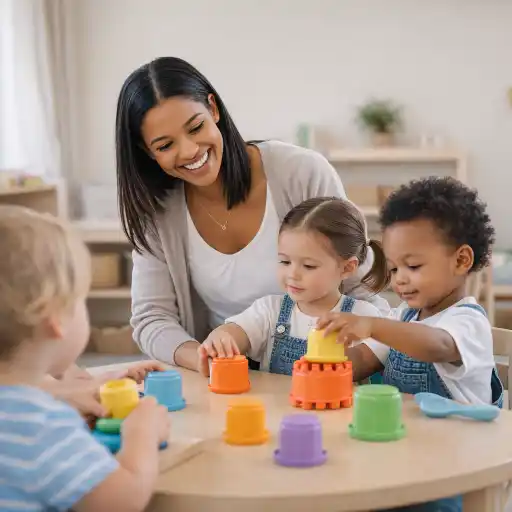
Preschool development includes increasingly coordinated movement, richer language, more complex pretend play, emerging self-regulation, and growing participation in group learning. Around age three, many children use longer phrases, engage in simple storytelling, sort objects, complete basic puzzles, draw lines or circles, run and jump, and participate in parallel or beginning cooperative play.
By four, children often ask detailed questions, use more complex sentences, remember songs and routines, negotiate roles in pretend play, identify some colors and shapes, draw recognizable forms, use scissors with growing control, and manage many self-help tasks with reminders. Emotional regulation is developing, but children still need adult coaching during conflict, waiting, and transitions.
By five, many children can participate in extended conversations, tell a simple story with sequence, follow multi-step directions, recognize some letters or numbers, count meaningfully, hop or balance briefly, catch a bounced ball, use classroom tools, and cooperate in increasingly sustained play. These abilities support kindergarten participation but should not be treated as entrance tests.
The Head Start Early Learning Outcomes Framework organizes development into Approaches to Learning; Social and Emotional Development; Language and Literacy; Cognition; and Perceptual, Motor, and Physical Development. Teachers can use these domains to connect observations with curriculum planning without reducing children to scores.
How can teachers observe and support milestones without labeling children?
High-quality monitoring is ongoing, purposeful, and embedded in play and routines. NAEYC recommends culturally, linguistically, and developmentally responsive observation, documentation, and assessment. Teachers should gather information from multiple contexts because children may demonstrate a skill with a trusted adult, in a familiar language, or during a preferred activity before using it in a group setting.
A practical observation note includes:
- Date, time, setting, and activity.
- Exact words, actions, or communication attempts.
- Materials and adult or peer support provided.
- What the child did independently and what required assistance.
- A possible next step or classroom adaptation.
For example, replace “Maria has poor language” with “During snack on September 10, Maria pointed to the banana, said ‘more,’ and followed the teacher’s gesture to the serving bowl.” This documentation identifies competence and suggests a next opportunity for communication.
Support milestones through intentional play: read interactively, model vocabulary, provide open-ended materials, invite movement, offer sensory regulation choices, and scaffold peer interaction. Adjust the environment with larger tools, visual cues, reduced steps, additional wait time, or alternative communication methods when needed. For ideas that support physical and fine-motor development through play, see ways to support children’s natural development through play.
Screening is different from observation. The CDC notes that monitoring involves watching development over time, while screening uses formal, research-based tools. Teachers should follow program procedures and collaborate with qualified professionals rather than diagnosing.
When should teachers share concerns and encourage follow-up?
Teachers should share concerns when observations are consistent across time and settings, when a child is not demonstrating one or more expected skills, when participation is significantly limited, or when a child loses a skill previously demonstrated. Regression deserves prompt attention. A concern does not establish a diagnosis; it signals that additional information may be helpful.
Begin with a private, respectful conversation:
- Lead with genuine strengths and interests.
- Share two or three dated, objective examples.
- Ask what the family notices at home and what language the child uses there.
- Describe classroom strategies already attempted.
- Offer collaborative next steps, such as speaking with the child’s health care provider or requesting developmental screening.
The CDC recommends acting early when concerns arise. Families may contact their state early intervention system for children younger than three, while children age three and older may be referred through local public school systems for evaluation, depending on eligibility and local procedures. State requirements vary - check your state licensing agency.
Common mistakes include treating milestones as deadlines, comparing children publicly, confusing bilingual language development with delay, relying on a single observation, or using screening results as a diagnosis. Avoid these pitfalls by consulting families, considering the child’s full communication repertoire, using validated tools through appropriate personnel, protecting confidentiality, and scheduling follow-up.
Conclusion: How should teachers use milestone knowledge from birth to age 5?
Teachers should use developmental milestones as a flexible framework for noticing strengths, planning meaningful experiences, and identifying when additional support may be appropriate. Infants build foundational relationships, movement, exploration, and communication; toddlers expand mobility, language, independence, and symbolic play; preschoolers develop complex communication, cooperation, problem-solving, self-help, and early academic concepts.
The most effective practice is not memorizing every milestone. It is observing carefully, documenting specifically, responding intentionally, and partnering respectfully with families and specialists. Use authoritative resources such as CDC checklists, the Head Start ELOF, and NAEYC guidance, while honoring each child’s culture, language, ability, and developmental pathway. Your consistent attention can turn everyday routines into opportunities for growth and ensure that concerns are addressed with empathy rather than alarm.
Additional professional learning can deepen this work. Consider Baby Steps to Milestones Buy Now $35.00 for focused infant and toddler development training, Developmental Screening in Early Childhood Buy Now $16.00 for screening and documentation concepts, and Exceptional Children and Early Intervention Buy Now $25.00 for recognizing possible delays and supporting families through referral processes.
- 45 Hour Preschool Methods and Materials
- Birth to Five CDA Credential with Portfolio Review
- The Science of Growing Up: Typical and Atypical Development
- 45 Hour Infant and Toddler Methods and Materials
- Baby Steps to Milestones
- 45 Hour School Age Methods and Materials
- CDA Bridge Bundle: Family Child Care without Portfolio Review
- 45-Hour Infant and Toddler Curriculum
- CDA Home Visitor Subject Area 8 Part 3 Birth to 5
- Child Development Training
- Child Growth and Development
- 🌈From Wobbly Steps to Confident Learners: Understanding Growth and Development
- 😫🧸 ¿Qué hacer cuando un bebé no quiere dormir la siesta en el aula?
- Menos Estrés a la Hora de Comer: Rutinas Simples Que Sí Funcionan
- What are the developmental milestones from birth to 5 years and how can providers track them?
- Proporciones de Cuidado Infantil y Tamaños de Grupo por Edad en Maryland (Guía Rápida para Centros y Hogares)
- Retraso del Habla en la Guardería: Cómo Pueden Ayudar los Proveedores
- Understanding Developmental Milestones in Children
- What Should Texas Child Care Providers Watch for in Preschool Development?
- 45-Hour Infant and Toddler Course: Training, Requirements, and Tips
- How Can Child Care Providers Understand and Use Developmental Milestones from Birth to Age Eight?
- What Should Child Care Providers Expect: Developmental Milestones From Birth to Five?
- Should You Use Corrected Age for an 8-Week-Old Baby Born Prematurely?
- What Is the Difference Between Early Childhood Education and Child Development?
- 45 Hour Infant and Toddler Certification: Is 45 Hours Enough to Be a Lead Teacher in Maryland?
- What Developmental Milestones Should Teachers Know From Birth to Age 5?
- What Should a 2-Year-Old Be Learning at Daycare?
- What Are the Social-Emotional Milestones From Birth to Age 5?
