When a child’s development raises questions, careful documentation can protect the child’s dignity, strengthen family partnerships, and guide appropriate support without crossing into diagnosis. The Privacy Matters: Documentation and Observation in Early Learning  Buy Now $55.00 course can help you build practical skills in objective observation, confidentiality, screening tools, and collaboration with families and specialists.
Child care providers are often the adults who notice meaningful patterns first. That responsibility can feel significant, especially when you want to act quickly but do not want to alarm a family or make a conclusion outside your role. The goal is not to label a child. The goal is to create a clear, respectful record of what you observed, consider what support may help, and communicate appropriately.
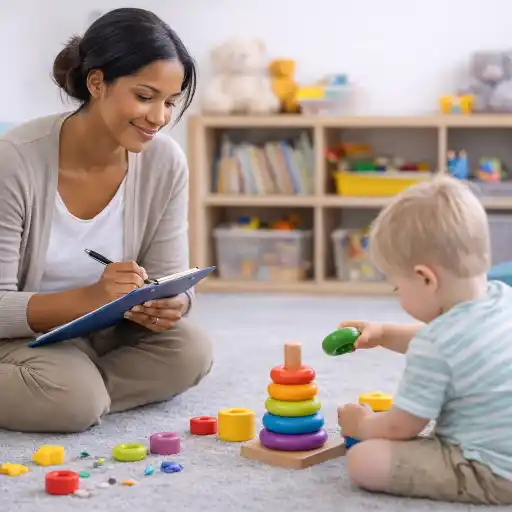
Effective documentation is grounded in evidence rather than interpretation. It captures the child’s strengths, the context of an observation, the frequency or duration of a behavior, and the strategies adults tried. This approach aligns with intentional teaching: the NAEYC discussion of observing, planning, and guiding describes teachers as thoughtful observers who use information to plan responsive learning experiences.
What belongs in an objective developmental observation?
An objective observation answers practical questions: What happened? When and where did it happen? Who was present? What was the child doing or saying? What happened immediately before and afterward? A useful entry separates direct evidence from professional reflection.
Include the following elements:
- Date, time, and setting: Record whether the observation occurred during arrival, free play, meals, outdoor activity, or a transition.
- Specific behavior: Describe actions, words, gestures, movements, or completed steps.
- Context and antecedent: Note the materials, instructions, peer interactions, noise level, and activity expectations.
- Duration and frequency: When relevant, record how long the behavior lasted or how often it occurred.
- Adult response: Document prompts, modeling, visual supports, environmental changes, and the child’s response.
- Strengths and successful conditions: Identify settings, people, materials, or routines in which the child participated effectively.
For example, replace “Maya is inattentive” with: “At 10:15 during a six-minute story, Maya looked toward the book for approximately two minutes, then moved behind the shelf. After the teacher offered a seat cushion and showed the illustrations individually, Maya returned and pointed to two pictures.” The revised record is more useful because it identifies both a concern and a potential support.
The definition of observation emphasizes recognizing and recording a fact or occurrence. That is a helpful reminder: documentation should make it possible for another professional to understand what you saw without having to accept your interpretation.
How can providers distinguish observation, screening, assessment, and diagnosis?
These terms are related but not interchangeable. An observation is a record of what a child does in a particular context. Developmental surveillance is an ongoing process of gathering information through relationships, conversations, and repeated observations. Screening uses a standardized tool to identify children who may benefit from further assessment; it does not establish a diagnosis. Assessment is a more comprehensive process that examines skills, functioning, and needs using multiple sources of information. Diagnosis is a clinical determination made by an appropriately qualified professional.
Providers should understand their role in the continuum:
- Observe: Record concrete examples across routines and developmental domains.
- Screen, when authorized and trained: Follow program policy and tool instructions precisely.
- Collaborate: Share records with families and designated professionals only with appropriate consent.
- Refer or recommend consultation: Encourage families to speak with a health care provider or early intervention agency when concerns persist.
- Follow up: Continue supporting the child and documenting changes without assuming a clinical role.
The ChildCareEd course Developmental Screening in Early Childhood Buy Now $16.00 specifically addresses the difference between screening and assessment, collaboration with specialists, and accurate documentation. State requirements vary - check your state licensing agency before administering a screening tool, sharing records, or initiating a referral.
A screening result should be described carefully. “The screening indicates that follow-up may be appropriate” is more accurate than “The screening confirms a delay.” Avoid converting a score into a label, particularly when language, culture, hearing, attendance, or situational factors may influence performance.
How should documentation describe concerns without labels?
Professional language is specific, neutral, and strengths-based. It avoids adjectives that imply character or certainty, such as “lazy,” “defiant,” “immature,” or “abnormal.” It also avoids diagnostic terms unless they appear in documentation provided by a qualified professional and are relevant to an authorized support plan.
Use a structure such as:
- Strength: “Jonah independently completes four-piece puzzles and seeks adult help when a piece does not fit.”
- Observed concern: “During three fine-motor activities, he used his left hand to stabilize the paper but needed hand-over-hand support to open child-safe scissors.”
- Context: “The activities occurred after snack at a small table with two peers.”
- Support attempted: “The teacher offered thicker paper, demonstrated opening and closing the scissors, and reduced the task to two cuts.”
- Response and next step: “Jonah made two independent cuts. Continue short practice opportunities and monitor progress across routines.”
When discussing social-emotional behavior, describe observable interaction rather than assigning motives. Instead of “Ava does not care about others,” write, “When a peer began crying, Ava continued building and did not look toward the peer. After the teacher modeled offering a tissue, Ava handed it to the peer.”
Use cautious phrases such as “may benefit from,” “has not yet consistently demonstrated,” “additional information may be helpful,” and “the family may wish to consult.” These phrases preserve professional humility while still communicating that action may be needed.
It is also essential to document the child’s capabilities. A concern-only file can create a distorted picture and may cause future readers to overlook competence, interests, and progress.
How can providers communicate concerns with families respectfully?
Family communication should be collaborative rather than confrontational. Begin with the child’s strengths and describe the shared purpose: understanding how to support participation, communication, learning, or comfort. Choose a private setting, allow sufficient time, and use the family’s preferred language or interpretation support when needed.
A practical conversation may follow this sequence:
- Connect: “We appreciate how much Eli enjoys music and movement.”
- Share evidence: “We have noticed that he often watches during group conversations but rarely responds verbally, even when given extra time.”
- Invite the family’s perspective: “What do you notice at home or in other settings?”
- Explain support: “We are trying picture choices, shorter questions, and small-group opportunities.”
- Discuss options: “Would you be comfortable speaking with Eli’s health care provider or learning about local screening resources?”
- Plan follow-up: Agree on what will be tried, who will contact whom, and when the team will review progress.
Do not promise that a referral will produce a particular outcome. Do not pressure families to consent immediately, and do not present outside services as punishment or proof that something is “wrong.” Families possess essential knowledge about their children, and their observations may reveal skills that are not visible in the classroom.
The Parent to Parent USA resource reflects the value of ensuring that families do not feel alone when navigating disability-related concerns. Providers can contribute by listening carefully, protecting dignity, and offering clear information without making clinical judgments.
What common documentation mistakes should providers avoid?
Even experienced educators can write records that are unintentionally vague, biased, or overly conclusive. Reviewing documentation before filing it can prevent harm and improve usefulness.
- 🚩 Writing labels instead of evidence: Replace “aggressive” with the observable action, such as “pushed a peer’s shoulder after the peer took the truck.”
- Recording only problems: Include strengths, interests, successful supports, and progress.
- Relying on one incident: Gather information across days, routines, adults, and settings.
- Ignoring context: Consider sleep, hunger, transitions, language demands, sensory conditions, group size, and cultural expectations.
- Copying assumptions into permanent records: Clearly identify family reports, staff interpretations, and direct observations as different sources.
- Sharing too broadly: Follow confidentiality policies, secure records, and disclose information only to authorized individuals.
- Using developmental checklists as diagnostic tools: Milestones guide observation and discussion; they do not independently determine a condition.
Directors can strengthen practice by creating a common observation template, training staff to distinguish facts from interpretations, and reviewing sample entries during supervision. The Tracking Progress, Shaping Futures: Observation & Assessment Skills Buy Now $55.00 course offers additional instruction in objective documentation, multiple measures, screening tools, and translating information into meaningful goals.
Documentation should also be timely. Complete entries soon after the event, identify the observer, preserve original wording when quoting a child, and correct errors according to program policy rather than deleting records without an audit trail.
Conclusion: How can providers document developmental concerns responsibly?
Child care providers can document developmental concerns without diagnosing by recording observable behavior, describing context, noting strengths and supports, monitoring patterns over time, and communicating with families as partners. The central question is not “What condition does this child have?” but “What have we observed, what might help, and what additional information should qualified professionals consider?”
A responsible record is:
- Specific enough that another person can understand what occurred.
- Neutral enough to avoid labels, blame, or premature conclusions.
- Strengths-based enough to represent the whole child.
- Confidential enough to protect the child and family.
- Action-oriented enough to guide classroom support and appropriate follow-up.
When providers use this approach, documentation becomes more than paperwork. It becomes a bridge between attentive care, intentional planning, family knowledge, screening, and professional evaluation. Your careful observations may be an important first step toward support, while your restraint ensures that the child is seen accurately and treated with dignity.
- CDA Family Child Care Credential with Portfolio Review
- CDA Bridge Bundle: Preschool
- CDA Bridge Bundle: Family Child Care
- CDA Bridge Bundle: Family Child Care without Portfolio Review
- CDA Bridge Bundle: Infant/Toddler without Portfolio Review
- CDA Bridge Bundle: Infant/Toddler
- Privacy Matters: Documentation and Observation in Early Learning
- Early Childhood Education
- Texas Director Credential
- Bridging Cultures: Family Communication & Collaboration
- Proporciones de Cuidado Infantil y Tamaños de Grupo por Edad en Maryland (Guía Rápida para Centros y Hogares)
- Proporciones de Cuidado Infantil y Tamaños de Grupo por Edad en Virginia (Guía Rápida para Centros y Hogares)
- Apoyo en Preescolar para Retrasos del Habla: Estrategias Simples que Ayudan
- Retraso del Habla en la Guardería: Cómo Pueden Ayudar los Proveedores
- How Can Child Care Providers Understand Typical and Atypical Child Development?
- Is This Development Typical? When Child Care Providers Should Watch, Document, or Refer
- How Can Child Care Providers Recognize and Support Developmental Delays?
- How Can Child Care Providers Use Developmental Screening to Support Every Child?
- How Can Child Care Providers Understand and Support Infant Milestones?
- How Can Child Care Providers Support Infant Development?
- How Can Child Care Providers Share Developmental Concerns with Sensitivity?
- How Can Child Care Providers Handle Difficult Conversations with Families Professionally?
- What Signs Suggest a Preschooler May Need Extra Developmental Support?
- How Can Child Care Providers Recognize and Report Suspected Child Abuse and Neglect?
- When Should a Child Care Provider Be Concerned About Development?
- How Can Child Care Providers Document Developmental Concerns Without Diagnosing?
- What Should a Teacher Do If They Suspect Autism?
- Developmental Delay vs. Developmental Difference: What’s the Difference?
- When Is a Child’s Behavior a Developmental Concern?
- How Can Child Care Providers Discuss Uneven Child Development with Parents?
