Children may pass the same tree or garden every day without noticing its quiet transformations—but a repeated photograph can make those changes visible and invite rich scientific thinking. Try a simple same-spot routine, and consider Observing & Assessing in Child Care  Buy Now $16.00 to strengthen your skills in documenting children’s growth and turning observations into responsive learning experiences. The course offers a practical next step for providers who want to make everyday noticing more intentional.
Why does returning to one outdoor spot matter?
Young children are immersed in immediate experiences: a puddle is exciting now, a fallen leaf is worth examining today, and a familiar tree may seem unchanged tomorrow. Returning to the same outdoor location helps them compare what they see across days, weeks, and seasons. A photograph preserves a moment that memory alone may not hold, making subtle shifts—new buds, a bare branch, a changed patch of shade—available for close looking and conversation.
This routine introduces phenology: the observation of recurring seasonal and natural events. The National Park Service’s kindergarten phenology routine describes how documenting seasonal changes helps children pay close attention to their surroundings. The USA National Phenology Network likewise encourages children to observe and record plant growth and development.
There is no need to frame the activity as a formal science lesson. A few minutes outdoors can support #curiosity, attention, language, memory, and a growing sense of connection to place. Repeated visits also communicate that children’s ideas are worth revisiting: their earlier predictions and questions remain part of an ongoing investigation.
- Children compare “before” and “now” using visible evidence.
- They practice noticing patterns without assuming every change follows a fixed schedule.
- Educators gain concrete material for planning follow-up experiences.
How do we choose and photograph a useful spot?
Choose a location that is safe, accessible, and easy to revisit: a tree beside the playground, a garden bed, a small section of a fence with climbing plants, or even a view from a classroom window. The spot does not need to be spectacular. Consistency matters more than size; a modest patch of ground can reveal abundant change when children know where to look.
Make photographs comparable by returning to roughly the same position and angle. A simple landmark—such as a path edge, post, or painted mark—can help staff find the viewpoint again. Keep the camera framing broad enough to show context, while taking occasional close-ups of details children want to investigate. Avoid moving branches or rearranging the scene for a better picture; the purpose is to document what is there.
Before taking or sharing images, follow program policies and obtain required family consent. If children appear in photographs, protect their privacy and use approved devices and storage. Often, the most useful image focuses on the natural feature rather than children’s faces. Early Childhood Australia’s guidance on purposeful photography emphasizes documenting learning and stories rather than producing a high volume of pictures.
- Pick one recurring time, such as a weekly outdoor transition.
- Use a photo log with date, location, and brief weather notes.
- Let children suggest what to include in the frame and what detail to revisit.
- 📷 Take one clear image consistently; more photographs are not automatically better documentation.
What should educators invite children to notice?
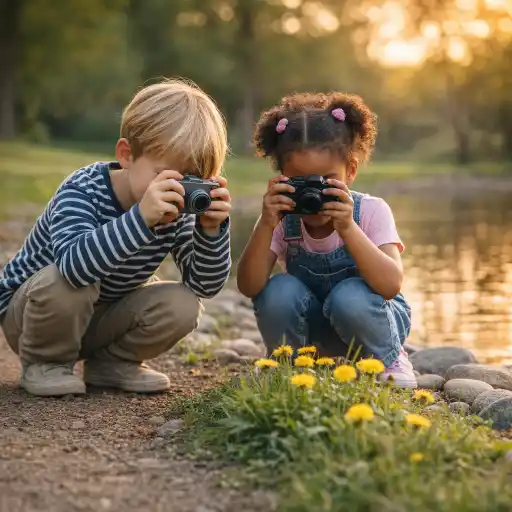
Begin with open prompts that do not imply a “right” answer: “What do you notice?” “What looks different from last time?” and “What stayed the same?” Pause long enough for children to look. Their responses may come through pointing, movement, drawing, a home-language word, or a detailed explanation. Record their words as accurately as possible; a child’s interpretation can be as valuable as the photograph itself.
Ask children to compare specific features: color, shape, amount, position, texture, or signs of living things. For example, they may notice that a branch now has tiny green tips, the ground is darker after rain, or a familiar flower is no longer visible. Follow their interests rather than rushing to name every plant or explain every cause. If no one knows why something changed, “Let’s keep watching” is a scientifically honest response.
Help children distinguish observation from inference. “There are three yellow leaves” describes visible evidence; “the tree is getting ready for winter” offers an explanation that could be explored. Both kinds of thinking matter, but separating them supports careful reasoning and #language development.
- Use a simple “I notice / I wonder” routine.
- Invite children to draw, dictate, point to details, or choose comparison photographs.
- Offer descriptive words such as bud, dry, damp, curled, brighter, or fewer.
- Connect questions to other learning: count leaves, compare heights, or make a picture timeline.
How can a same-spot book make change visible?
A Same Spot Nature Documentation Book can bring photographs, children’s words, and drawings together in a format they can revisit. Add pages in chronological order, with a date and a short caption that describes what the group observed. Keep the layout uncluttered: one photograph, one or two child quotes, and a small space for a drawing or mark-making can be enough.
Invite children to help assemble the book. They can choose a photograph, dictate a caption, draw what they remember, or place two images side by side to compare. Re-reading the book makes earlier observations available for discussion and helps children see change as a process, not a single event. Penn State Better Kid Care notes that photographs can help children revisit experiences, recall details, and communicate about learning.
Use the book as living documentation rather than a polished display that is finished once and put away. Keep it within children’s reach when practical, revisit it during small-group conversations, and share selected pages with families according to consent and privacy policies. A book that captures children’s voices can also help families contribute observations from home or notice similar seasonal changes in their neighborhood.
- Include dates so the sequence is clear.
- Label what is visible, not what an educator assumes caused it.
- Preserve children’s language and drawings rather than correcting them into adult versions.
- Use a shared book or individual pages, depending on children’s participation and program needs.
How can documentation guide teaching while staying safe and inclusive?
Use the record to plan the next invitation. If children notice buds, offer magnifiers, drawing materials, or a plant book. If they wonder where insects go after rain, return to the spot and observe without disturbing habitat. The USA National Phenology Network’s classroom phenology resources describe how sustained observation can lead to questions, data collection, and recognition of patterns. For early learning, keep the inquiry flexible and developmentally appropriate.
Make participation accessible. Provide seated viewing, accessible routes, large images, tactile alternatives, visual prompts, and different ways to communicate. Some children may prefer to observe from a distance or use a camera rather than touch natural materials. Children of different ages can participate in the same routine: one may look and point, while another compares dates or dictates an observation.
Maintain active supervision and check the site for hazards before each visit. Avoid handling unknown plants, fungi, or animals; consider allergies, weather, handwashing, and small-object risks. Follow program policies for outdoor supervision and image privacy. State requirements vary - check your state licensing agency.
For providers who want to deepen their practice, Assessing through Observation Buy Now $35.00 focuses on observation strategies and assessment methods. Additional relevant learning includes Tracking Progress, Shaping Futures: Observation & Assessment Skills Buy Now $55.00, Creating the Natural Outdoor Classroom Buy Now $16.00, and Building Early Science Foundations Buy Now $16.00.
Conclusion: How can one repeated photograph support deeper noticing?
Photographing the same outdoor spot over time gives children a practical way to see what everyday routines can hide: gradual growth, seasonal patterns, weather effects, and the persistence of familiar features. Choose an accessible location, return regularly from a consistent viewpoint, invite children to describe and question what they see, and gather the images and children’s words in a Same Spot Nature Documentation Book.
The goal is not perfect photographs or a predetermined answer. It is a thoughtful cycle of noticing, recording, revisiting, and planning. When educators make space for multiple forms of participation and use documentation respectfully, children can build observation skills, scientific thinking, language, and a meaningful relationship with their local environment—one visit at a time.
- 45 Hour Child Growth and Development
- Lesson Planning for Preschoolers
- Teacher-Child Interactions for Stronger CLASS® Outcomes
- SIDS: Saving Babies: A Change of Position, A Change in Tradition
- 45 Hour Preschool Methods and Materials
- Emergent Learning & Development
- Self-Regulation & Change: Helping Children Cope
- Creating Environments that Nurture Growth and Community
- Texas Director Credential
- CDA Certification en Español: Recursos y Consejos para Educadores Bilingües
- 💛🧩 ¿Cómo puedo hacer que mi enseñanza sea inclusiva para los niños con autismo?
- ❄️ ¿Qué actividades al aire libre funcionan bien para los niños de Illinois en cada estación? 🌷🍂
- ¿Cuáles son las mejores actividades del Día de la Tierra para niños en casa o en el aula?
- ¿Cómo empiezo mi certificación CDA en Florida en línea?
- 10 Ejemplos de Cómo la Cultura Influye en el Desarrollo Infantil
- ¿Qué Preguntas Vienen en el Examen CDA de Nacimiento a los Cinco Años?
- Proporciones de Cuidado Infantil y Tamaños de Grupo por Edad en Nueva Jersey (Guía Rápida para Centros y Hogares)
- Proporciones de Cuidado Infantil y Tamaños de Grupo por Edad en Virginia (Guía Rápida para Centros y Hogares)
- Consejos de Supervisión Activa para Salones de Preescolar y el Juego al Aire Libre
- Cómo Trabajar en el Cuidado Infantil en Carolina del Norte: Requisitos y Pasos
- Celebrando la amistad en el cuidado infantil durante el Día de los Mejores Amigos
- Canciones, juegos y preguntas de círculo para niños
- Go on a Fall Hunt! Outdoor Learning Challenges for Preschoolers
- How Does Building from Another Photograph Angle Change Children’s Thinking?
- How Can One Plant Help Children Notice Gradual Change Outdoors?
- Why Does the Wind Feel Different on Opposite Sides of the Playground?
- How Can Photographing the Same Outdoor Spot Help Children Notice Change?
- Where Does My Voice Come Back? How Can Children Explore Outdoor Echoes?
- Nature Treasure or Litter? How Can We Teach Children to Ask Before Collecting?
