Wearable crafts turn children’s excitement about celebration into meaningful practice with cutting, coloring, decorating, and fastening. The Art from the Heart for Preschoolers course Buy Now $35.00 helps providers use open-ended art to strengthen choice-making, confidence, and classroom practice; Power of Art: Building Self-Esteem and Positive Behavior for All Abilities  Buy Now $24.00 offers another relevant professional-learning option. Together with the affordable 4th of July Badge Buy Now $0.25, these resources can help you create a joyful, purposeful celebration.
Why do wearable crafts matter in early childhood classrooms?
A wearable badge is more than a festive decoration. When children color, cut, attach, and proudly wear a creation, they are coordinating vision and hand movement, strengthening small muscles, and practicing persistence. The finished item also gives children a visible way to participate in a shared classroom experience.
Wearable projects are especially effective because they connect development with meaning. Children are often more willing to repeat a challenging action when the result becomes something they can display or use. Research on arts engagement has associated drawing, painting, and making with children’s self-esteem, while classroom guidance on fine-motor activities emphasizes the value of practical, playful repetition.
Celebration also creates an opportunity for belonging. A classroom display or badge ceremony can recognize every child’s contribution without requiring identical results. Providers can invite children to explain their designs, compare colors, and celebrate one another’s choices.
Which fine-motor skills does a badge activity develop?
A simple badge can involve several developmental actions. Coloring encourages controlled wrist and finger movements. Decorating with stickers or small paper pieces supports pincer grasp. Cutting around a shape promotes bilateral coordination as one hand stabilizes the paper while the other operates scissors. Wearing the badge can add fastening practice when children use tape, adhesive dots, or a child-safe clip with adult support.
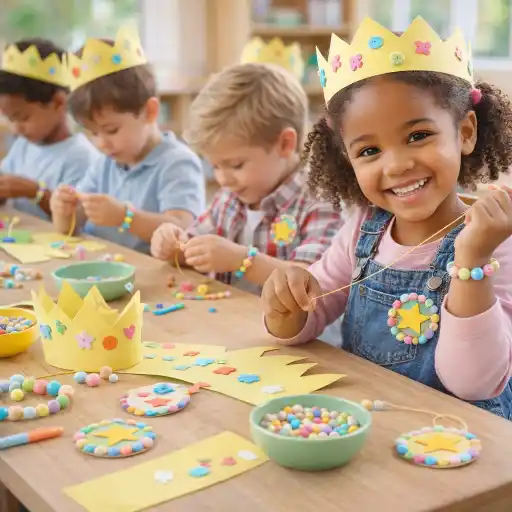
- 🖍️ Coloring supports grasp, pressure control, and visual attention.
- ✂️ Cutting strengthens hand coordination and visual-motor planning.
- ⭐ Placing stickers or paper pieces encourages precision and finger isolation.
- 📌 Attaching the badge introduces sequencing and functional problem-solving.
- 🎉 Wearing and discussing the badge supports language and social participation.
Children develop at different rates, so the goal is active participation rather than a perfectly cut outline. Offer thicker paper, larger crayons, spring-assisted scissors, or partially prepared shapes when appropriate. Supervise closely, especially with small pieces; state requirements vary - check your state licensing agency.
How can providers use the 4th of July Badge as an intentional learning experience?
The 4th of July Badge Buy Now $0.25 is designed for children to color, decorate, cut out, and wear. Providers can preserve that structure while adding developmentally appropriate choices. Begin with a brief conversation about celebration symbols, colors, and classroom community. Avoid turning the project into a test of historical knowledge; young children benefit from concrete, age-appropriate language and opportunities to share ideas.
Set up the activity in a clear sequence:
- Invite children to select crayons, markers, stickers, or collage materials.
- Demonstrate safe scissor handling without taking over the child’s work.
- Encourage children to decide where and how to decorate.
- Help children attach the completed badge safely.
- Invite each child to share one detail about the design.
Use descriptive language such as, “You made short cuts around the edge,” or “You chose three different shapes.” This communicates genuine observation and avoids comparing children’s products. For a broader celebration plan, ChildCareEd’s Fourth of July craft guidance recommends limiting the number of stations, using safe materials, and connecting crafts to short learning goals.
How can wearable crafts remain inclusive and child-led?
Celebrations should be joyful without pressuring children to participate in one specific way. Some children may enjoy decorating; others may prefer observing, choosing materials, or joining a movement activity. Offer multiple entry points and honor family perspectives. A badge can represent classroom participation, friendship, summer, or a child’s own interpretation rather than requiring a single patriotic message.
Open-ended choices make a structured printable more responsive:
- Provide crayons, paint daubers, stickers, fabric scraps, or stamps.
- Offer pre-cut badges for children who need to focus on decorating.
- Use larger tools or adaptive scissors to support access.
- Invite children to dictate a sentence about their badge.
- Allow children to wear, display, or take home the finished work.
Family communication matters. Explain that the activity supports fine-motor coordination, decision-making, language, and belonging—not merely holiday decoration. Inclusive celebrations also avoid assumptions about how families observe national holidays. The goal is a welcoming classroom experience in which children can participate according to their comfort, identity, and ability.
How can directors and teachers extend the learning beyond the craft table?
A badge activity can become a short, integrated learning sequence. During circle time, children can count stars, sort materials by color, or compare badge sizes. At the writing table, they can dictate or copy a name. In dramatic play, badges can support a pretend parade, community-helper role-play, or classroom welcome team. A photo and brief observation can document how each child used tools, made choices, or communicated an idea.
Directors can support consistency by preparing a small craft kit and sharing a common observation prompt with staff. For example, teachers might record whether a child:
- used one or both hands purposefully;
- attempted cutting or accepted an adaptation;
- made an independent material choice;
- described a design or responded to a peer.
Common mistakes include overcorrecting children’s designs, doing the cutting for everyone, using too many materials, and treating a celebration as a competition. A short demonstration, limited choices, and flexible participation prevent many of these problems. For deeper guidance on process art, the Open Heart, Open Art course Buy Now $16.00 connects open-ended expression with social-emotional development, while Montessori Cultural Activities Buy Now $24.00 explores hands-on art and meaningful cultural learning.
What are the key takeaways for classroom practice?
Wearable crafts support fine-motor development when children actively manipulate materials, make choices, and use tools with appropriate support. They support classroom celebration when every child’s contribution is welcomed and the activity connects to belonging, language, and shared joy.
The 4th of July Badge offers a practical starting point: children can color, decorate, cut, and wear a badge while teachers observe coordination, persistence, communication, and confidence. Keep the experience brief, flexible, and safe; provide adaptations; and celebrate the process as much as the finished product.
For providers seeking a more complete professional-learning experience, the linked ChildCareEd courses can deepen understanding of open-ended art, self-esteem, inclusion, and purposeful classroom design. Start with one badge activity, document what children do, and use those observations to plan the next invitation.
Frequently asked questions
How long should the activity last?
Approximately 10–20 minutes, depending on age, interest, and whether children work in small groups.
Is the badge appropriate for toddlers?
It may be adapted with larger materials and pre-cut shapes. Avoid small parts and provide close supervision.
Should every badge look the same?
No. A shared template can support participation, while decorations and explanations should reflect children’s individual choices.
How can I document learning?
Record a short note about tool use, coordination, material choices, persistence, or the child’s description of the design.
How can I make the celebration respectful?
Use age-appropriate language, invite family perspectives, avoid stereotypes, and provide alternatives for children who do not wish to wear or decorate a badge.
Five relevant ChildCareEd courses
- Moving About the Classroom: Effective Transitions for Everyday
- Many Colors, One Canvas: MD ECE Conference
- Power of Art: Bldg Self-Esteem & Positive Behavior for ALL Abilities
- The ABCs of Behavior: Turning Challenges into Learning Opportunities
- Art from the Heart for Preschoolers: Open Ended Art Projects that Build Self-Esteem
- Texas Director Credential
- Building Bridges for Dual Language Learners
- Supporting School Age Development ONLINE
- Montessori Cultural Activities: Exploring the World Through Play and Learning
- Labor Day Activities
- Reminder for Mother's Day
- Memorial Day Activities
- How to boost fine motor skills: Holiday Edition
- DIY Snow Globes: The Fine Motor Craft That’ll Keep Kids (and Adults) Busy for Hours
- Increasing Fine Motor Skills in the Early Childhood Education Classroom
- CDA Certification en Español: Recursos y Consejos para Educadores Bilingües
- 🔍 ¿Qué ves cuando observas a un niño aprender?
- Actividades de Otoño Fáciles para Preescolares esta Temporada
- Cinco de Mayo Crafts and Activities for Preschool and Daycare
- How to Celebrate the Fourth of July in Your Center or Daycare
- Mexican-Themed Activities That Teach Culture and Creativity
- Ice Cream Day Crafts, Games, and Learning Activities
- Pool Noodle Sea Creatures: A Fun Ocean Craft for Preschoolers
- How can Michigan child care providers celebrate National Ice Cream Day safely and with learning?
- How can Florida child care providers celebrate National Ice Cream Day safely and with learning fun?
- Can Superhero Day Capes and Pretend Play Teach Children to Help Others?
- What are age-appropriate Fourth of July activities for daycares?
- Snip, Stick, Celebrate! What Easy Labor Day Crafts Can Toddlers Make?
- How Do Wearable Crafts Support Fine-Motor Skills and Classroom Celebration?
