Fall decorations can make a classroom feel welcoming, but anything placed within children’s reach also becomes part of their play environment. Use a child-height safety review to spot hazards, preserve supervision, and keep seasonal displays meaningful—and build broader daily health and safety practices with Everyday Safety: Creating Healthy Environments  Buy Now $55.00. This course offers practical strategies for routines, hygiene, and safer care; consider exploring it as a next step for strengthening your classroom practice.
Why does fall decoration safety deserve a deliberate review?
At child height, a decoration is not simply something to look at. Young children may reach, pull, mouth, carry, climb toward, or play with it. A display that seems harmless from an adult’s perspective can create choking, strangulation, tipping, tripping, allergy, or fire concerns when it is accessible to curious hands.
A thoughtful review does not mean removing every seasonal touch. Instead, it helps educators distinguish between decorations that support a warm, engaging environment and items that introduce avoidable risk. A few sturdy, well-placed materials can invite children to notice the season without crowding the room or distracting from play.
Safety is also a team practice. Head Start guidance emphasizes hazard-free environments, active supervision, and communication about concerns. A short walkthrough gives staff a shared way to identify issues, document corrections, and revisit displays as children’s abilities or classroom arrangements change. For more on preparing for the season, see ChildCareEd’s fall classroom preparation guidance.
How can you inspect decorations from a child’s point of view?
Begin by viewing the room from the heights and positions children use: crawling, sitting, standing, and reaching from a chair or low shelf. Look beyond the obvious wall display. Check low windowsills, doors, shelves, table edges, sensory areas, and places where a child might tug on a hanging item.
- Can a child pull the decoration down, climb toward it, or use it to reach something else?
- Are there small or detachable parts, sharp edges, loose fasteners, long strings, or loops?
- Could the item obstruct an exit, create a blind spot, or interfere with staff sightlines?
- Is it clean, intact, age-appropriate, and suitable for children with allergies or sensory sensitivities?
- Could it be near a heat source, electrical outlet, cord, or other ignition or burn risk?
Repeat the review for the youngest and most mobile children in the group. A decoration appropriate for preschoolers may not be suitable in a room shared with infants or toddlers. The ChildCareEd article on what belongs at a toddler’s eye level reinforces the value of balancing access with safety and supervision.
Which fall decoration hazards should you look for first?
Prioritize hazards that children can pull down, put in their mouths, wrap around themselves, or use as a climbing aid. Small faux leaves, beads, buttons, acorns, decorative berries, loose craft pieces, and breakable ornaments can become choking or injury risks. Natural items also need inspection: discard anything moldy, sharp, contaminated, or unidentified, and do not allow children to taste unknown plants or seeds.
Strings, ribbons, and cords deserve special attention. The Caring for Our Children Basics guidance identifies accessible cords long enough to circle a child’s neck as strangulation hazards. Avoid hanging long loops within reach; secure displays firmly and keep cords from lights or other equipment out of children’s access. Decorations should never be attached in a way that compromises fire equipment, emergency routes, or required wall and ceiling conditions.
Check stability and surfaces as well. A lightweight display can still topple if attached to a shelf children pull on. Keep floor-level decorations out of pathways, and remove items with peeling paint, exposed staples, sharp wire, or loose parts. Where fire safety is concerned, use materials and electrical items only as permitted by your program’s policies and local fire code; never use open flames in children’s areas.
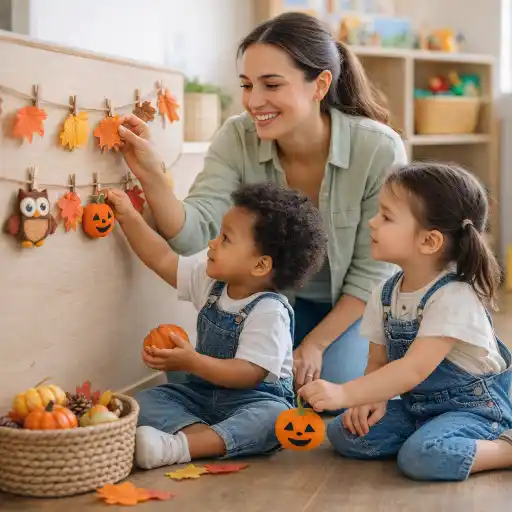
How can seasonal displays stay child-friendly and useful for learning?
Choose a small number of sturdy, washable, age-appropriate items that children can safely observe or use with supervision. Display children’s drawings, photographs of local autumn changes, or large fabric leaves secured to a wall. Keep decorations simple and leave clear pathways, uncluttered activity surfaces, and open sightlines. Child-height placement should make a display understandable and welcoming—not automatically make every object available for handling.
When materials are intended for exploration, present them as a planned learning experience rather than unattended décor. For example, educators can offer large, clean leaves in a supervised observation activity, along with magnifiers and drawing paper. Check for allergies and individual needs, establish clear boundaries, and clean or remove materials after use. Natural objects that are small, sharp, toxic, or difficult to sanitize should not be used as accessible classroom decorations.
- 🍂 Invite children to compare photographs of changing trees or describe colors they notice outdoors.
- Display a few examples of children’s seasonal artwork at their height, fastening each piece securely.
- Use picture labels or simple questions to encourage noticing without requiring children to touch materials.
- Rotate or remove displays when they become damaged, distracting, or no longer relevant.
For ideas on keeping seasonal changes intentional rather than overwhelming, read ChildCareEd’s guide to creating an autumn classroom without overdecorating.
How can your team use a practical decoration safety checklist?
A consistent checklist turns a seasonal setup into a repeatable safety routine. Before installing decorations, identify the age group, location, materials, attachment method, and supervision plan. After installation, walk the room at child height, test that items are secure, and check the overall classroom from the positions staff use during care.
- Placement: Keep exits, fire-safety equipment, windows, and walkways unobstructed. Preserve clear sightlines.
- Materials: Remove small parts, sharp edges, breakable items, unsafe cords, and materials that may trigger known sensitivities.
- Attachment: Secure wall and shelf displays so children cannot pull them down; recheck fasteners regularly.
- Condition: Inspect for damage, loose pieces, peeling surfaces, dirt, or moisture, and remove anything compromised.
- Supervision: Decide who monitors hands-on seasonal activities and how children will access and put away materials.
- Documentation: Note identified hazards, corrective steps, and the date of the next review.
Build quick checks into opening routines and repeat them whenever a display changes, furniture moves, or children’s mobility develops. A checklist is a practical aid, not a substitute for active supervision or program policy. State requirements vary - check your state licensing agency, and consult applicable fire and building authorities when questions arise.
What common decoration mistakes can providers avoid?
One common mistake is choosing decorations for visual impact before considering how children will interact with them. Another is assuming that a high shelf is safe because it is initially out of reach; children may move furniture or climb. Teams may also overlook hanging cords, blocked sightlines, floor clutter, or a display that has loosened after repeated handling.
Use a simple decision process: remove, relocate, secure, or supervise. If an item is fragile, small, sharp, or difficult to clean, choose a safer alternative rather than relying on reminders. If an activity requires close monitoring, set it up for a defined time with a staff member responsible for supervision, rather than leaving the materials available all day.
Keep the review collaborative and strengths-based. Ask staff what children are drawn to, what they have noticed, and whether the setup supports participation. Then document any changes and share relevant expectations with substitutes. For broader facility and material safety, the Caring for Our Children building and physical premises topics and Head Start’s safety practices resources offer additional context.
Conclusion: How can you make fall decorations safer at child height?
Make seasonal displays welcoming by checking them from children’s perspectives, removing choking and strangulation hazards, securing materials, and preserving open paths and sightlines. Use only suitable, well-maintained decorations, and plan supervision whenever children handle seasonal objects. Revisit the setup as the room or children’s abilities change.
The goal is not a perfect display; it is a classroom where seasonal interest and safety work together. A brief walkthrough, a shared checklist, and prompt corrections can help your team turn autumn details into thoughtful invitations to notice and learn—without adding avoidable risks. For additional practical learning on daily health and safety routines, explore Everyday Safety: Creating Healthy Environments Buy Now $55.00.
Frequently asked questions
Should all fall decorations be placed out of children’s reach?
Not necessarily. Some displays can be placed where children can see them, while materials meant for handling should be selected for age appropriateness and used with a clear supervision plan.
Are natural leaves and pinecones safe classroom decorations?
They require careful review. Use only clean, intact, appropriately sized materials that meet program policies, and supervise children during exploration. Avoid unknown plants, berries, moldy items, and objects that present choking or sharp-edge risks.
Can we hang decorations from the ceiling or near exits?
Do not allow decorations to obstruct exits, fire-safety equipment, or required sightlines. Follow local fire and licensing requirements and confirm any uncertain installation with the appropriate authority.
How often should staff recheck seasonal displays?
Check during routine opening or safety walkthroughs and after any change, damage, or classroom rearrangement. Remove or repair compromised decorations promptly.
What should we do if staff disagree about an item’s safety?
Pause its use, review the material and placement at child height, consult program policies and applicable licensing guidance, and select a safer alternative if uncertainty remains.
- Creating Safe & Healthy Child Care Environments
- 1,2,3, Eyes on Me: Classroom Safety
- Classroom Setup for Child Care
- Basic Health & Safety and Breastfeeding Awareness
- What Makes Me Special: An Overview of Autism and ADHD
- Building Equity: Inclusionary Practices in Preschool
- Texas Director Credential
- Preventative Health and Safety
- Family Child Care: Building, Premises, and Outdoor Safety
- Developing Skills Through Fall Crafts in Childcare
- CDA Certification en Español: Recursos y Consejos para Educadores Bilingües
- 💛🧩 ¿Cómo puedo hacer que mi enseñanza sea inclusiva para los niños con autismo?
- 10 Ejemplos de Cómo la Cultura Influye en el Desarrollo Infantil
- Capacitación en Salud y Seguridad Preventiva en Línea para Proveedores de Cuidado Infantil
- Proporciones de Cuidado Infantil y Tamaños de Grupo por Edad en Maryland (Guía Rápida para Centros y Hogares)
- Proporciones de Cuidado Infantil y Tamaños de Grupo por Edad en Nueva Jersey (Guía Rápida para Centros y Hogares)
- Proporciones de Cuidado Infantil y Tamaños de Grupo por Edad en Virginia (Guía Rápida para Centros y Hogares)
- Actividades de Otoño Fáciles para Preescolares esta Temporada
- Retraso del Habla en la Guardería: Cómo Pueden Ayudar los Proveedores
- Cómo Trabajar en el Cuidado Infantil en Carolina del Norte: Requisitos y Pasos
- Cómo Trabajar en el Cuidado Infantil en California: Requisitos y Pasos
- Celebrando la amistad en el cuidado infantil durante el Día de los Mejores Amigos
- Canciones, juegos y preguntas de círculo para niños
- What Can Preschoolers Build to Catch the Breeze?
- How Can Preschoolers Manage Fall Layers More Independently?
- How Can One Cardboard Box Become Four Fall Dramatic-Play Settings?
- When Fall Decorations Overwhelm the Classroom, How Can You Create a Calmer Seasonal Environment?
- How Can You Safely Decorate a Child Care Classroom for Fall at Children’s Height?
- How Can a Name Card at Every Place Make a Preschool Fall Gathering More Meaningful?
