When a coloring page becomes a conversation about quantity, representation, and choice, art can support meaningful mathematics instead of becoming busywork. The Math Foundations in Early Childhood  Buy Now $16.00 course can help providers strengthen these connections through hands-on, play-based strategies while earning professional development hours; explore it when you are ready to move from an isolated worksheet to intentional math teaching.
Why does combining counting and coloring matter?
Counting and coloring naturally invite children to coordinate visual attention, language, fine-motor movement, and mathematical thinking. However, the learning value depends on how the experience is framed. If children merely color predetermined pictures after writing numerals, the task may produce a neat page without deep understanding. When educators connect each image to a quantity, ask children to explain their thinking, and allow meaningful choices, the same activity becomes a compact learning experience.
Early mathematics is strongest when children work with real or represented quantities in meaningful situations. NAEYC explains that young children develop mathematical ideas through playful exploration involving number, quantity, size, pattern, measurement, and data (making math meaningful). Coloring can serve as the representational layer after children count, compare, sort, or discuss the objects.
- Counting supports one-to-one correspondence and cardinality.
- Coloring strengthens hand control, visual discrimination, and sustained attention.
- Conversation develops mathematical vocabulary and reasoning.
- Choice protects children’s agency and makes the work feel personally relevant.
The goal is not to make every art experience academic. Rather, it is to notice when a simple creative invitation can support more than one domain without sacrificing enjoyment or autonomy.
How can educators use Picnic Food Count and Color intentionally?
The Picnic Food Count and Color Buy Now $0.49 resource gives children a familiar context: foods arranged for a picnic. Children count each type of food, write or match the number, and color the pictures. Its greatest value comes from the interaction surrounding the page, not from completion alone.
Begin with a brief invitation. Show the page and say, “Let’s find out how many foods are here.” Model touching each picture once while counting aloud. Then ask the child to demonstrate. Before coloring, invite the child to identify a quantity, compare two groups, or predict which food appears most often.
- Preview the images and introduce only the vocabulary children need.
- Count one category together using touch-and-say correspondence.
- Ask the child to recount independently or with a partner.
- Connect the quantity to a numeral, dot card, fingers, or objects.
- Invite the child to color, choosing colors when the learning goal does not require a specific match.
- Return to the page for a short reflection: “How do you know there are five?”
Use the page as one part of a learning sequence rather than the entire lesson. For example, place plastic food, counters, or pretend picnic items nearby so children can build the same quantities before recording them. This approach keeps the #counting conceptual, active, and connected to play.
How can coloring remain art instead of becoming a compliance task?
Art becomes meaningful when children have room to make decisions, experiment, and communicate ideas. A count-and-color page has boundaries, but educators can still preserve agency by separating mathematical requirements from artistic choices. The number may need to represent the counted quantity; the color, pattern, background, or additional details can often remain open-ended.
Offer crayons, markers, colored pencils, collage pieces, or paint daubers when appropriate. Ask questions that invite interpretation rather than prescribe appearance:
- “What colors would make your picnic feel sunny?”
- “How could you show that this group has more?”
- “Would you like to add a picnic blanket or a basket?”
- “What pattern could you make around the edge?”
Process-focused art guidance emphasizes exploration and children’s decisions rather than identical products. A related discussion of meaningful art in the early childhood curriculum encourages providers to value experimentation, language, and revision over visual uniformity.
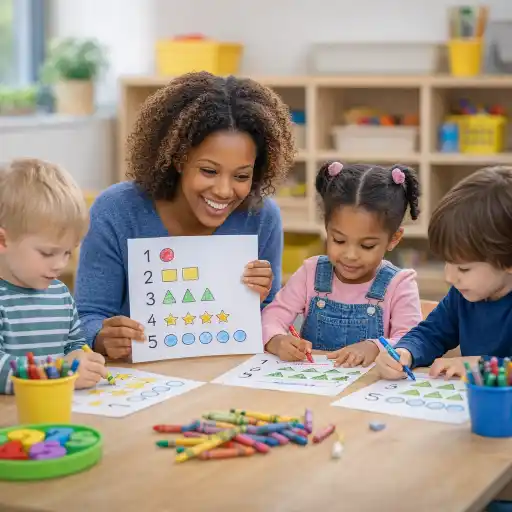
Avoid correcting a child’s color choice simply because it differs from an adult’s expectation. If color matching is the objective, state that clearly and offer a separate opportunity for free expression. This distinction helps children understand that some tasks involve representing information while others invite imaginative expression. Both belong in a high-quality classroom.
How can you differentiate the activity for varied learners?
A single worksheet should not determine the level of challenge for every child. Use the same picnic theme while adjusting the quantity, materials, language, motor demands, and expected response. Developmentally appropriate teaching begins with observation: identify what the child can do independently, then provide a manageable next step.
- For emerging counters, cover or focus on one to three food items and use large manipulatives first.
- For children developing fine-motor control, offer chunky crayons, adaptive grips, stickers, or a choice to point and dictate.
- For children ready for extension, compare groups using “more,” “fewer,” and “equal,” or ask them to combine two foods.
- For dual language learners, pair pictures, gestures, numerals, and number words in the child’s home language and English.
- For children who benefit from reduced visual input, present one section at a time or use a simplified copy.
Children do not need to demonstrate learning in only one way. A child may count accurately with objects but not yet write a numeral. Another may explain the quantity verbally while needing motor support to color. Document the mathematical understanding separately from handwriting or coloring performance.
🖍️ Consider setting up a three-part center: real or pretend picnic foods for counting, the printable for recording, and an open art area for designing a picnic scene. This arrangement makes the activity accessible to different interests and abilities while keeping the mathematical purpose visible.
How can teachers assess learning without overtesting?
Assessment can be brief, embedded, and useful. The purpose is to learn what children understand and decide what to offer next—not to judge the attractiveness of a completed page. Observe during the activity and record one specific behavior or statement.
- Does the child touch each object once while counting?
- Does the child understand that the final number names the total?
- Can the child match a numeral to a quantity?
- Can the child compare two groups?
- Can the child explain or demonstrate how the answer was found?
A concise note might read: “Mia counted six sandwiches with one-to-one correspondence and matched the 6 card; she needed a prompt to compare groups.” This note provides a meaningful next step: offer another comparison game, perhaps with pretend picnic plates.
Common mistakes include rushing directly to paper, requiring identical colors, praising neatness more than reasoning, and treating writing numerals as proof of number understanding. Instead, use a progression of concrete objects, oral counting, visual representation, and optional written recording. The simple counting guidance in ChildCareEd’s preschool counting activity resource similarly emphasizes manipulatives, cardinality, differentiation, and short formative observations.
State requirements vary - check your state licensing agency when selecting materials, documenting curriculum, or determining whether professional development hours apply to your role.
How can directors build this approach into classroom practice?
Directors can help staff avoid “worksheet math” by making intentional integration easy. Provide a small collection of ready-to-use materials, schedule brief planning conversations, and ask teachers to identify the mathematical idea behind an activity before placing it in a center.
A practical planning template includes:
- Math goal: Count sets to five and connect quantities to numerals.
- Art invitation: Color and add details to a picnic scene.
- Teacher language: “How many?” “How do you know?” “Which group has more?”
- Materials: Picnic Food Count and Color, counters, pretend food, crayons, numeral cards.
- Evidence: One observation note or photograph with the child’s explanation.
Staff can deepen their practice through the Early Mathematics Through Play Buy Now $24.00 course, which addresses number sense, counting, patterns, geometry, measurement, and mathematical reasoning in play-based contexts. The No Such Thing as Boring Math Buy Now $24.00 course offers another option for connecting developmental theory with engaging classroom experiences. Providers interested in strengthening the art component may explore Art from the Heart for Preschoolers Buy Now $35.00, which focuses on open-ended art and children’s self-esteem.
These courses do not replace local guidance, but they can support reflective planning and provide additional professional learning. When teams consistently connect materials, language, observation, and children’s choices, integrated curriculum becomes manageable rather than burdensome.
Conclusion: How can counting and coloring become meaningful learning?
Counting and coloring work well together when each has a clear purpose and children are treated as active thinkers and artists. Use Picnic Food Count and Color Buy Now $0.49 as a springboard: count real or pictured foods, connect quantities to numerals, invite comparisons, and then provide time for creative choices. Keep the mathematical conversation central without turning art into a test.
The most effective approach is simple: prepare accessible materials, model one-to-one counting, ask open questions, differentiate the response, and document what children understand. A printable can be useful, but it should be one moment within a larger cycle of play, representation, conversation, and reflection. With intentional guidance, children can strengthen #numberSense, fine-motor skills, vocabulary, and confidence—while still enjoying the pleasure of making something their own.
Frequently asked questions
Should every child use the same colors?
Only when color matching is the specific objective. Otherwise, allow artistic choice and focus assessment on counting and representation.
How long should the activity last?
A focused small-group experience may take five to fifteen minutes, followed by optional center exploration.
Is the worksheet appropriate for toddlers?
Use caution. Toddlers often benefit more from large, safe objects, sorting, movement, and oral counting; avoid small parts and adapt materials to supervision and safety requirements.
What if a child counts correctly but cannot write the numeral?
Honor the mathematical understanding and offer numeral cards, tracing in a sensory medium, dictation, or adult scribing as alternatives.
How can families extend the learning?
Invite families to count plates, fruit, cups, or picnic items at home and ask, “Which group has more?” Everyday routines provide authentic practice without requiring extra worksheets.
- 45 Hour Child Growth and Development
- Early Mathematics Through Play
- Many Colors, One Canvas: MD ECE Conference
- Open Heart, Open Art
- Power of Art: Bldg Self-Esteem & Positive Behavior for ALL Abilities
- Art from the Heart for Preschoolers: Open Ended Art Projects that Build Self-Esteem
- No Such Thing as Boring Math
- Texas Director Credential
- Montessori Cultural Activities: Exploring the World Through Play and Learning
- CDA Certification en Español: Recursos y Consejos para Educadores Bilingües
- 💛🧩 ¿Cómo puedo hacer que mi enseñanza sea inclusiva para los niños con autismo?
- Proporciones de Cuidado Infantil y Tamaños de Grupo por Edad en Virginia (Guía Rápida para Centros y Hogares)
- ¿Cuál es la Diferencia Entre la Crianza Respetuosa y la Crianza Permisiva?
- Ejemplos de Crianza Respetuosa vs. Crianza Permisiva
- Celebrando la amistad en el cuidado infantil durante el Día de los Mejores Amigos
- Cómo simplificar la capacitación para sus empleados de daycare
- Crayola Grants, Teacher Supplies, and Free Classroom Resources
- How Can Technology Make Staff Training Faster, Fairer, and More Effective?
- STEM for Preschoolers: Fun Activities That Encourage Curiosity
- Labor Day Crafts for School-Age Kids That Go Beyond Coloring Pages
- After School Activities for Elementary Kids Who Finish Homework Early
- What Should Child Care Providers Look For in Fine Motor Skills by Age?
- How Can You Make Addition Practice More Engaging Without Losing the Learning Goal?
- How Can Child Care Providers Integrate Counting into Seasonal Art Activities?
- How Can Coloring Pages Spark Meaningful Historical Conversations About Juneteenth?
- How Can Addition Review Feel Purposeful and Engaging for Young Children?
- How Can Child Care Providers Introduce Reptiles Through Art, Observation, and Conversation?
- How Can Dinosaur Coloring Become a Science and Language Experience?
- How Can You Follow a Preschool Interest Without Turning It into a Month of Busywork?
