Donations can stretch a child care budget, but sorting, cleaning, storing, and checking them takes staff time and space. Use the Daily Toy Inspection Checklist for Child Care Buy Now $1.49 to support condition checks, then weigh each item’s suitability, learning value, and preparation needs before accepting it. For guidance on selecting age-appropriate materials that support children’s development, explore Using Toys to Support Learning  Buy Now $16.00. To discover ways to turn suitable recyclables into learning experiences, consider Beautiful Junk: Using Recycled Materials in the Classroom Buy Now $16.00. Read on for a practical approach to deciding which donations deserve a place in your program.
Why does the decision matter beyond the price tag?
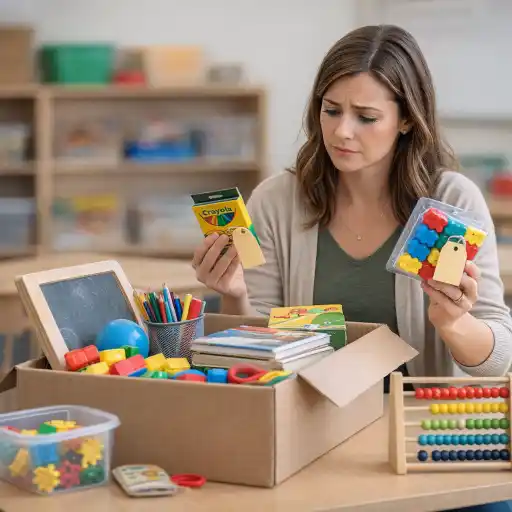
Donated materials can improve access to books, art supplies, construction items, and dramatic-play props, particularly when budgets are tight. Community partnerships may also provide more than goods: the Afterschool Alliance notes that in-kind contributions can include supplies, professional services, and other local resources, sometimes supporting grant matching requirements. Yet every item comes with an operational footprint. Staff may need to communicate with donors, transport boxes, inspect goods, clean them, document receipt, find storage, and decide how they fit the curriculum.
That workload matters because educator time is already finite. A donation that sits unused takes up space that could support accessible, purposeful play; an unsuitable item can also create disposal or safety concerns. Federal Head Start standards require covered programs to maintain materials that are clean, safe, age-appropriate, and appropriately maintained. Use the governing requirements for your program, and remember: state requirements vary—check your state licensing agency.
- Count staff time and storage capacity as real costs, even when no purchase is involved.
- Consider whether the donation serves children’s interests, abilities, and curriculum goals.
- Protect relationships by communicating clearly and appreciatively when an item is not a fit.
How can you estimate a donation’s real value?
Compare the practical value of the items with the full cost of accepting and using them. Start with condition and usefulness: Is each item intact, cleanable, durable, and suitable for the age group? Would you otherwise buy something similar? Can it be used by several children, across more than one activity, or in multiple learning areas? A box of sturdy blocks or a set of relevant children’s books may have lasting value; a large assortment of damaged, incomplete, or highly specific items may not.
Then estimate the staff effort. A brief, organized donation of requested supplies might take little time to inspect and distribute. An unsorted load of mixed toys may require much longer to triage, clean, inventory, and store. Include transport, packaging disposal, cleaning supplies, shelving, and eventual repair or disposal in your assessment. For nonprofit financial statements, consult your accountant about applicable recognition and valuation practices. The IRS explains that fair market value is generally the price a willing buyer and willing seller would agree on in an open market; donors and receiving organizations may have different documentation responsibilities, so avoid treating a donor’s estimate as automatic accounting value.
A simple decision test can help:
- Would we choose this item if we had to pay for it?
- Does it meet a specific learning, access, or operational need?
- Can we safely clean, supervise, store, and maintain it?
- Is the staff time proportionate to its likely use?
What safety and quality checks should happen before accepting materials?
Make inspection a condition of acceptance, not an afterthought. The Head Start safety practices standard says equipment and materials must be clean and safe, accessible only to children for whom they are age-appropriate, and maintained through preventative care. Caring for Our Children guidance also highlights hazards such as sharp edges, loose or broken parts, pinch points, choking risks, unstable furniture, strangulation hazards, and deteriorating paint. A donation’s low cost does not offset a preventable hazard.
Check the manufacturer, age guidance, recalls where applicable, and whether an item can be cleaned according to its material and intended use. Be especially cautious with infant and toddler items, electrical equipment, furniture, car seats, cribs, and outdoor play equipment. Do not assume an item meets current product standards simply because it was previously used in a home or classroom. Decline anything with unknown history when that history is essential to safe use, or when staff cannot reasonably inspect and maintain it.
Hygiene also requires the right method. The CDC distinguishes cleaning, sanitizing, and disinfecting; clean surfaces first, then use the appropriate product and follow label directions and contact times. Don’t accept porous or damaged objects if the program cannot clean them effectively. Keep chemical products and cleaning tools inaccessible to children and follow facility procedures.
- Inspect each item individually; do not rely on the appearance of the box or the donor’s description.
- Set aside questionable items until a designated staff member can make a decision.
- Record why an item was accepted, repaired, restricted, or declined when appropriate.
How can a clear donation policy save time and protect relationships?
A short, written policy helps staff respond consistently and lets families know that donations are welcome when they meet children’s needs. Instead of asking for “anything,” publish a focused wish list with examples, quantity limits, condition expectations, and items the program cannot accept. Specify where and when donations can be delivered, who inspects them, and whether the program can accept only items it has requested. A clear policy prevents boxes from arriving at the door during busy transitions and reduces the awkwardness of declining items after they have been dropped off.
Assign one coordinator to receive and review donations, with a backup for absences. Use a lightweight intake log that notes the date, source, item, quantity, condition, decision, and intended classroom or learning purpose. For higher-value goods or restricted gifts, record any conditions and clarify whether the program can meet them before accepting. Donations are voluntary support, not a substitute for purchasing essential supplies or ensuring safe classroom provision.
Thank donors warmly while being honest: “We appreciate you thinking of our children. We can currently use clean, complete picture books and washable art materials; we cannot accept used car seats or items with missing parts.” This protects trust while keeping decisions grounded in professional responsibility. If possible, redirect unsuitable items to a community organization that can use them.
- Share a prioritized wish list instead of inviting unscreened donations.
- Provide families with a simple explanation of condition and safety expectations.
- Offer other ways to participate, such as sharing a story, volunteering, or connecting the program to community resources.
How can you put accepted donations to purposeful use?
An accepted item should have a clear destination and a reason to be there. Consider whether it supports exploration, language, creative expression, collaboration, or children’s independence. Open-ended resources—such as sturdy boxes, fabric, large blocks, and appropriate art materials—may support more than one kind of play, but versatility is only an advantage when the item is safe and relevant. Recycled objects can be especially useful when they connect to a specific invitation or children’s current interests rather than accumulating in a “maybe someday” bin.
Before placing items on shelves, clean them according to program procedures, label and organize them, and consider accessibility for children with different abilities. Observe how children use them. Are materials inviting sustained play, conversation, and problem-solving? Are they being chosen, or are they simply occupying space? A brief observation can help teachers decide whether to keep, rotate, adapt, or remove an item. Use inventory reviews to avoid duplicate stock and identify items that are damaged or rarely used.
For example, a clean, sturdy carton might become a dramatic-play delivery counter, a building component, or an art surface—depending on the children’s ideas and safe setup. A book donation can add representation or vocabulary that is missing from the current collection. Thoughtful use turns a gift into an intentional part of the learning environment rather than an obligation to display everything received.
What common donation pitfalls should directors avoid?
The most common pitfall is accepting a donation out of politeness, then discovering that it is unsafe, unusable, or expensive to process. A gracious “no” is often more responsible than storing items indefinitely. Another mistake is assuming that “free” means zero cost. Staff time, transport, cleaning, repair, storage, and disposal all matter when weighing value.
Programs can also overlook the importance of clear ownership and documentation. Without an intake process, materials may be misplaced, duplicated, or distributed without age-specific review. Donated goods may come with restrictions or expectations; clarify these in advance, particularly for substantial or designated gifts. Finally, avoid making promises about tax deductions or assigning a value on behalf of donors. The IRS’s guidance on donated property explains valuation principles for donors; programs should direct tax questions to qualified professionals and maintain appropriate internal records.
- ❌ Accepting everything: use a current, focused wish list and consistent criteria.
- ❌ Skipping inspection: check condition, age fit, safety, and cleanability before classroom use.
- ❌ Letting items pile up: set a review date and a plan for redistribution or disposal.
- ❌ Confusing appreciation with obligation: thank donors while maintaining program standards.
Conclusion: Are donated classroom materials worth the time and cost?
They can be—when donations address a real need, meet safety and quality expectations, and require a reasonable amount of staff time to process. Directors can make better decisions by estimating the full effort involved, inspecting each item, using a written policy, documenting what is accepted, and linking materials to children’s learning. The central question is not whether a donation is free, but whether it contributes more value than it consumes in labor, space, and risk.
Start with a short wish list and an intake checklist, then review how accepted materials are actually used. When a donation is a fit, it can stretch resources and enrich the classroom; when it is not, a respectful decline is sound stewardship. To deepen your team’s skills in selecting appropriate resources, explore Using Toys to Support Learning Buy Now $16.00, or consider Beautiful Junk Buy Now $16.00 for ideas on using suitable recycled materials with purpose.
Further ChildCareEd courses: CDA: Curriculum Alignment & Materials Buy Now $16.00; Classroom Setup for Child Care Buy Now $24.00; Handling and Storage of Hazardous Materials Buy Now $10.00.
- 45 Hour Child Growth and Development
- Financial Assistance for Child Care
- Balancing Physically Active Play in Child Care
- Using Toys to Support Learning
- 45 Hour Infant and Toddler Methods and Materials
- 45 Hour School Age Methods and Materials
- 45-Hour Infant and Toddler Curriculum
- Texas Director Credential
- Balancing Active Play in Child Care
- CDA Certification en Español: Recursos y Consejos para Educadores Bilingües
- Cuáles Son las Señales de Alerta en el Desarrollo Infantil que Todo Educador Debe Conocer?
- ❄️ ¿Qué actividades al aire libre funcionan bien para los niños de Illinois en cada estación? 🌷🍂
- Recursos en Español sobre el Sueño Seguro del Bebé
- Cómo usar tu certificación de 90 horas en Maryland para completar tu CDA
- ¿Cuáles son las mejores actividades del Día de la Tierra para niños en casa o en el aula?
- ¿Qué es la Certificación de 90 Horas para Cuidado Infantil en Maryland?
- ¿Cómo empiezo mi certificación CDA en Florida en línea?
- ¿Cómo afecta la dopamina a los niños: señales, efectos e influencias diarias?
- Actividades de Fiesta para Niños de Preescolar y Primaria
- Proporciones de Cuidado Infantil y Tamaños de Grupo por Edad en Wisconsin (Guía Rápida para Centros y Hogares)
- Proporciones de Cuidado Infantil y Tamaños de Grupo por Edad en Nueva Jersey (Guía Rápida para Centros y Hogares)
- Retraso del Habla en la Guardería: Cómo Pueden Ayudar los Proveedores
- Cómo Ser Maestra de Preescolar en Maryland
- Las Mejores Ideas de Excursiones para Guarderías en Texas
- Canciones, juegos y preguntas de círculo para niños
- ¿Todos los niños deben participar en el tiempo de círculo?
- How Should You Budget for a Family Child Care Opening Before Buying Classroom Supplies?
- Are Donated Classroom Materials Worth the Time and Cost?
