A wet footprint appears, changes, and vanishes—and toddlers are often captivated by every part of that small mystery. With a little preparation, child care providers can turn those fleeting marks into a safe, joyful investigation of observation, movement, language, and change. For practical support in designing age-appropriate activities, explore Playing with a Purpose: Infant/Toddler Lesson Planning  Buy Now $24.00; it can help you build this experience into intentional planning for children from birth through age three.
To extend your science-planning toolkit, consider Building Early Science Foundations Buy Now $16.00, which focuses on supporting young children’s curiosity and inquiry through play.
Why are temporary water marks meaningful learning?
A child steps onto a damp surface, lifts a foot, and notices a darker shape left behind. The mark is visible for a moment, then gradually becomes lighter and disappears. For adults, this is a familiar result of drying; for toddlers, it is a compelling event to investigate again and again. Their repeated actions—stepping, looking, waiting, and returning—are beginnings of scientific inquiry.
Head Start explains that infants and toddlers naturally observe, test ideas, and communicate what they discover. In a footprint exploration, a child might notice that a mark appears after a wet step, compare it with a dry area, and look back to see what changed. The educator’s role is not to demand a formal explanation but to make space for the child’s questions and ideas.
This playful investigation also touches multiple areas of development. Children practice balance and movement, attend to visual differences, build vocabulary, and share space and materials with peers. The simple, repeated action gives toddlers room to participate at their own pace, including through gestures, facial expressions, or a few emerging words. Respecting that pace is part of thoughtful, responsive teaching.
How can providers set up the footprint investigation?
Keep the invitation simple and purposeful. Choose a warm, suitable outdoor area with a clean, level surface that can become damp without creating a slipping hazard. A washable patio or smooth paved area may work; avoid surfaces that are rough, contaminated, or difficult to supervise. Provide only a small amount of clean water in a shallow container and one or two large, easy-to-hold tools, such as a sponge or broad brush.
- Check the surface and weather before starting; remove tripping hazards and watch for slippery patches.
- Offer a damp sponge or brush for making marks. Children do not need to walk barefoot to investigate footprints.
- Invite children to make one mark or footprint, then pause together to observe it changing.
- Use a clear boundary and arrange the space so every child remains within the educator’s view and reach.
- Have towels and a dry alternative activity ready for children who prefer not to touch water.
Start by following the toddlers’ interest rather than directing them toward a particular result. You might say, “You made a dark mark. What do you notice?” or “Let’s look again after we wait.” The Howtosmile disappearing-water activity uses water painting and tracing to invite children to notice that wet marks dry and fade; providers can simplify the idea for toddlers with brief, closely supervised turns.
What can toddlers discover as the marks fade?
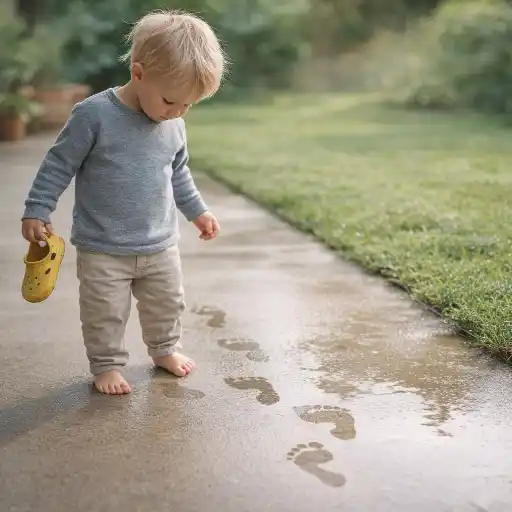
The central idea is change over time: water makes a surface look wet or dark, and as it dries, that appearance changes. For toddlers, keep the language concrete. Describe what they can see—“The mark is getting lighter”—rather than expecting them to understand or repeat a technical explanation of evaporation. If the interest continues, you can introduce the word “evaporate” as a label while emphasizing direct observation.
Offer a few open-ended prompts, then give children time to respond in their own way. “Where did the mark go?” may invite a word, a gesture, or another experiment. “What happens if we make another one?” supports prediction and repetition without turning play into a quiz. Head Start’s guidance on early science learning for infants and toddlers emphasizes that observation, investigation, and communication can happen together and recur as children explore.
Notice and narrate what children do: “You made a big mark,” “This one is still dark,” or “You came back to check.” Such comments connect actions with outcomes and introduce words such as wet, dry, dark, light, appear, and disappear. A child may simply repeat the mark-making or watch quietly; both are meaningful participation. Avoid correcting a toddler’s imaginative explanation too quickly. A curious “You think it went away—let’s look at the surface” honors the idea and invites another observation.
How can the activity support development and inclusion?
Temporary water marks can be a rich experience without elaborate equipment. Broad brushing and reaching invite whole-arm movement and coordination; smaller tools can offer a different grip challenge for children who are ready. Looking for marks, comparing large and small shapes, and noticing what has changed support early thinking. Naming actions and waiting for a child’s response makes space for language, while playing alongside peers creates natural moments for turn-taking and shared attention. Research and practice resources on the scientific inquiry of water play describe how water exploration can connect sensory, physical, language, and social-emotional learning.
Make participation flexible. Some toddlers will want to touch or step near the water; others may prefer to watch, point, or use a brush. Offer choices, demonstrate without pressure, and adapt the pace or tools as needed. Children with mobility, sensory, or communication differences can engage by observing a mark, directing an adult to make one, or using a tool from a comfortable position. A responsive educator treats each child’s way of joining as valid rather than measuring success by a finished picture.
Plan for practical classroom needs, too. Tell families in advance that outdoor clothing may get damp, keep spare clothes available when possible, and offer an indoor alternative if conditions are unsuitable. An intentional play-based toddler lesson plan can help staff identify a goal, prepare materials, and reflect on what children actually explored.
How do providers keep water exploration safe and purposeful?
Even a small amount of water calls for attentive supervision. Stay close enough to respond immediately, keep the water volume minimal, and prevent access to buckets or standing water when the activity is over. The Child Care Technical Assistance Network’s guidance on supervision near water recommends active supervision and, for water play, touch supervision—an adult within arm’s length. Follow the applicable requirements and your program’s procedures; state requirements vary - check your state licensing agency.
- Use clean water and a shallow, stable container; do not allow children to drink the activity water.
- Keep children away from puddles or other untreated water sources.
- Maintain active supervision and close proximity throughout the activity; do not let materials distract the supervising adult.
- Dry or block off slick areas promptly, and end the activity if the surface becomes unsafe.
- Empty, clean, and store water containers after use, and have children wash their hands.
- 🌞 Choose a comfortable time of day, provide shade as appropriate, and stop if children show discomfort.
Purposeful teaching does not mean controlling every move. Prepare the environment, observe closely, describe discoveries, and adjust the experience when children’s cues or safety needs call for it. That balance helps preserve the delight of the investigation while making care and learning intentional.
Conclusion: What should providers remember about disappearing footprints?
Wet footprints offer toddlers a captivating, low-cost way to notice that marks can appear and change. The richest learning may be found in a child’s repeated steps, focused gaze, gesture, or delighted return—not in a polished product or a scientific explanation. Keep the setup simple, use concrete language, follow children’s curiosity, and adapt materials so every child can participate in a comfortable way.
Most importantly, pair exploration with active supervision: use clean, minimal water, stay within reach, and remove wet surfaces or containers promptly. When providers combine safety with patient observation and responsive conversation, a disappearing mark becomes an invitation to wonder, try again, and learn together. Thoughtful planning courses such as Playing with a Purpose: Infant/Toddler Lesson Planning Buy Now $24.00 can help educators carry that intentional approach into many everyday experiences.
- 45 Hour Child Growth and Development
- Turning Behavior Around for Toddlers and Preschoolers
- SIDS: Saving Babies: A Change of Position, A Change in Tradition
- SIDS: Saving Babies: A Change of Position, A Change in Tradition
- Safe and Sound: Creating Healthy Environments for Every Child
- Sensitive Periods in Montessori: Guiding Natural Learning
- Texas Director Credential
- Wellness in Action: Teaching Healthy Habits to Children
- Enhancing STEM Education for Infants and Toddlers
- ¡El Método Científico en el Aula!
- CDA Certification en Español: Recursos y Consejos para Educadores Bilingües
- 💛🧩 ¿Cómo puedo hacer que mi enseñanza sea inclusiva para los niños con autismo?
- 👶 ¿Cuáles son las proporciones y grupos requeridos en Dakota del Norte? 🏫
- Recursos en Español sobre el Sueño Seguro del Bebé
- ¿Cuáles son los pasos, requisitos y opciones en línea para la certificación de 90 horas en cuidado de Infantes/Toddlers en Maryland?
- 10 Ejemplos de Cómo la Cultura Influye en el Desarrollo Infantil
- Proporciones de Cuidado Infantil y Tamaños de Grupo por Edad en Maryland (Guía Rápida para Centros y Hogares)
- Proporciones de Cuidado Infantil y Tamaños de Grupo por Edad en Nueva Jersey (Guía Rápida para Centros y Hogares)
- Proporciones de Cuidado Infantil y Tamaños de Grupo por Edad en Virginia (Guía Rápida para Centros y Hogares)
- Por Qué la Supervisión Activa Es Clave para la Seguridad en el Cuidado Infantil
- Cómo Trabajar en el Cuidado Infantil en Carolina del Norte: Requisitos y Pasos
- Can Toddlers Do STEM in the Sandbox at Minnesota Daycares?
- Celebrando la amistad en el cuidado infantil durante el Día de los Mejores Amigos
- Canciones, juegos y preguntas de círculo para niños
- Cómo simplificar la capacitación para sus empleados de daycare
- How Can Dinosaur Coloring Become a Science and Language Experience?
- What Made This Track? How Can Providers Separate Outdoor Observations from Guesses?
- When Rain Erases the Chalk, How Can Disappearing Art Become a Science Investigation?
- How Can Wet Footprints That Disappear Spark Toddler Science?
