When toddlers fill, empty, and pause with a container that is almost full, they are exploring relationships they can see and feel—and words that help them describe them. Try the Language Development in Early Childhood course  Buy Now $16.00 to deepen your strategies for supporting spoken and nonverbal communication; its practical ideas can help you turn everyday play into responsive language-rich interactions.
Why do “full,” “empty,” and “almost” matter in toddler play?
Container play gives toddlers a concrete way to notice how the amount inside changes. A cup can be empty, hold one object, become almost full, and then be full. As children watch and act on these changes, they begin connecting words with visible relationships—not simply memorizing labels.
This play can bring together early math, communication, motor coordination, and problem-solving. Toddlers may compare containers, repeat a filling action, or signal that they want more. NAEYC describes volume and capacity words such as “full,” “empty,” “almost full,” and “almost empty” as meaningful math language to use during play. These concepts are accessible in ordinary routines, too: a snack bowl empties, a water cup fills, or a basket is almost full of blocks.
For educators, the goal is not to quiz children or require them to say each word. Instead, offer clear models while remaining attentive to what each toddler is doing and communicating. The adult’s words connect action to meaning, while the child remains in charge of the exploration.
- Give children opportunities to see and create changes in container contents.
- Repeat a small set of useful words in meaningful contexts.
- Respond to speech, gestures, signs, gaze, sounds, and other communication.
How can providers set up safe, engaging container play?
Start with a few sturdy, clean containers in varied sizes—such as bowls, cups, baskets, or nesting containers—and a small number of large, age-appropriate objects. A manageable setup makes it easier for toddlers to focus and for adults to observe. Offer containers that children can reach and handle, and leave enough space for pouring, transferring, or placing objects inside.
Choose materials with each child’s age, abilities, and mouthing behaviors in mind. Avoid small loose parts for children who may put objects in their mouths, and supervise closely throughout play. Inspect containers for cracks, sharp edges, loose lids, and other hazards. If using water, keep it shallow and maintain active supervision; follow program procedures for sanitation and safe use.
Keep the activity open-ended. A toddler might fill a bowl with large blocks, nest one container inside another, or simply look inside and out. Those choices are part of the learning. ZERO TO THREE’s container-play ideas also show how familiar containers can invite stacking, nesting, sorting, and exploration.
- Offer two or three containers with noticeable differences in size or shape.
- Use large, safe objects that are easy to grasp and retrieve.
- Set clear, positive limits, such as “Objects stay on the mat” or “We pour into the bowl.”
Which prompts help toddlers understand full, empty, and almost?
Use short, descriptive language that matches what is happening. When a toddler puts an object into a container, say, “One block is in.” As the child adds more, observe together: “The bowl is getting full.” When there is only a little space left, model “almost full.” After the child removes the objects, say, “Now it’s empty.” Give toddlers time to look, act, and respond before adding another comment.
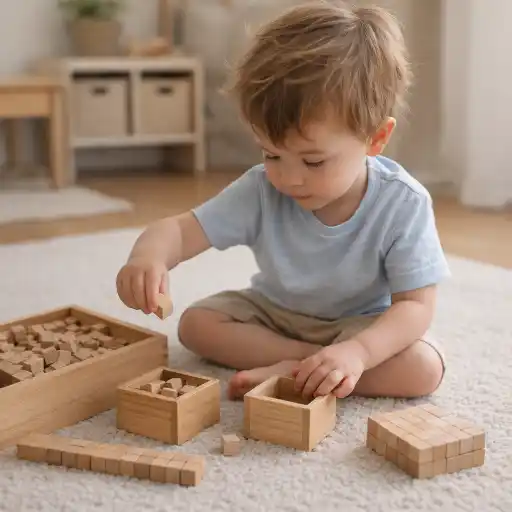
Prompts work best as invitations rather than tests. Instead of asking repeated questions such as “Is it full?” narrate the action and occasionally wonder aloud: “I wonder if another block will fit.” A toddler can answer by trying, pointing, looking, vocalizing, signing, or speaking. NAEYC recommends taking conversational turns, describing children’s actions, and allowing time for learning and exploration.
- “You put the cup in the basket. Now the basket has something inside.”
- “The container is almost full. There’s room for one more.”
- “You took everything out. It’s empty now—nothing is inside.”
- “This bowl is full; that cup is empty.”
Use words children already know, then add a related term naturally. If a child says “all gone,” respond, “Yes, it’s empty—all the blocks are gone.” This builds a bridge from familiar expressions to relational vocabulary without asking children to perform on demand.
How can educators extend language while preserving child-led play?
Follow the toddler’s attention and talk about the action the child has chosen. If a child repeatedly pours objects from one cup into another, stay with that interest: “Out of the cup. Now in the bowl.” Add one contrasting word or idea at a time—full versus empty, more versus less, big versus small. Responsive repetition helps children hear vocabulary in a predictable context and gives them space to join in when they are ready.
Expand a child’s communication without replacing it. If a toddler points to an empty cup, you might say, “You want more blocks in the cup.” If the child says “full,” you could respond, “Yes, the big bowl is full.” A child who is not speaking may communicate by reaching, handing over a container, using eye gaze, signing, or using an AAC system. Treat these as meaningful participation and respond to the message.
- Follow the child’s lead and describe what you see before introducing a new idea.
- Pause after a comment to invite a gesture, sound, word, or action.
- Offer choices: “Would you like the big cup or the little cup?”
- Include familiar words from children’s home languages when possible.
Container play can also become shared play: one toddler fills while another holds a bowl, with an adult modeling “your turn” and “my turn.” Keep interaction warm and flexible; the purpose is connection and exploration, not a prescribed result.
How can teachers adapt play and notice learning?
Make the same basic idea accessible in different ways. Some toddlers may enjoy pouring; others may prefer placing objects in a wide container, watching an adult demonstrate, or using a scoop. Offer visual or gestural cues, a stable surface, larger containers, or a quieter space as needed. Children learning more than one language can participate through actions and gestures while hearing vocabulary in English and, when possible, their home language.
Observe what each toddler does and how they communicate over several play experiences. Can the child find the empty container, notice when it is almost full, or show an adult that they want another object? Note the context and the child’s actual action or words. These observations help you decide whether to repeat the activity, simplify materials, add a new container, or model a different word.
Avoid treating one response as proof of what a child does or does not understand. A toddler may demonstrate a concept through action before using the word, and a confusing prompt may obscure what the child knows. Rephrase, demonstrate, and observe over time. If developmental concerns persist, share objective observations with the family and follow program procedures for discussing next steps. State requirements vary—check your state licensing agency.
Conclusion: How does container play build relational vocabulary?
Full, empty, and almost become meaningful when toddlers can see and create the changes those words describe. With safe containers, interesting objects, repeated play, and responsive adult language, providers can support vocabulary, early mathematical thinking, and communication without turning play into a test.
Begin with a simple invitation: offer a few containers, model words that fit the moment, and wait to see what toddlers notice. Follow their interests, welcome all forms of communication, and record small examples of learning. To strengthen your broader language-support practice, explore the Language Development in Early Childhood course Buy Now $16.00.
Related ChildCareEd courses:
- Early Mathematics Through Play Buy Now $24.00
- Baby Play: Planning Infant and Toddler Activities Buy Now $16.00
- Playful Spaces for Infants & Toddlers Buy Now $24.00
- Building Vocabulary Buy Now $16.00
References
- How Can Child Care Providers Teach Zero Through Empty Collections? — ChildCareEd
- Kids: Container Play and Language Ideas — Wannemacher Therapy
- What Toddler Activities Encourage Language and Communication? — ChildCareEd
- 5 Ways to Play With Empty Plastic Containers — ZERO TO THREE
- How Can “Almost Finished” Activities Encourage Young Children to Problem-Solve? — ChildCareEd
- Boosting Language Through Play — ChildCareEd
- 12 Ways to Support Language Development for Infants and Toddlers — NAEYC
- How Can Task Cards Turn Free Play Into Purposeful Learning? — ChildCareEd
- Play ideas for toddler language & talking — Raising Children Network
- Communicating and Speaking: Infant/Toddler — ECE Resource Hub
- How Can Sensory Bin Ideas Promote Early Language Skills? — ChildCareEd
- Top 10 Play Activities for Toddler Language Development — Speech Therapy Connections
- Language Development in Early Childhood — ChildCareEd course Buy Now $16.00
- Measurement: Toddler — ECE Resource Hub
- How can child care providers best support language development in young children? — ChildCareEd
- Language Development Milestones in Early Childhood — ChildCareEd
- Dump It, Stack It, Build It! Open-Ended Activities for Curious Toddlers — ChildCareEd
- Resources: Language Development in Early Childhood — ChildCareEd
- Rocking and Rolling: Nurturing Early Math Play and Discovery — NAEYC
- Milestones by 2 Years — CDC
- 45 Hour Infant and Toddler Methods and Materials
- CDA Infant/Toddler Credential with Portfolio Review
- CDA Bridge Bundle: Family Child Care without Portfolio Review
- CDA Bridge Bundle: Infant/Toddler without Portfolio Review
- CDA Bridge Bundle: Preschool without Portfolio Review
- 45-Hour Infant and Toddler Curriculum
- Risk Reduction: Infants and Toddlers in Family Child Care
- Texas Director Credential
- Building Vocabulary
- Every Moment Matters: Schedules and Transitions
- 😫🧸 ¿Qué hacer cuando un bebé no quiere dormir la siesta en el aula?
- 👶 ¿Cuáles son las proporciones y grupos requeridos en Dakota del Norte? 🏫
- Curso Gratis De Cuidado Infantil Con Certificado
- Celebra El Cumpleaños de Dr. Seuss En Tu Guardería Con Actividades Fáciles y Divertidas!
- Curso de Comunicación de 9 Horas de Maryland
- ¿Cuáles son los pasos, requisitos y opciones en línea para la certificación de 90 horas en cuidado de Infantes/Toddlers en Maryland?
- 10 Ejemplos de Cómo la Cultura Influye en el Desarrollo Infantil
- Proporciones de Cuidado Infantil y Tamaños de Grupo por Edad en Nueva Jersey (Guía Rápida para Centros y Hogares)
- Proporciones de Cuidado Infantil y Tamaños de Grupo por Edad en Virginia (Guía Rápida para Centros y Hogares)
- Cómo Trabajar en el Cuidado Infantil en Carolina del Norte: Requisitos y Pasos
- Celebrando la amistad en el cuidado infantil durante el Día de los Mejores Amigos
- Canciones, juegos y preguntas de círculo para niños
- Cómo simplificar la capacitación para sus empleados de daycare
- What Milestones Should You Watch Between Age 2 and 30 Months?
- Big Feelings, Busy Bodies: Self-Control Activities for Toddlers
- What Toddler Activities Encourage Language and Communication?
- How Can Puppets Support Communication and Literacy in Early Childhood?
- How Can Child Care Providers Help Families See the Learning Hidden Inside Messy Play?
- How Can One Plant Help Children Notice Gradual Change Outdoors?
- How Can Toddler Container Play Build Relational Vocabulary?
