Great school-age programming does more than fill the afternoon—it gives children meaningful ways to think, create, move, read, and belong. If your team needs practical activities that fit real schedules and mixed-age groups, explore Lesson Planning to Meet School Age Needs  Buy Now $16.00 to strengthen differentiated planning and earn useful professional learning hours; for a broader curriculum foundation, consider 45-Hour School Age Curriculum Buy Now
 $399.00$275.00. The ideas below can help you begin tomorrow while building a more intentional program over time.
Why does a balanced school-age lesson plan matter?
After-school children arrive with different energy levels, interests, school experiences, and support needs. A thoughtful plan offers both predictability and choice: children know what comes next, yet they can make decisions and pursue questions that matter to them. The CDC identifies academic, arts, sports, and STEM enrichment as common forms of out-of-school-time programming and notes that movement can support concentration and memory (CDC out-of-school-time guidance).
A balanced plan also protects staff from relying on worksheets, screens, or unstructured waiting. SEDL’s after-school resources emphasize choice, age-appropriate goals, real-world connections, informal assessment, and ongoing staff training (SEDL academic enrichment guidance). In practice, this means a reading activity can include discussion, a STEM challenge can include writing, and movement can reinforce cooperation and measurement.
Think of the weekly plan as a portfolio of experiences rather than a checklist of subjects. Children should have repeated opportunities to practice #problem-solving, #creativity, communication, self-regulation, and collaboration.
How can providers create a usable one-page lesson plan?
A lesson plan should guide action without becoming another burden. ChildCareEd’s school-age lesson planning guidance recommends a concise structure that staff can scan quickly.
- 🎯 Goal: State one observable outcome, such as “children will test two bridge designs.”
- Materials: List supplies, alternatives, and any items requiring additional supervision.
- Time: Identify the activity length, transition time, and cleanup expectations.
- Steps: Use First, Next, and Last; limit directions to the essential sequence.
- Questions: Prepare two open-ended prompts that invite explanation rather than guessing.
- Adaptations: Include easier, standard, and extension options, plus seated or visual alternatives.
- Assessment: Record one observation, child quote, photo, or next-step idea.
Keep plans flexible. If children become deeply engaged in a design challenge, preserve the inquiry and adjust the schedule rather than ending abruptly. If the group is tired, shorten the direct instruction and offer a quieter version. A labeled supply basket, visual schedule, and consistent cleanup routine make implementation more realistic for busy teams.
What STEM activities invite investigation and problem-solving?
Strong STEM activities begin with a question or design problem, not a demonstration children merely watch. ORISE provides free K–12 STEM lesson plans that model investigation, data analysis, scientific explanation, and cross-curricular connections (ORISE STEM lesson plans). For school-age care, the same principles can be scaled into short, low-cost invitations.
- Cup-tower challenge: Build the tallest stable tower with ten cups. Ask children to sketch, test, revise, and explain what made the structure stronger.
- Ramp and friction investigation: Roll objects over carpet, cardboard, and smooth flooring. Children predict, measure distance, and compare results.
- Balloon rocket: Send a balloon along a string and change one variable—balloon size, string length, or payload.
- Nature data walk: Collect observations about leaves, shadows, insects, or weather. Create a group chart and discuss patterns.
- Simple circuits: Use batteries, wires, and bulbs with clear safety expectations. Challenge teams to diagnose why a circuit does not work.
Use a 20–40-minute block and invite at least two revisions. Avoid taking over when a design fails; ask, “What did you notice?” or “What could you change?” Older children can serve as documenters, coaches, or materials managers while younger participants test ideas. STEM becomes more inclusive when there are multiple ways to contribute: building, drawing, measuring, explaining, and organizing.
How can art and literacy become engaging, connected experiences?
Art and reading are especially powerful when children have authentic reasons to communicate. SEDL recommends book discussions, read-alouds, dramatization, writing, family literacy events, and small-group tutoring as promising after-school literacy practices (SEDL’s after-school resource list).
Try a weekly “story studio.” Read a short text, article, graphic novel excerpt, or poem, then let children choose one response:
- Create a comic that adds an alternative ending.
- Design a setting using recycled materials and label important features.
- Perform a short scene or produce a reader’s theater.
- Write a letter from one character to another.
- Illustrate a scientific idea from a nonfiction text.
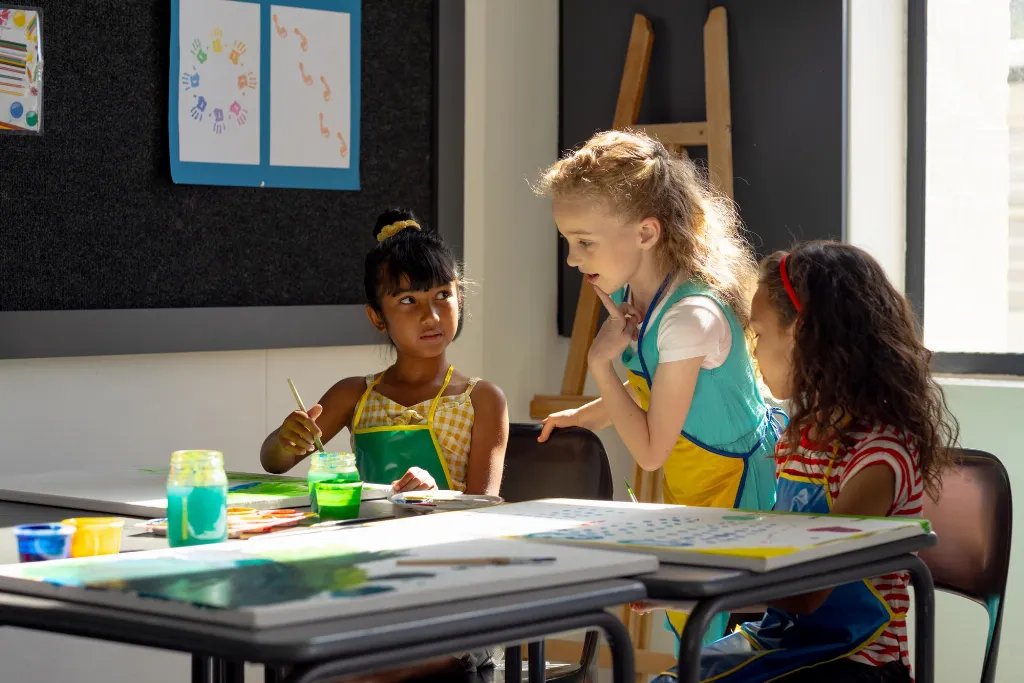
For visual art, prioritize process over identical products. Personal identity flags, zines, collaborative murals, and artist trading cards can build community while allowing children to make individual choices; examples of these approaches appear in All About Me art project ideas. Connect art to children’s cultures and interests without asking any child to represent an entire group.
Support readers without turning enrichment into remedial school. Offer audiobooks, partner reading, quiet reading, vocabulary games, and text-to-life conversations. A child may participate by listening, drawing, discussing, acting, or writing. These options protect dignity and expand access while strengthening #reading and oral language.
How should movement, choice, and inclusion shape the weekly rotation?
Movement should be planned as a meaningful part of the day, not used only as a reward or emergency release. The CDC notes that physical activity in out-of-school time can support health, concentration, and memory. Include both structured games and child-led activity.
- Use relay variations in which children walk, skip, roll, or navigate with a partner.
- Offer dance, stretching, yoga, or rhythm games in limited indoor space.
- Create cooperative obstacle courses with roles such as designer, timer, encourager, and participant.
- Use chalk mathematics outdoors: estimate, measure, graph, or create geometric paths.
- Schedule water, shade, weather checks, and transitions into the plan.
For mixed-age groups, design two levels and one extension: “try,” “improve,” and “coach.” A child who does not want to run may be a scorekeeper or course designer; a child who needs less stimulation may use a quieter station. Visual instructions, flexible seating, sensory breaks, and peer partnerships help children participate without making differences a public problem.
A sample rotation might include STEM, art, movement, literacy, and free choice across the week. Let children select one station when possible. Choice builds ownership, while consistent boundaries preserve safety and fairness. Document which adaptations worked so the next plan becomes easier.
How can staff organize time, safety, assessment, and family communication?
A reliable daily flow may include arrival and snack, homework or quiet support, activity rotations, and free choice or reflection. Within the activity period, 15–30-minute stations work well for many groups, while multi-day projects may need 40–60 minutes. Post a visual schedule and use the same warning cues—such as five minutes, two minutes, and thirty seconds—before transitions.
Safety planning must be specific to the activity. Staff should map supervision zones, count children during movement, inspect materials, and clarify which tools or small parts require close adult support. Safe Supervision in Child Care: Birth to School Age Buy Now $24.00 can help providers strengthen supervision practices across indoor, outdoor, transportation, and field-trip settings. State requirements vary - check your state licensing agency.
Assessment can remain light:
- One photo or work sample, with permission.
- One sentence describing engagement or a skill observed.
- A brief child reflection: “I discovered…,” “I changed…,” or “Next time…”
- A weekly staff note identifying what to repeat, adapt, or discontinue.
Share short family updates that describe learning rather than only the finished product. Invite optional contributions such as a family story, recipe, book recommendation, or cultural connection. Strong communication helps families see that after-school experiences are purposeful, joyful, and responsive.
Summary
How can school-age lesson plans balance STEM, art, movement, reading, and more? Begin with a predictable structure, then fill it with varied experiences that offer choice, challenge, collaboration, and reflection. Use one-page plans with observable goals, simple materials, open questions, adaptations, and low-burden assessment.
Start this week by selecting one STEM challenge, one art-and-literacy connection, one movement option, and one quiet choice. Train staff to use consistent transitions and active supervision, then adjust based on children’s engagement. With thoughtful planning, your program can become a place where #children build, read, move, create, and develop confidence in what they can do.
Helpful ChildCareEd courses: Lesson Planning to Meet School Age Needs Buy Now $16.00; 45-Hour School Age Curriculum Buy Now $399.00$275.00; Supporting School Age Development ONLINE Buy Now $24.00; Language Development in School Age Buy Now $16.00; Safe Supervision in Child Care: Birth to School Age Buy Now $24.00.
- 45-Hour School Age Curriculum
- CDA Home Visitor Subject Area 3 Part 3 Birth to 5
- Designing Your School Age Classroom
- Birth to Five CDA Credential with Portfolio Review
- 45 Hour School Age Methods and Materials
- 45-Hour Infant and Toddler Curriculum
- Lesson Planning to Meet School Age Needs
- Texas Director Credential
- Every Moment Matters: Schedules and Transitions
- Menos Estrés a la Hora de Comer: Rutinas Simples Que Sí Funcionan
- ¡Obtén Tu Certificación de Cuidado Infantil de 90 Horas En Línea!
- Apoyo en Español para Capacitaciones Grupales Presenciales y por Zoom en Cursos Selectos
- Actividades de Otoño Fáciles para Preescolares esta Temporada
- Las Mejores Ideas de Excursiones para Guarderías en Dakota del Norte
- Calabazas, hojas y manzanas: actividades de otoño para preescolares
- Canciones, juegos y preguntas de círculo para niños
- After-School Activities for School-Age Children
- School-Age Lesson Plans for After-School Child Care
- How can we build a Minnesota summer program that keeps school-agers engaged?
- How can North Dakota fill the gap for school-age children before and after school?
- How Can We Plan Engaging Before- and After-School Activities That Balance Fun, Learning, and Safety?
- School-Age Program Ideas: Games, Projects, and Group Activities
- School-Age Lesson Plan: A Full Week of After-School Activities
- School-Age Lesson Plan Ideas: STEM, Art, Movement, Reading, and More
- What Should a School-Age Curriculum Include? A Guide for After-School Programs
- After School Lesson Plans That Don’t Feel Like More School
- Push, Pull, Carry, Move! Heavy Work Activities for School-Age Kids
- After School Activities for Elementary Kids Who Finish Homework Early
- What School-Age Activities Create Engaging, Inclusive, and Well-Managed Programs?
