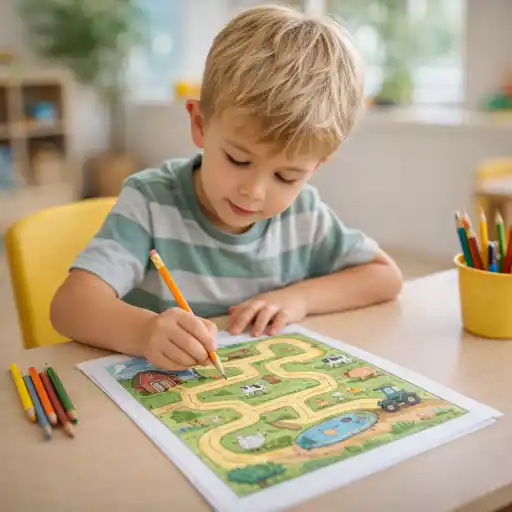
A farm maze can turn a simple trip from field to barn into meaningful practice with planning, direction, and steady hand movements. Explore how to use the Farm Maze Buy Now $1.99 as part of an intentional preschool experience, and consider ChildCareEd’s Curriculum Planning course  Buy Now $24.00 for practical support connecting playful activities with developmental goals and lesson plans.
Farm themes offer familiar images and stories that invite children to explore where a path goes, which turns may work, and how to guide a tool through a route. With thoughtful scaffolding, this enjoyable activity can support spatial reasoning and pencil control while giving educators useful moments to observe children’s strategies.
Why use a farm maze to practice spatial reasoning and pencil control?
A maze asks a child to coordinate what they see with what their hand does. As children follow a route, they scan ahead, notice boundaries, anticipate turns, and adjust movements. These actions draw on visual-motor coordination and early #spatial reasoning: understanding position, direction, pathways, and relationships between places.
Tracing a maze also offers purposeful practice with controlled movements. Children may start, stop, turn, and regulate pressure as they guide a crayon or pencil along a path. Those experiences are related to the motor skills used in drawing and early writing, but a single maze is not a test of readiness or a guarantee of later outcomes. Children develop at different rates, and progress is best understood across varied everyday activities.
The farm story adds a meaningful goal. A farmer needs to travel from the field to the barn; the child can imagine possible routes and talk through choices. This narrative keeps the task playful, making a dead end an opportunity to reconsider rather than a sign of failure. Mazes can therefore bring together visual attention, #pencil control, planning, and persistence in one accessible activity.
- Practice direction and position words such as around, beside, toward, and between.
- Invite children to anticipate a turn and explain what they notice.
- Observe how the child responds when a route is blocked or needs revision.
How can educators introduce the Farm Maze at an appropriate level?
Begin by matching the challenge to the child, not by expecting every preschooler to complete the same route in the same way. Look at pathway width, length, contrast, number of turns, and visual detail. A child who is new to maze play may first explore the route with a finger or move a small toy along it. A child ready for more precision might use a crayon or pencil.
Before handing over the tool, invite children to look over the page. Ask where the journey begins and ends, and let them trace a possible route in the air or with a finger. This gives the child a chance to plan without making accurate pencil tracing the only way to participate. If the route feels difficult, cover part of the page, simplify the task, or demonstrate one small strategy and then return the decision-making to the child.
Possible ways to scaffold include:
- Start with finger-tracing, then offer a short crayon or other comfortable writing tool.
- Use a clipboard or slanted surface if it supports a comfortable working position.
- Offer a larger copy or a toy to move through the route when paper-pencil work is not the current goal.
- Invite children to narrate the route using words, gestures, or their home language.
The Farm Maze Buy Now $1.99 features a farmer traveling from a field toward a barn in a non-seasonal farm setting. Connecting the route with a classroom farm theme can help children bring prior knowledge and imaginative play to the challenge.
What teacher language encourages planning rather than giving the answer?
Children benefit when adults create space for them to observe, choose, and revise. Instead of pointing directly to the correct path, use open-ended prompts that make thinking visible. You might ask, “Where could this path take the farmer?” or “What do you notice where the two paths meet?” Such questions focus attention on evidence and possible choices while leaving the problem for the child to solve.
Helpful prompts include:
- “Can you show me where the journey starts and where it ends?”
- “Which way would you like to try first? What makes you think that?”
- “What did you discover at this turn?”
- “If this path is blocked, what could you do next?”
- “Can you describe the route using words like around, beside, or toward?”
When a child reaches a dead end, respond calmly: “That route gave you new information. Let’s look again.” This validates effort and frames #problem-solving as a process of testing and adjusting. Descriptive feedback can also draw attention to controlled movement: “You slowed your hand at the curve,” or “You paused before choosing a different path.” Avoid evaluating the child only by speed or whether the line stayed perfectly inside the boundaries.
Children can also work in pairs. One child can describe a route while the other traces or moves a toy; then they can switch roles. This adds listening, turn-taking, and shared planning. Keep the child who is navigating in charge of decisions, and offer help when needed without taking over the task.
How can a maze become part of a broader farm curriculum?
A maze is most valuable when it connects with children’s interests and other learning experiences, rather than appearing as an isolated worksheet. Use the farm journey as a starting point for conversation: What might the farmer carry? Which animals live near the barn? What could be planted in the field? Children might build a farm with blocks, position animal figures around a barn, or draw their own map showing a route between places.
These extensions encourage children to move between a two-dimensional paper path and a three-dimensional play space. They can compare routes, construct fences, place a toy tractor beside a field, or direct a peer to move from one landmark to another. Add early math by counting turns, comparing longer and shorter routes, or using positional words. Invite children to tell a story about why the farmer is traveling and what happens along the way.
For a purposeful plan, choose one main learning objective and one or two related areas. For example:
- Spatial language: use around, between, near, and beside while describing the route.
- Motor control: observe starts, stops, turns, and how the child guides a tool or object.
- Reasoning: notice whether the child anticipates a turn, tests a route, or changes strategy.
- 🌾 Farm inquiry: connect the destination to children’s questions about crops, animals, or farm work.
Planning with a clear objective helps educators select appropriate materials and decide what to observe. The ChildCareEd Curriculum Planning course Buy Now $24.00 offers further learning about curriculum, developmentally appropriate lesson planning, and early learning standards. State requirements vary - check your state licensing agency.
How can providers include different learners and observe progress?
Adapt the route, materials, or response method while keeping the intended learning goal in view. Some children may benefit from a larger, high-contrast copy, a shorter route, or less visual information on the page. Others may prefer to move a farm animal figure through the maze, trace with a finger, or explain the route verbally. These alternatives can still reveal planning and spatial understanding without requiring the same fine-motor response from every child.
Consider supportive options such as:
- Offer a short crayon, marker, or other tool the child can comfortably control.
- Present one section of the maze at a time or use a finger to frame the area being explored.
- Add tactile boundaries where appropriate, or place the maze on a stable surface.
- Allow extra time, breaks, or a partner for shared discussion while preserving the child’s choices.
Observe the process rather than recording only completion. In a brief activity, note whether the child located the start, looked ahead, used direction words, controlled a tool or object, and responded to a blocked route. A concise note could read: “The child finger-traced the route, paused at a dead end, and chose another path with one verbal prompt.” Over time, these observations help educators plan next steps and share strengths with families. If concerns about development persist across settings and activities, follow program procedures and collaborate with the family and appropriate professionals; maze performance alone is not a diagnosis.
Conclusion: What should providers remember about farm mazes?
A farm maze can offer more than a pleasant themed page: it can invite children to reason about direction and position, practice controlled movement, and persist through a manageable challenge. The activity works best when providers select an accessible level, let children make meaningful decisions, and use language that supports thinking without supplying the route.
Connect the maze to farm play, movement, stories, and conversation so children can explore the same ideas in multiple ways. Observe planning, self-correction, communication, and tool use—not just a finished line. With flexible materials and developmentally responsive expectations, educators can make the Farm Maze a useful part of a thoughtful curriculum that respects how each child learns.
- Moving About the Classroom: Effective Transitions for Everyday
- Lesson Planning for Preschoolers
- 45 Hour Preschool Methods and Materials
- Children at the Wheel: Emergent Curriculum
- Injury Prevention: Their Safety Is In Your Hands
- Art from the Heart for Preschoolers: Open Ended Art Projects that Build Self-Esteem
- Creating Engaging and Meaningful Learning Experiences
- Sensitive Periods in Montessori: Guiding Natural Learning
- Texas Director Credential
- Enriching Education: Field Trips
- Creativity & Logic Activities
- CDA Certification en Español: Recursos y Consejos para Educadores Bilingües
- 👶 ¿Cuáles son las proporciones y grupos requeridos en Dakota del Norte? 🏫
- Recursos en Español sobre el Sueño Seguro del Bebé
- 10 Ejemplos de Cómo la Cultura Influye en el Desarrollo Infantil
- Capacitación en Salud y Seguridad Preventiva en Línea para Proveedores de Cuidado Infantil
- Proporciones de Cuidado Infantil y Tamaños de Grupo por Edad en Maryland (Guía Rápida para Centros y Hogares)
- Proporciones de Cuidado Infantil y Tamaños de Grupo por Edad en Nueva Jersey (Guía Rápida para Centros y Hogares)
- Proporciones de Cuidado Infantil y Tamaños de Grupo por Edad en Virginia (Guía Rápida para Centros y Hogares)
- Cómo Trabajar en el Cuidado Infantil en Carolina del Norte: Requisitos y Pasos
- Calabazas, hojas y manzanas: actividades de otoño para preescolares
- Celebrando la amistad en el cuidado infantil durante el Día de los Mejores Amigos
- Canciones, juegos y preguntas de círculo para niños
- Cómo simplificar la capacitación para sus empleados de daycare
- How Do Mazes Strengthen Pencil Control and Problem-Solving in Preschool?
- How Can You Increase Maze Difficulty Without Frustrating Young Learners?
- How Can Low-Prep Christmas Activities Build Preschoolers’ Visual Planning?
- How Can Farm-Themed Mazes Build Spatial Reasoning and Pencil Control?
- How Can Valentine’s Day Problem-Solving Activities Help Preschoolers Learn?
- How Can a Jungle Maze Turn Play into Problem-Solving for Young Learners?
