Grandparents can bring warmth, time, cultural knowledge, stories, skills, and valuable life experience into early childhood programs. When their involvement is planned thoughtfully, children gain additional opportunities to strengthen language, social-emotional skills, intergenerational relationships, and their sense of family and community. This article gives child care providers and directors practical, scalable ways to involve #grandparents in centers and family child care programs through activities such as storytelling, music, gardening, cultural demonstrations, classroom projects, and special events. For programs planning craft-based special events or keepsake projects, consider simple footprint art and similar celebration ideas—see footprint art for Father's Day—which adapt easily for intergenerational visits and make meaningful family mementos. For concrete music-focused activities and community event ideas you can use when planning intergenerational music sessions with visiting grandparents, see Make Music Day. For ready-to-use craft and event ideas you can adapt for intergenerational celebrations (for example, Mother's Day), see ChildCareEd's Mother's Day Weekend Activities. It also addresses permissions, background checks, health and safety expectations, accessibility, family diversity, and professional boundaries so participation remains safe, inclusive, and connected to learning goals.
To strengthen your program’s approach to family participation, explore ChildCareEd’s self-paced online course Community and Family Engagement in Childcare  Buy Now $24.00, which focuses on building safe, nurturing environments through meaningful relationships with families and the wider community. Providers can also take Community Partnerships Buy Now $24.00, a self-paced course that examines how collaboration among teachers, families, and community members supports children’s learning and development. These strategies can help programs invite grandparents to contribute in purposeful ways while respecting each family’s structure, preferences, and level of involvement.
Why it matters
Intergenerational engagement supports social-emotional development, provides one-on-one attention that can deepen early literacy and vocabulary, and often reduces family stress by expanding caregiving supports. See practical ideas on hosting meaningful visits in Grandparents Day Activities and planning templates in ChildCareEd’s Intergenerational Activities. Research also shows high-quality early interactions (emotional and instructional support) drive long-term child outcomes (OECD).
1) What meaningful roles can grandparents play in my program?
Think beyond a single “Grandparents Day.” Grandparents can be classroom volunteers, story readers, cultural-heritage guests, craft partners, or regular reading buddies. Use roles that match the adult’s interests and mobility.
- 🎨 Role ideas (match to ability):
- Read-aloud volunteers—one grandparent per small group (see Connecting Generations).
- Craft & keepsake helpers—handprint gifts, bookmarks, memory pages (Grandparents Day Activities planner Buy Now $0.00).
- Oral-history guests—share short memories or songs to build vocabulary and narrative skills.
- Garden or nature partners—planting or simple sensory projects. Consider coordinating these visits with seasonal themes—see ChildCareEd's Earth Day activities for child-friendly sustainability projects and simple classroom actions you can pair with a garden visit.
- 📅 Frequency and format:
- Invite grandparents for 1) drop-in events, 2) scheduled weekly reading shifts, or 3) short monthly stations. Short, repeated visits build relationships more than one long event.
- 🔁 Inclusion tip: Use the language “grandparents & grandfriends” so children who lack nearby relatives can bring trusted adults. For structured volunteer models, consider partnerships like local Foster Grandparent Programs (Classroom Grandparents / FGP).
These approaches center relationship-building and reinforce classroom goals—language, turn-taking, and identity—that are linked to measurable gains in early learning (Canada ELCC quality review). #familyengagement
2) How do I plan visits so they run smoothly, safely, and inclusively?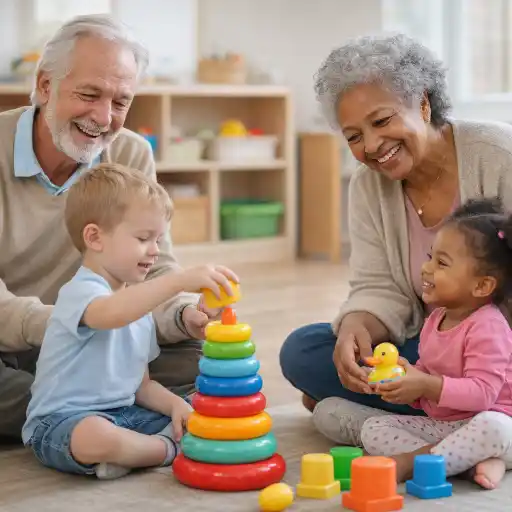
Planning reduces stress for staff, families, and visiting adults. Follow clear steps and name responsibilities.
- 📆 Logistics (keep it short):
- Limit visits to 30–60 minutes for mixed-age groups; toddlers need shorter shifts (5–10 minutes per station). See timing examples in Grandparents Day Activities.
- ✉️ Invitations & communication:
- Send clear arrival, parking, and accessibility instructions. Include an opt-in for photos and note whether masks or health checks are required.
- 🛡️ Safety & policy:
- Follow visitor sign-in, ID badges, supervision ratios, and allergy protocols. State requirements vary - check your state licensing agency. For creating a safety culture, see ChildCareEd guidance (10 Actions to Create a Culture of Safety Buy Now $0.00).
- ♿ Accessibility & comfort:
- Provide chairs, clear pathways for mobility devices, and a quiet corner for visitors or children who need downtime (Intergenerational Activities).
Assign roles: greeter, station helper, and a floating staff tech-person for virtual links. These simple systems let visits feel calm, predictable, and dignified.
3) How do intergenerational activities support children’s learning,g and why does it matter?
Intergenerational work is more than “feel-good.” It can advance learning goals when aligned to curriculum and guided by clear objectives.
- Learning benefits:
- 📚 Language & literacy: One-on-one reading and storytelling boost vocabulary and narrative skills (see literacy benefits reviewed by ChildCareEd and the OECD).
- 🤝 Social-emotional: Turn-taking, empathy, and gratitude are practiced naturally in small interactions.
- ✋ Fine motor & cognition: Crafts, gardening, and snack-assembly support fine motor control and sequencing.
- Why it matters:
1) Short-term: richer language exposure and calm, focused attention. 2) Mid/long-term: repeated quality interactions support trajectories described in the OECD analysis on ECEC and inequality reduction (OECD).
- Program linkages:
Document learning goals on lesson plans (language, SEL, fine motor). Create keepsakes (memory pages, class storybooks) that reinforce identity and provide family conversation starters (Connecting Generations).
4) How can we include grandparents who can't attend and children without grandparents?
Equity and flexibility matter. Not every family has grandparents nearby or grandparents comfortable visiting. Offer multiple participation paths.
- 💻 Virtual options:
- Schedule 10–15 minute video calls, or accept short recorded messages to play during circle time. Design a tech-runner role to test audio/video ahead of time (Grandparents Day Activities).
- 📬 Mail & keepsakes:
- Send a craft home or create classroom mailboxes for notes grandparents can read at home.
- 🤝 Grandfriend alternatives:
- Invite community supporters, retired staff, or trained volunteers (e.g., Foster Grandparent Program) to act as “grandfriends” so each child can participate in the experience (FGP info).
- 📱Low-tech options:
- Offer phone calls for older adults who prefer voice-only contact; send photos or transcripts to families with permission.
These inclusive choices respect family diversity and maintain meaningful engagement for children who otherwise might miss out. #community
5) How do we measure success, avoid common mistakes, and sustain these partnerships?
Measure impact with modest tools and avoid common pitfalls that erode trust or program quality.
- Common mistakes & fixes:
- ❌ Over-scheduling — Fix: Short, regular visits beat long, rare events.
- ❌ Too many crafts — Fix: Use 2–3 stations and rotate small groups.
- ❌ Skipping accessibility — Fix: Ask about mobility, hearing, or cognitive needs in advance.
- ❌ No consent/documentation — Fix: Collect written photo/media permission and clarify privacy rules.
- Measuring success (simple, low-burden):
- 📷 Take one photo + one child quote per visit (with permission).
- 🙂 Use quick feedback forms for grandparents and a3-point smile chart for children.
- 📝 Track one classroom goal (e.g., vocabulary: 1 new word used; SEL: one turn-taking instance).
- 🔁 Review with partners quarterly and iterate.
- Staff training & sustainability:
- Invest in staff skills for family partnerships—see ChildCareEd courses like How Family Involvement Supports Children’s Learning and Growth and community coordination trainings.
- Document a simple volunteer handbook and orientation checklist for visiting adults.
FAQ (quick):
- Q: How long should visits be? A: 30–60 minutes for most; shorten for infants/toddlers.
- Q: What if a senior has memory loss? A: Use sensory activities and music; keep interactions short and guided.
- Q: Do I need photo permission? A: Yes — always get written consent from families and visitors.
- Q: Where can I find templates? A: Start with ChildCareEd resources: Grandparents Day planner Buy Now $0.00 and intergenerational activity pages.
Conclusion
Involving grandparents in your daycare program is practical, low-cost, and high-impact when it’s planned around relationships, safety, and learning goals. Start small: pick one recurring role (reading buddy or memory guest), set clear logistics and safety rules, and document one simple outcome. Use the ChildCareEd resources linked throughout for ready-made scripts, invitations, and staff training. Partnerships grow stronger with reflection—meet with grandparents and partners regularly, celebrate small wins, and adjust.
Helpful reading & partners: ChildCareEd’s Grandparents Day and Intergenerational pages, the OECD overview on ECEC impacts, local Foster Grandparent Programs, and AARP’s findings on grandparents’ economic and caregiving contributions (AARP Grandparent Economy).
Ready to start? Choose one activity, invite one grandparent or grandfriend, document the visit, and build from there. Your program, the children, and your local #community will notice the difference.
- CDA Home Visitor Subject Area 3 Part 3 Birth to 5
- CDA Home Visitor Subject Area 2 Part 3 Birth to 5
- Staff Supervision, Observation & Feedback
- Children at the Wheel: Emergent Curriculum
- Pediatric RSV First Aid & CPR/AED
- CDA Bridge Bundle: Family Child Care without Portfolio Review
- CDA Bridge Bundle: Infant/Toddler without Portfolio Review
- CDA Bridge Bundle: Preschool without Portfolio Review
- Staff Supervision, Observation & Feedback
- Texas Director Credential
- 👶 ¿Cuáles son las proporciones y grupos requeridos en Dakota del Norte? 🏫
- Recursos en Español sobre el Sueño Seguro del Bebé
- Que es Título 22 en California?
- 10 Ejemplos de Cómo la Cultura Influye en el Desarrollo Infantil
- Cómo Solicitar una Licencia de Guardería en Texas
- Cómo Empezar una Guardería en Casa: Requisitos y Pasos
- ¿Cómo solicito la licencia para una guardería en California?
- Proporciones de Cuidado Infantil y Tamaños de Grupo por Edad en Maryland (Guía Rápida para Centros y Hogares)
- Proporciones de Cuidado Infantil y Tamaños de Grupo por Edad en Nueva Jersey (Guía Rápida para Centros y Hogares)
- Lista para Abrir una Guardería en Casa en Carolina del Norte: Cómo Empezar
- Lista para Abrir una Guardería en Casa en Dakota del Norte: Cómo Empezar
- Lista para Guardería en Casa en Illinois: Cómo Iniciar una Guardería en el Hogar
- Lista para Guardería en Casa en Texas: Cómo Iniciar una Guardería en el Hogar
- Cómo Trabajar en el Cuidado Infantil en California: Requisitos y Pasos
- Cómo Trabajar en el Cuidado Infantil en Wisconsin: Requisitos y Pasos
- Intergenerational Activities for Kids: Learning Across Generations
- Celebrando la amistad en el cuidado infantil durante el Día de los Mejores Amigos
- Cómo simplificar la capacitación para sus empleados de daycare
- How can I meaningfully involve grandparents in my daycare program?
- How Can Child Care Providers Respect Different Family Structures?
