You work hard every day to keep children safe, learning, and smiling. This short guide helps child care directors and providers in North Dakota take clear steps to improve their Bright & Early / QRIS quality rating. You will find simple actions, training tips, records to collect, and places to get help. Put these ideas into a weekly plan and your team will see steady progress.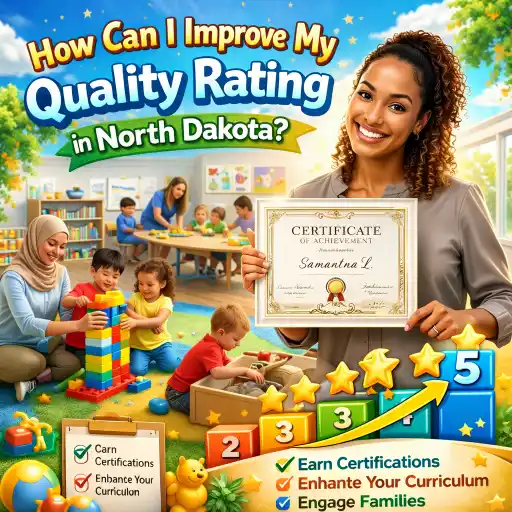
Across the article, you'll see links to helpful resources and state-focused steps from ChildCareEd and local Bright & Early guidance like the University of North Dakota Bright & Early ND. Remember: state requirements vary - check your state licensing agency.
Why does improving our Bright & Early quality rating matter?
1) Families look for clear signs of #quality care. Finishing steps in Bright & Early ND helps families find you and trust your program. See why Bright & Early matters at the UND Bright & Early page.
2) Better quality helps children. Research shows that strong classroom interactions, safe spaces, and planned learning activities improve early development and later school success — see a summary of evidence from the CDC.
3) Practical program benefits:
- Better enrollment and family confidence.
- Access to CCAP bonuses and quality payments when you meet steps — read a practical overview at ChildCareEd on QRIS payments.
- Stronger staff retention when training and coaching are part of your plan.
Why it matters: Improving your rating is not just paperwork. It shows you provide safer, more #safe care and stronger learning. It can also open funding and bonus streams for your program.
What small steps can we take now to raise our rating?
Start with one classroom and one staff file. Small, steady work beats last-minute rushes. Use these steps you can do this month:
- 📸 Gather visual evidence.
- Take dated photos of each classroom showing learning centers, labeled shelves, and child-sized furniture. ChildCareEd suggests photos as part of proof for Bright & Early steps — see ChildCareEd Bright & Early tips.
- 🧾 Organize records.
- One folder per child (enrollment, emergency contacts, health forms).
- One folder per staff (background checks, certificates, training plan). Make a single Licensing Binder for quick review — see the ChildCareEd licensing visit guide.
- 🎨 Improve learning spaces.
- Set up clear centers (books, blocks, art). Date and keep a short note with each photo describing the learning goal.
- 🧰 Update health & safety basics.
- Check safe sleep, medication logs, cleaning records, and first aid kits. ChildCareEd lists ND-accepted health & safety courses here: ND training overview. State requirements vary - check your state licensing agency.
- Health and safety requirements: For programs working to strengthen their health and safety evidence for Bright & Early reviewers, ChildCareEd's Health & Safety Requirements for Childcare Providers
 Buy Now $79.00 is a 10-hour online course covering safe sleep, medication administration, emergency planning, and infection prevention — completing it and uploading the certificate to the ND Registry is one of the fastest, most visible ways to build documented staff training evidence toward a higher rating.
- 🤝 Document interactions and family partnerships.
- Keep short observation notes, family contact logs, and examples of child work tied to learning goals.
- For ideas on encouraging peer friendships and building classroom community, see Building Social Foundations.
Tip: make weekly goals (e.g., update one classroom photo set and one staff file). These small wins build your #quality story for Bright & Early reviewers and families.
How can staff training and the ND Registry help us get credit?
1) Use the ND Early Childhood Workforce Registry (formerly Growing Futures) to track staff learning. Adding staff registry IDs to training accounts helps with automatic uploads. ChildCareEd explains the process and ND bundles on their state pages: ChildCareEd Bright & Early prep.
2) Simple steps to link training and get credit:
- 👥 Have each staff member create/update their Registry profile and share their Registry ID.
- 📌 Add the Registry ID to their ChildCareEd account so course completions upload automatically (allow several business days for uploads).
- 📤 Choose ND-approved courses and bundles for required competency areas and annual hours — see ND bundles on ChildCareEd: ND requirements.
3) Blended skills: Remember, pediatric CPR/AED and pediatric first aid often need a hands-on skills check,k even if the classroom portion is online. ChildCareEd offers blended options — see ChildCareEd blended training guide. Keep paper/digital certificates until the Registry shows the upload.
4) Why this helps your rating: the Registry shows documented staff development,nt which Bright & Early reviewers and licensing specialists review. Organized training evidence supports your #training goals and lifts your program toward higher steps.
What common mistakes should we avoid, and where can we get help?
Common pitfalls and fixes:
- ⚠️ Waiting until the last minute — Fix: schedule training and file updates across the year. Use quarterly goals and small checklists.
- ⚠️ Missing or unorganized records — Fix: one child folder, one staff folder, and a Licensing Binder. Use the ChildCareEd Universal Checklist Buy Now $0.00 for inspections.
- ⚠️ Training not linked to the Registry — Fix: collect Registry IDs and add them to training accounts so hours upload.
- ⚠️ Choosing unapproved courses — Fix: pick ND-approved courses from ChildCareEd or the ND training calendar and confirm with your licensing specialist.
- ⚠️ Assuming every bonus applies — Fix: check CCAP and bonus rules. ChildCareEd explains payment links and bonuses: QRIS & CCAP bonuses. #CCAP
Where to get help:
- 📞 Contact your local Child Care Resource & Referral (CCR&R) for coaching and CACFP help — see ChildCareEd CCR&R overview.
- 🗂️ Program administration and leadership: For directors working to organize records, strengthen policies, and lead staff development more effectively, ChildCareEd's Early Childhood Program Administration Buy Now $120.00 is a comprehensive 32-hour online course covering program management, documentation systems, and administrative best practices — a strong investment for any North Dakota director working steadily toward higher Bright & Early steps.
- 🧾 Use ChildCareEd training bundles and state pages for mapped competency courses.
- 💸 Look for grants and bonuses before applying — read ChildCareEd’s guide on ND grants and supports: ND grants & supports.
FAQ (quick answers):
- Q: How long for ChildCareEd uploads to appear in the Registry? A: Allow 5–10 business days; keep certificates until you see the credit — see ChildCareEd upload notes.
- Q: Which topics matter most for Bright & Early? A: Health & safety, learning environments, curricular, ul, u, m, and nurturing relationships — see Bright & Early ND.
- Q: Can online courses count?A: Yes, when state-approved, CPR/First Aid may need a skills check — see ChildCareEd blended training guide.
Conclusion
1) Start small: pick one classroom and one staff file to update this week.
2) Use the ND Registry and ChildCareEd-approved courses to document training and earn credit for Bright & Early steps.
3) Keep a Licensing Binder, dated photos, lesson plans, observation notes, and staff training records. Reach out to your CCR&R or ChildCareEd if you need coaching. Your steady work raises program #quality, helps families find you, and supports better outcomes for children. You are doing important work — one small step at a time builds higher ratings.
- Professional Presence in Early Childhood
- Tracking Progress, Shaping Futures: Observation & Assessment Skills
- Privacy Matters: Documentation and Observation in Early Learning
- Texas Director Credential Renewal
- Leadership Through Mentorship
- Texas Director Credential
- 40-Hour Director's Course
- Effective Coaching & Mentoring in ECE
- CDA Certification en Español: Recursos y Consejos para Educadores Bilingües
- Can Continuing Education in North Dakota Directly Impact Child Outcomes?
- ⏰📘 ¿Cuáles son los requisitos de capacitación anual en el cuidado infantil en Dakota del Norte?
- 👶 ¿Cuáles son las proporciones y grupos requeridos en Dakota del Norte? 🏫
- Lista para Abrir una Guardería en Casa en Dakota del Norte: Cómo Empezar
- Cómo Trabajar en el Cuidado Infantil en Carolina del Norte: Requisitos y Pasos
- Cómo Ser Maestra de Preescolar en Dakota del Norte
- Capacitación Previa al Servicio para Proveedores de Cuidado Infantil en Dakota del Norte
- Las Mejores Ideas de Excursiones para Guarderías en Dakota del Norte
- Child Care Resource Center in North Dakota: What Is It and How Can It Help?
- How can North Dakota programs climb the Bright & Early ND steps before the July 2026 update?
- What is the Infant & Toddler Bonus and how can ND providers use it to improve care?
- How Can I Improve My Quality Rating in North Dakota?
- Celebrando la amistad en el cuidado infantil durante el Día de los Mejores Amigos
- What Does Quality Documentation Look Like for Step 3 in Bright & Early ND?
- Cómo simplificar la capacitación para sus empleados de daycare
- How Can North Dakota Providers Show Quality and Attract Families?
- How can North Dakota fill the gap for school-age children before and after school?
- How can I build a simple assessment system for my North Dakota program?
