When children are overwhelmed, telling them to “calm down” rarely provides the skill or support they need. A carefully taught choice board can make regulation concrete while preserving children’s dignity and agency; for deeper strategies, explore Supporting Social Learning: Creating Classrooms that Care  Buy Now $24.00, which helps providers strengthen relationships, problem-solving, community building, and open dialogue while earning professional learning credit according to the course requirements.
A visual choice board is most effective when it is part of a larger relational approach. It does not replace co-regulation, safety limits, individualized supports, or thoughtful observation. Instead, it gives children a small, manageable menu of actions they can try with an adult’s guidance.
Why do real choices matter when children are upset?
Strong emotions can temporarily reduce a young child’s access to language, working memory, and flexible problem-solving. In that moment, an open-ended question such as “What do you want to do?” may feel impossible. Two or three concrete choices reduce cognitive demand while communicating, “Your feelings matter, and you have a safe next step.”
Choice is not the same as unlimited control. Adults remain responsible for safety, supervision, and boundaries. A teacher might say, “You are angry. I will not let you hit. Would you like to take breaths or talk with me?” The child chooses the regulation strategy, while the adult maintains the limit.
Head Start describes self-regulation as developing through co-regulation, the interactive process in which caring adults support children’s emotional and behavioral control. Similarly, ZERO TO THREE explains that infants and toddlers first borrow an adult’s calm before they can regulate independently. Real choices therefore work best when paired with a steady voice, proximity, validation, and predictable routines.
- Choices increase participation without requiring lengthy explanations.
- They support independence and problem-solving over time.
- They help children notice which strategies work for their bodies.
- They communicate that a child is capable, even during a difficult moment.
What should a calm-down choice board include?
A useful board should show a limited number of familiar, developmentally appropriate strategies. The Calm Down Choice Board Buy Now $1.49 includes eight options: deep breaths, counting to 10, talking to a teacher, drinking water, asking for a hug, drawing, stretching, and reading. It also provides space to reflect on what the child chose and how the strategy helped.
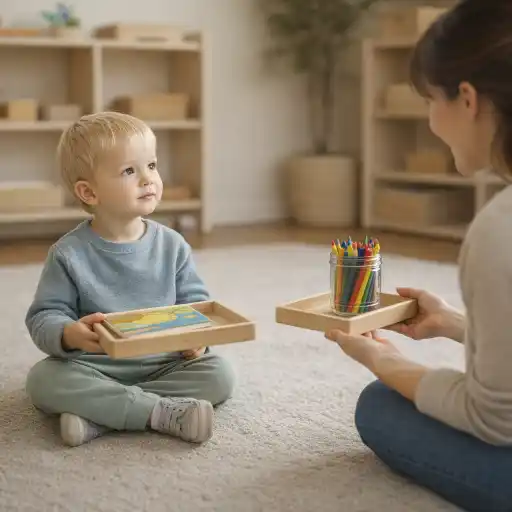 That range is valuable because children regulate differently. One child may need connection, another may need movement, and another may need a quiet visual or literacy activity. Providers should introduce the choices during calm periods, model each option, and observe how children respond. A board is not a test; children do not need to use every strategy.
For younger children or children who are already highly activated, begin with two or three options rather than displaying all eight at once. Use photographs, simple drawings, symbols, or objects alongside words so nonreaders, multilingual learners, and children with communication differences can participate.
- 🧘 Deep breathing or counting for slowing the body.
- 💧 Drinking water or stretching for a brief physical reset.
- 💬 Talking to a teacher or asking for a hug for connection.
- 🎨 Drawing or reading for quiet expression and focus.
Check that materials are safe, washable, accessible, and appropriate for the child’s age. State requirements vary - check your state licensing agency.
How should educators teach children to use the board before a crisis?
Children need rehearsal. Introduce the board during a group meeting, small-group activity, or individual conversation when children are regulated. Explain that strong feelings are normal and that the board offers ideas for helping the body feel safer and more organized.
Model the process explicitly: “I feel frustrated because the blocks fell. I’m going to choose three slow breaths.” Then invite children to practice with puppets or pretend situations. A puppet might lose a turn, spill paint, or struggle to zip a coat. Ask, “What could help the puppet?” Children can point to a strategy, act it out, and notice the result.
Practice across the day rather than only after conflict. A 30-second breathing routine before lunch, stretching after outdoor play, or a brief feelings check-in at arrival builds familiarity. Play-based activities such as Freeze Dance, Red Light/Green Light, and emotion charades also strengthen stopping, waiting, noticing, and choosing.
Use specific encouragement instead of evaluating the child as “good” or “bad.” Try:
- “You noticed your fists were tight and chose stretching.”
- “You asked for help instead of grabbing.”
- “You tried counting, and your body became ready to talk.”
Repeated practice helps children internalize a simple sequence: notice, choose, try, and reflect. The goal is not perfect independent regulation; it is gradual growth with adult support.
How can adults offer choices during emotional escalation?
During escalation, use fewer words and a calm, predictable sequence: Connect, Calm, Coach. First, connect by moving nearby and acknowledging the child’s experience: “I’m here. You are safe.” Next, calm by reducing stimulation and offering one or two board choices. Only after the child is more organized should the adult coach problem-solving or repair.
Choice language should be brief and concrete:
- “Do you want breaths or water?”
- “Would you like to draw or sit with me?”
- “Do you want a hug, or would you like space nearby?”
Do not insist that a child select a strategy immediately. The adult may point to the board, demonstrate one option, or remain close while the child watches. Some children need connection before they can make a choice. Others may need reduced noise, movement, visual communication, or a familiar comfort object.
Choices must never be used to negotiate away safety. If a child is hitting, biting, throwing dangerous objects, or attempting to run, calmly block the unsafe action and follow program procedures: “You may be angry. I will not let you hurt anyone. You can stomp here or squeeze the pillow.” Move other children as needed and maintain supervision.
After the child returns to participation, reflect briefly: “You chose water, then you were ready to talk. What should we try next time?” Avoid turning the reflection into a lecture or requiring an apology before the child is ready.
How can directors and teaching teams make choice boards inclusive and effective?
Consistency across adults is essential. Teams should agree on the purpose of the board, the language used to introduce it, supervision expectations, and the process for returning to play or learning. A shared script might be: “This board helps you choose a safe way to care for your body. I will help you.”
Invite families to identify familiar calming strategies, home-language feeling words, and cultural practices that support comfort. Some children may need individualized communication supports or collaboration with early intervention, occupational therapy, mental health consultation, or other specialists. A choice board should expand access, not require children to communicate in one prescribed way.
Place the board where children can see it without making the calm space feel like isolation. A calm-down area should be voluntary or offered as a supportive option, supervised, and never used as humiliation or punishment. Keep the environment uncluttered, and offer only the materials children can use safely.
Directors can review implementation through brief observation and documentation:
- What happened before the child needed support?
- Which choices were offered and selected?
- Did the strategy reduce distress or support re-entry?
- Did the child need adult proximity, modeling, or physical assistance?
- Are particular routines producing repeated dysregulation?
Patterns may point to environmental changes, clearer transition warnings, smaller groups, more movement, or a task adjustment. If distress remains frequent, prolonged, or unsafe despite consistent support, partner with the family, director, and appropriate professionals. The board is a classroom tool, not a substitute for individualized assessment.
What common mistakes should providers avoid?
The most common mistake is presenting choices only after a child is already overwhelmed. Without prior teaching, a board can become confusing or feel like another demand. Practice each strategy when children are calm, and introduce new options gradually.
Another mistake is offering too many choices. A large display may look attractive to adults but can overwhelm a child whose attention is already narrowed. Begin with two or three strategies and expand as children become familiar with the routine.
- Mistake: “Choose now or you will lose your turn.”
Better: “I’ll stay with you. You can choose breaths or water when you are ready.” - Mistake: Using the board as a time-out system.
Better: Frame it as a voluntary, supervised support. - Mistake: Treating one strategy as universally calming.
Better: Observe individual responses and adapt. - Mistake: Asking for explanations during peak distress.
Better: Use short language and reflect later. - Mistake: Ignoring the classroom environment.
Better: Address noise, waiting, transitions, crowding, and task difficulty.
Providers also deserve compassion. Supporting regulation repeatedly is demanding work. Team reflection, coverage, and consistent planning help adults remain available and responsive. For additional professional learning, consider From Tantrums to Triumphs: Equipping Preschoolers with Self-Regulation Skills Buy Now $25.00, which focuses on calming breaths, engaging activities, self-control, and challenging behavior.
Other relevant options include Social Foundations and Responsive Classrooms Buy Now $24.00, Supporting Children’s Independence Buy Now $24.00, and CDA Subject Area 3 Buy Now $80.00. Course details, completion requirements, and state acceptance should be reviewed before enrollment.
Conclusion: How do real choices help children calm down?
Giving children real choices helps them calm down by reducing cognitive demand, strengthening agency, and connecting regulation to practical actions. The most effective approach combines a small visual menu with co-regulation, clear safety limits, repeated practice, and responsive observation.
- Teach the choices before children need them.
- Offer two or three familiar strategies during escalation.
- Honor differences in sensory, communication, cultural, and relational needs.
- Use the Calm Down Choice Board to connect feelings with concrete actions.
- Reflect after calm and celebrate effort, not perfection.
- Collaborate with families and specialists when patterns persist.
When a child points to breathing, water, drawing, a teacher, or another option, that small decision represents meaningful learning. With patient adults and consistent practice, choices become a bridge from overwhelming feelings to safety, connection, and growing independence.
- CDA Home Visitor Subject Area 3 Part 3 Birth to 5
- Emergency and Disaster Preparedness
- Pediatric RSV First Aid & CPR/AED
- Play with Purpose: Supporting Children with Autism
- Creating Engaging and Meaningful Learning Experiences
- Sensitive Periods in Montessori: Guiding Natural Learning
- Self-Regulation & Change: Helping Children Cope
- Anxiety: Signs & Strategies
- Access for All: Inclusion and the ADA
- Supporting Children's Independence
- Confidence Boosters for Preschoolers
- Gift of Gratitude: Fostering Emotional Intelligence in Children through Acts of Kindness
- CDA Certification en Español: Recursos y Consejos para Educadores Bilingües
- 💛🧩 ¿Cómo puedo hacer que mi enseñanza sea inclusiva para los niños con autismo?
- Recursos en Español sobre el Sueño Seguro del Bebé
- ¿Cómo empiezo mi certificación CDA en Florida en línea?
- Proporciones de Cuidado Infantil y Tamaños de Grupo por Edad en Nueva Jersey (Guía Rápida para Centros y Hogares)
- Proporciones de Cuidado Infantil y Tamaños de Grupo por Edad en Virginia (Guía Rápida para Centros y Hogares)
- Lista para Guardería en Casa en Illinois: Cómo Iniciar una Guardería en el Hogar
- Cómo Trabajar en el Cuidado Infantil en Carolina del Norte: Requisitos y Pasos
- Calabazas, hojas y manzanas: actividades de otoño para preescolares
- Celebrando la amistad en el cuidado infantil durante el Día de los Mejores Amigos
- Canciones, juegos y preguntas de círculo para niños
- How Saying No Supports Children’s Emotional Development
- Happy or Sad? Preschool Activities That Help Children Read Emotional Clues
- Feelings Activities for Toddlers: Point, Move, Match, and Name It
- How Does Co-Regulation Help Children Learn to Calm Down?
- How Can Child Care Providers Teach Beginning Sounds with Tracing, Pictures, and Repetition?
- How Can Giving Children Real Choices Help Them Calm Down?
- How Can You Use a Hundreds Chart Beyond Rote Counting?
