Transportation is one of the highest-risk parts of an early childhood program’s day because transitions, tight schedules, mixed age groups, supervision demands, and children’s individual medical or accessibility needs can all converge. This practical, evidence-informed guide helps directors and providers create reliable transportation procedures for both center-based and family child care programs. It covers vehicle inspections, attendance checks, appropriate child restraints, active supervision, driver and monitor responsibilities, emergency information, medication needs, field-trip planning, and procedures to ensure no child is ever left in a vehicle. For guidance on preventing heat-related injuries and managing vehicle temperatures during warm months, see the Vehicle Safety Tips for Summer. To strengthen staff knowledge and preparation, explore ChildCareEd’s self-paced online Transportation Safety  Buy Now $16.00 course, which addresses safe transportation practices, supervision, passenger restraints, vehicle operation, and field-trip planning. Programs can also use the free Child Seatbelt Safety Checklist Buy Now $0.00 to reinforce consistent safety checks. Remember that transportation requirements vary by state, so always consult your state licensing agency.
Why it matters:
1) Injury prevention: Motor-vehicle crashes and mishandled transitions are major causes of serious injury. Trusted guidance — for example, from the CDC on child passenger safety — shows how car seats, proper harnessing, and the back seat reduce risk.
2) Program quality and trust: Clear policies, practiced routines, and good communication reduce staff stress, protect children, and reassure families. Use straightforward documentation and rehearsal to make safety habitual. Remember: state requirements vary - check your state licensing agency.
What paperwork, policies, and pre-trip checks should every program have?
Every trip — from daily pick-up to a field trip — should begin with the same basic paperwork and written plan. Prioritize simplicity and redundancy so staff can act fast when needed.
- 📋 Permission and authorization
- Obtain a signed field-trip/transportation permission slip that lists destination, date, times, travel mode, and the adult authorized to receive the child. See the ChildCareEd model: How can child care programs keep children safe during transportation?.
- Where allowed, accept electronic signatures — but verify your licensing rules first. State requirements vary - check your state licensing agency.
- 🧾 Medical and emergency info
- Pack each child’s medication authorizations, allergy plans, and emergency contacts in a leader packet and also keep copies in the child’s file.
- Designate one staff member to carry and manage medications (documented and labeled).
- 🧰 Leader packet and vehicle checklist
- Include roster, map, phone, first aid kit, paper copies of permissions, and a plan for what to do if the authorized pickup person is absent.
- Perform and document a vehicle safety check each use: lights, tires, seat anchors, and restraint availability. For vehicle rules and model language, see Illinois DCFS transportation standards: Section 407.280.
- 🔁 Practice and role assignment
- Before departure, assign roles: leader, counter, medication holder, first aid person. Use the same roles every trip so staff know expectations.
How do we choose, install, and check car seats and restraints correctly?
Use the child’s size, the seat’s limits, and the vehicle’s installation options — in that order. National guidance and hands‑on checks are essential.
- Match seat to child
- Follow the CDC’s staged recommendations: keep children rear‑facing as long as the seat allows, switch to forward‑facing with harness when outgrown, then booster until a seat belt fits. See the CDC guidance: Child Passenger Safety.
- Install using LATCH or seat belt correctly
- 🔧 Tighten so the seat moves no more than 1 inch side-to-side at the belt path. The CDC and ChildCareEd resources emphasize the 1" rule and top-tether use — see CDC resources and ChildCareEd’s practical guides (example: North Dakota guidance).
- 📌 Check stickers: confirm the manufacture date, expiration, and recall status before using any seat.
- Daily verification routine (numbered checklist)
- 1) Verify the correct seat assigned to the child.
- 2) Confirm harness snug, chest clip is at armpit level.
- 3) Document who checked and the time.
- Get hands‑on support
- 👩🏫 Arrange certified car‑seat checks with local Safe Kids or law‑enforcement events or have staff trained via ChildCareEd courses (Transportation Safety Buy Now $16.00).
- 👩🏫 Arrange certified car‑seat checks with local Safe Kids or law‑enforcement events or have staff trained via ChildCareEd courses (Transportation Safety
What staffing, supervision, and training practices keep children safest while moving?
Active supervision is non‑negotiable. Your policies should spell out ratios, staff roles, and continuous observation strategies that travel with the children — not just classroom norms.
- Maintain clear ratios and written roles
- 1) Write ratios into the trip plan and exceed licensing minimums for transitions when possible. ChildCareEd recommends adding an extra adult during loading/unloading and for mixed‑age groups (see practical guidance).
- Use active supervision techniques
- 👀 Position staff so each adult can see and hear their assigned children. Rotate counters (a named staff member who performs the head count) at each transition: before loading, after boarding, on arrival, and before returning.
- 🧭 Assign a dedicated ‘‘safety sweep’’ to check the vehicle at trip end (a documented post‑trip sweep prevents tragic oversights; this is also stressed in state rules such as Illinois Section 407.280).
- Train, practice, and refresh
- 📚 Require staff to complete transportation safety training (e.g., ChildCareEd’s Transportation Safety and Appropriate Precautions courses) and practice drills for loading/unloading and behavior expectations.
- 🔁 Rehearse routes, emergency plans, and the counting routine weekly or before major trips to keep skills sharp.
How do we include children with medical needs or disabilities and manage emergencies?
Inclusion and safety are complementary. Transport plans should be individualized, co‑created with families, and documented so staff can act confidently.
- Plan with families early
- 🤝 Meet the family to collect medical authorizations, device instructions (EpiPen, inhaler, oxygen), and calm
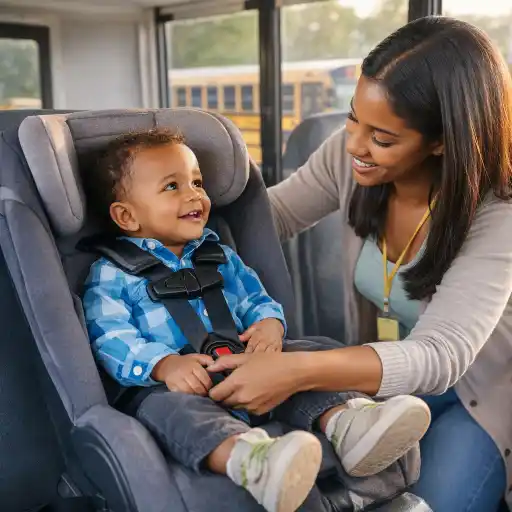 ing strategies. Put those instructions in the leader packet.
- 🤝 Meet the family to collect medical authorizations, device instructions (EpiPen, inhaler, oxygen), and calm
- Document individualized transport plans
- 1) Add a short transportation safety plan to the child’s record describing seating, staff support, medication administration steps, and emergency contacts.
- Train staff and check equipment
- 👩⚕️ Ensure at least one adult on the vehicle is trained to administer any required medication and to use medical devices. Use community specialists for hands‑on training where possible (ChildCareEd resources).
- 🔒 Verify specialized seating fits the vehicle and can be secured safely before the trip.
- Emergency protocols
- 📞 Carry a charged phone, a written emergency plan, and local emergency numbers. Assign who calls, who cares for the group, and where to meet if you must evacuate a vehicle.
- 🧾 Document incidents per your state reporting rules and follow up with families and licensing. Again: state requirements vary - check your state licensing agency.
How do we plan, practice, and audit trips to reduce risk and stay inspection‑ready?
Risk management is iterative. Use a short planning cycle and checklists before, during, and after each trip. Make audits part of routine supervision.
- Pre-trip planning checklist (use numbering)
- 1) Confirm permissions collected and leader packet assembled.
- 2) Verify car seats and restraints for each child and document the installation check.
- 3) Assign staff roles and review the counting routine with everyone.
- During-trip controls
- 🔢 Perform head counts at four critical points: before leaving, after boarding, after unloading, and before returning. Keep a visible roster and a count sheet.
- 👥 Keep the same adult next to the child who needs closer observation (a buddy or aide) for consistent supervision.
- Post-trip audit
- ✅ Conduct the post-trip vehicle sweep, record who completed it, and log any vehicle or seat issues.
- 📈 Review the trip in staff debriefs: what went well, what to change. Use the short debrief to update policies and training.
- External compliance and resources
- 1) Cross-check your policies against national standards like Caring for Our Children and CDC materials.
- 2) Keep state licensing contact info handy — state requirements vary - check your state licensing agency.
- 3) Use ChildCareEd templates and trainings to simplify documentation and staff onboarding (Transportation Safety course Buy Now $16.00).
Conclusion — a short, actionable checklist for today
Use this compact checklist to make transportation safe, inclusive, and defensible. Repeat it every trip until it becomes routine.
- 📋 Collect: signed permission, medical authorizations, and emergency contacts. #permission #transportation
- 🔒 Secure: correct car seat or restraint for each child; document installation. #carseats #safety
- 👥 Assign: named roles (leader, counter, medication holder) and maintain active supervision. #supervision
- 🧰 Pack: leader packet with roster, first aid, phone, and printed plans.
- 🔁 Practice: rehearse loading/unloading, counting routine, and emergency drills; audit after each trip.
FAQ (quick answers for directors)
- Q: Can we accept electronic permission slips? A: Often yes, if your state and licensing permit electronic signatures. Verify with your licensing agency; state requirements vary.
- Q: Who must check car seats each day? A: Assign and document a trained staff member to check installations before departure; consider a second checker for infant/toddler groups.
- Q: What if a parent is late at pickup? A: Have the center’s written drop-off/pickup plan; do not release the child to an unauthorized person; document attempts to contact the family. Follow your licensing rules.
- Q: Can volunteers drive children? A: Only if they and their vehicle meet your written approval process and your state licensing rules; center‑owned/contracted vehicles reduce compliance risk. See Illinois rules as an example: Section 407.280.
- Q: How do we include children with disabilities? A: Co-create a transport plan with families, confirm seating and device compatibility, train staff, and document consent and procedures.
Final encouragement: transportation safety is a system, not a single task. Build simple, repeated routines, train staff often, and use short audits to learn. Prioritize inclusion and communication with families, and lean on resources like ChildCareEd’s Transportation Safety, the CDC, and Caring for Our Children as you refine your practices. #transportation #safety #carseats #supervision #permission
- Creating Safe & Healthy Child Care Environments
- 45 Hour Child Growth and Development
- Basic Health & Safety and Breastfeeding Awareness
- Bienvenido! Welcoming All Families
- Children at the Wheel: Emergent Curriculum
- 45 Hour Infant and Toddler Methods and Materials
- Pediatric RSV First Aid & CPR/AED
- 45 Hour School Age Methods and Materials
- Texas Director Credential
- Vehicle Safety Tips for Summer
- CDA Certification en Español: Recursos y Consejos para Educadores Bilingües
- Does Maryland's Basic Health and Safety Training Cover Today's Biggest Risks?
- 💛🧩 ¿Cómo puedo hacer que mi enseñanza sea inclusiva para los niños con autismo?
- Recursos en Español sobre el Sueño Seguro del Bebé
- Proporciones de Cuidado Infantil y Tamaños de Grupo por Edad en Virginia (Guía Rápida para Centros y Hogares)
- Best Daycare Field Trip Ideas in Maryland
- Summer Field Trips for Daycares in Maryland
- Summer Field Trips for Daycares in North Carolina
- Canciones, juegos y preguntas de círculo para niños
- Cómo simplificar la capacitación para sus empleados de daycare
- How can child care programs keep children safe during transportation?
- How can childcare programs make transportation safe, inclusive, and compliant?
- How Can Farm-to-Table Experiences Teach Toddlers Where Food Comes From?
- How Can Child Care Programs Create Inclusive Programs for Rural Communities?
- Including Every Child: What Child Care Providers Should Know About the ADA
- Field Trips for Elementary Students: 15 Adventures That Bring Learning to Life
- What Certifications Do I Need to Open a Child Care Center? Owner vs. Director Requirements Explained
- What Do You Need to Open an After-School Program? Licensing, Training, and Staffing Explained
- How Can Social Stories Prepare Children for New Experiences?
