You work with children every day and can spot small changes others might not see. This article helps child care providers and directors notice early signs a child may need extra help and what to do next. It uses simple steps, real tools, and kind ways to 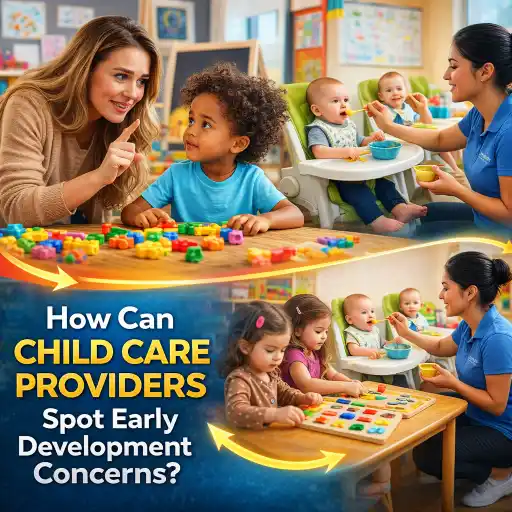 talk with families.
Why it matters: Finding concerns early gives children a better chance to get support and grow. Early help often makes a big difference in learning, speech, movement, and behavior. Providers who watch, write down what they see, and share with families help children succeed.
Please note: state requirements vary - check your state licensing agency.
What should I watch for every day?
- Watch the big areas: 1) talking and listening, 2) thinking and learning, 3) moving and using hands, 4) feeling and playing with others. These are the main milestone areas from the CDC milestones guide.
- Learn the warning signs: check age red flags like not babbling, not pointing, or losing skills. Help Me Grow gives clear age-based red flags you can use as a guide: red flags by age.
- Use quick checklists: print or use the CDC Milestone Checklists to compare what you see at the child’s age (milestone checklists).
- Remember: you are watching your #children every day. Spotting patterns matters more than a single moment.
How do I observe and record what I see?
- Collect facts. Write short notes that say exactly what happened and when. Example: "3/2 during snack, did not reach for cup." Use tools from ChildCareEd about observing and recording: observing and recording Buy Now $0.00.
- Use the CDC Milestone Tracker app or printable checklists to keep a timeline: Milestone Tracker app and checklists by age.
- Make it routine. Every week, update a short checklist for each child and keep a small portfolio of 3–5 photos or samples.
- Share facts, not labels. Write what you saw, not a diagnosis. This helps families and keeps records professional. For ideas on documentation and reflection, see observation, documentation, and reflection Buy Now $0.00.
- Try this short plan:
- 🔎 Observe 2 weeks,
- 📝 Record 3 examples,
- 📤 Share with family and follow up.
How do I talk with families without causing panic?
- Prepare: collect notes, milestone checklist, and a meeting time. ChildCareEd offers a guide on talking with families: how to tell families.
- Start with strengths. Say what the child does well first. Then share observations: be specific and short.
- Use the checklist as a tool. Show facts from the CDC checklists or the Milestone Moments booklet (developmental monitoring).
- Offer next steps and choices:
- 🙂 Monitor together and check back in 2–4 weeks,
- 🔁 Try classroom strategies and simple home activities. For example, short, inclusive cultural activities—such as age-appropriate Flag Day activities for young children—can support language development, routines, and social skills,
- 📞 Suggest a pediatrician visit for formal screening or a referral to early help.
- Common mistakes to avoid:
- 🚫 Don’t use scary labels or give a diagnosis — you are an observer, not the clinician.
- 🚫 Don’t rush the talk at pick-up; schedule a private time instead.
- Keep your #parents informed and part of the plan. Offer written notes and a follow-up time.
When should I refer for screening or early intervention?
Some signs mean you should act right away. Use these clear steps to decide and refer.
- Look for red flags or loss of skills. If a child loses skills they once had, refer now. Help Me Grow lists many age-based red flags to guide referral decisions: red flags by age.
- Follow screening timing advice. The American Academy of Pediatrics and CDC recommend screenings at 9, 18, and 30 months and autism checks at 18 and 24 months. Learn more at the CDC screening pages: developmental screening and ASD screening.
- If you decide to refer:
- 📞 Help the family contact their pediatrician or local early intervention program,
- 📝 Give them the written milestone notes and any checklists you used,
- 🤝 Offer to help fill referral forms or make the call if the family asks.
- Learn referral steps from Help Me Grow and local systems. For how to refer and what happens next, see: how to refer.
- Remember: early services help. The CDC and training materials explain that early intervention can improve a child’s learning and life outcomes (Watch Me! training).
Conclusion
You are a powerful partner for families. Use daily observation, clear notes, easy checklists, and kind conversations. Follow these quick actions now:
- 📋 Start or update a milestone checklist for each child this week.
- 📸 Collect 3 short observation notes or photos over 2 weeks.
- 🤝 Schedule a calm meeting with the family to share strengths and one concern if needed.
- 📞 If red flags appear, help the family contact the pediatrician or local early intervention program — referrals are a next step, not a label.
Want more training? ChildCareEd and CDC offer courses and materials on observation, screening, and family talks: see Developmental Screening in Early Childhood  Buy Now $16.00 and CDC resources like the Milestone Tracker app (Milestone Tracker).
Keep watching your #observation, tracking #milestones, and supporting each child’s #development every day.
Good notes help families and doctors know what’s happening. Try these steps for clear, useful records. Families trust you. Use calm, kind words. Follow these steps when you set a meeting. Look for small but important changes in how a child plays, talks, moves, and gets along with others. Use these simple steps:- 45 Hour Child Growth and Development
- 45 Hour Preschool Methods and Materials
- 45 Hour Infant and Toddler Methods and Materials
- 45 Hour School Age Methods and Materials
- CDA Bridge Bundle: Family Child Care without Portfolio Review
- CDA Bridge Bundle: Infant/Toddler without Portfolio Review
- Texas Director Credential
- Proporciones de Cuidado Infantil y Tamaños de Grupo por Edad en Virginia (Guía Rápida para Centros y Hogares)
- Retraso del Habla en la Guardería: Cómo Pueden Ayudar los Proveedores
- How can child care providers best support language development in young children?
- How Typical and Atypical Development Differ in Preschoolers
- How can child care programs best support infant and toddler development?
- Capacitación CDA gratuita en Illinois
- How to Know If Your Baby Is Developing Normally
- What Should Texas Child Care Providers Watch for in Preschool Development?
- Child Development Classes in Texas for Early Childhood Professionals
- How Can Early Childhood Programs Support Mental Health?
- How do Minnesota child care providers support child health and family stability?
- How Can Child Care Providers Understand Typical and Atypical Child Development?
- How Does the Brain Develop During the First Five Years?
- How should child care programs document infant and toddler development?
- Is This Development Typical? When Child Care Providers Should Watch, Document, or Refer
- How Can Child Care Providers Recognize and Support Developmental Delays?
- How Can Child Care Providers Use Developmental Screening to Support Every Child?
- What Are the Best Ways to Support a Child’s Speech Development?
- How Can Child Care Providers Understand and Support Speech and Language Development?
- When Should a Child Care Provider Be Concerned About Development?
