A child who knows what to expect can approach a new classroom with more confidence—even when goodbyes still feel hard. For children entering kindergarten, try the First Day Feelings Check-In Worksheet for Kindergarten Buy Now $0.99 as a conversation starter, then talk through what will happen at arrival, during play, and when their caregiver returns. Pairing space for feelings with clear explanations can make the day feel more understandable and welcoming. For focused professional learning on recognizing and responding to children’s worry, explore ChildCareEd’s Anxiety: Signs & Strategies  Buy Now $16.00. Read on for practical ways to prepare children and families for a reassuring first day.
Why does helping a child know what to expect matter?
A first day brings many unfamiliar experiences at once: a new room, new adults, other children, different sounds, and a separation from family. A worried child may cry, cling, withdraw, or resist joining an activity. These responses are not necessarily a sign that the child is unwilling or that a family has made the wrong choice. They may be the child’s way of communicating uncertainty while adjusting to change.
When adults make the sequence of the day more concrete, children have an easier starting point. A warm relationship, familiar routines, and honest reassurance help build a sense of safety. The goal is not to promise that a child will never feel upset; it is to show that caring adults understand the feeling and can help the child through it.
Preparation also supports families and educators. Families can share what comforts their child, while staff can plan consistent greetings, goodbyes, and check-ins.
How can providers prepare children and families before day one?
Preparation is most helpful when it is gradual, specific, and shaped around each child. Invite families to visit the room when possible. Let the child look around at their own pace, meet an educator, find their cubby, and see where familiar activities happen. If a visit is not practical, share a few photos of the entrance, classroom, teacher, and play area.
Talk about the day in simple, truthful language. Instead of saying, “You won’t be nervous,” try, “You’ll come in with Dad, put your backpack away, play, have lunch, and I’ll be here when your family comes back.” Use words that match the child’s experience of time, such as “after snack” or “after nap,” rather than relying only on clock time.
- Share the basic arrival and daily routine with families ahead of time.
- Ask about the child’s interests, home language, comfort strategies, sensory preferences, and important routines.
- Use a story, pretend play, or a brief practice visit to rehearse what arrival may look like.
- Agree on a familiar item—such as a family photo or small comfort object—if program policy allows.
- 📅 Make a simple first-day plan that identifies who will greet the child and what the first activity will be.
Children vary in temperament, communication, developmental needs, and how quickly they feel comfortable. Coordinate with families to make preparation relevant rather than expecting every child to respond the same way. For infants and toddlers, include familiar feeding, sleep, and soothing information in the plan.
How can a predictable routine make the first day easier?
A dependable sequence gives children useful clues about what comes next. Keep the arrival steps simple and consistent: greet the child, put belongings away, share a brief goodbye, connect with a familiar adult, and begin a welcoming activity. Use the same words and visual cues across staff whenever possible. Small repeated patterns can help the classroom feel more familiar over time.
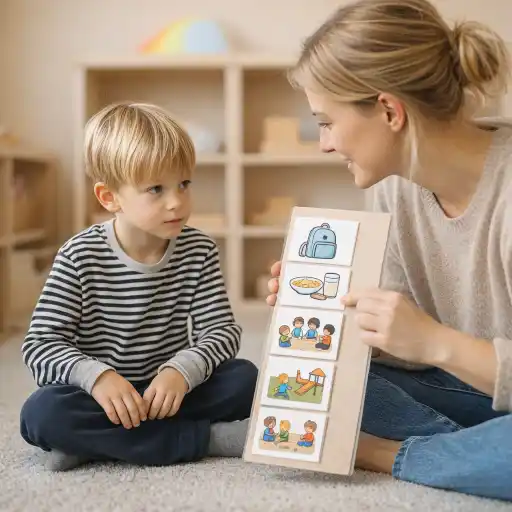
A picture schedule can show the main parts of the day—arrival, play, snack, outdoor time, lunch, rest, and pickup. Place it at children’s eye level and point to the next step as the day unfolds. Photographs, symbols, or objects may communicate more clearly than written words for children who are not yet reading or who are learning the classroom language. The Illinois Early Learning Project offers a helpful overview of visual schedules and related resources.
Make the schedule realistic and flexible. A visual plan is a guide, not a promise that every activity will happen at an exact time. If the day changes, show or explain the change in a calm, straightforward way. For a worried child, a short “first, then” message can help: “First we put your bag away, then we choose a book.”
When feasible, keep the first activity familiar and low pressure: blocks, a favorite book, playdough, or a simple classroom job. A choice between two appropriate options can offer a little control without overwhelming the child. Consistent routines do not eliminate every tear, but they can help a child understand the day’s shape and find the next point of connection.
What should educators say and do when a child feels worried?
Start by noticing and accepting the child’s feeling. A calm voice, an unhurried posture, and gentle proximity can communicate support before a child is ready to listen to explanations. Name the emotion without judgment: “You look worried. It can feel strange to be in a new room.” Then offer an honest, manageable next step: “I’m here with you. Let’s look at the picture schedule.”
Young children are still developing the ability to regulate emotions and behavior. Some need an adult to stay close, offer a lap or hand to hold when welcomed, or sit together with a book before joining play. Others may want space to observe. Follow the child’s cues, respect boundaries, and avoid pressuring immediate participation. ZERO TO THREE’s guidance on supporting children as they transition to an early learning environment highlights the value of warm, individualized interactions and support for developing self-regulation.
- Use a photo of family or a permitted comfort item to support connection to home.
- Offer a familiar activity or invite the child to watch before joining in.
- Repeat short, reassuring messages rather than giving a long explanation.
- Notice and describe small steps: “You walked in with me,” or “You chose a puzzle.”
- Coordinate staff roles so the child has a dependable adult at arrival when possible.
A child’s home language, disability, sensory needs, culture, and previous experiences may affect how they understand or express worry. Use family knowledge and accessible communication supports; do not mistake quietness or different forms of communication for a lack of feeling. The aim is connection and safety, not making distress disappear on demand.
How can providers and families work together through goodbyes?
A clear, loving goodbye helps the child understand that separation is happening and that the family member intends to return. Before the first day, agree on a brief ritual: a hug, a familiar phrase, and perhaps a wave from a doorway or window. The family can say, “I love you. I’ll be back after lunch,” then hand the child to the educator and leave. A steady routine is generally more reassuring than repeated departures and returns.
Encourage families not to slip away without saying goodbye. Although it may seem easier in the moment, disappearing can make the separation harder to understand. At the same time, avoid setting a rigid time limit for a child’s adjustment or promising the child will stop crying quickly. Be warm, direct, and dependable; let the educator take over with care once the goodbye is complete.
Communication with families should be respectful, specific, and guided by program privacy practices. At pickup, share observations rather than labels: “She was upset at arrival, sat with me for a few minutes, and later explored the art table.” If the program’s policy allows, agree in advance on how and when a family will receive a brief update.
Listen to family concerns without judgment. Ask what words, songs, objects, or routines comfort the child at home, and share what you observe at the center. The NAEYC guidance on easing first-day jitters describes partnership strategies such as consistent goodbye routines, familiar objects, and visual supports. Revisit the plan with the family as the child’s needs and responses become clearer.
What common pitfalls should providers avoid, and when might more support help?
Well-intentioned responses can sometimes add uncertainty. Avoid sneaking away, stretching the goodbye into a prolonged negotiation, or making promises you cannot keep. Do not shame, threaten, bribe, or tell a child they have no reason to feel worried. Instead, acknowledge the emotion, communicate the next step, and provide a calm adult presence.
Another pitfall is expecting a single strategy to work for every child. A comfort object may help one child but distract or upset another; a busy welcome activity may feel inviting to one child and overwhelming to another. Observe what actually helps and adjust in partnership with the family. Consider age, temperament, sensory preferences, language, disability-related supports, and changes in the child’s life.
- Keep brief notes on how the child arrives, what support is offered, and how they participate afterward.
- Share progress and concerns privately, using concrete observations rather than diagnostic labels.
- Review the plan with the family if distress persists, intensifies, or limits the child’s ability to take part.
- When appropriate, encourage the family to consult the child’s pediatrician or a qualified child development or mental health professional.
There is no universal timetable for adjustment, and one difficult morning does not predict how the transition will unfold. If worry remains severe or persistent, occurs in multiple settings, or is accompanied by significant changes that concern the family, collaborative consultation may help identify additional support. State requirements vary - check your state licensing agency, especially for program procedures, documentation, and communication rules.
Conclusion: How can we help a worried child know what will happen?
Help a worried child understand the first day by making it familiar, concrete, and relational. Before the start, invite visits or share photos, discuss the day in child-friendly steps, and learn from the family about the child’s strengths and comforting routines. In the classroom, use a warm greeting, a visible schedule, a predictable arrival sequence, and a low-pressure first activity.
When worry appears, validate it, stay calm, and offer support matched to the child’s cues. Partner with families on an honest, brief goodbye and communicate with specific, respectful observations. Watch for small signs of growing comfort, adjust strategies as needed, and seek further consultation when distress is persistent or significantly limits participation. Children do not need a perfect first day; they need caring adults who help them understand what comes next and show, through consistent actions, that they are safe and supported.
For further professional learning, explore these relevant English-language ChildCareEd courses:
- Anxiety: Signs & Strategies Buy Now $16.00 — recognizing and responding to children’s anxiety.
- Every Moment Matters: Schedules and Transitions Buy Now $55.00 — planning routines and transitions around children’s needs.
- Self-Regulation & Change: Helping Children Cope Buy Now $16.00 — supporting children through change and emotional regulation.
- CDA Infant/Toddler: Parent Relationships Buy Now $16.00 — strengthening family partnerships during separation and attachment.
- Let’s Talk: Effective Communication Buy Now $24.00 — building responsive communication with families.
- CDA Certification en Español: Recursos y Consejos para Educadores Bilingües
- ¿Cómo empiezo mi certificación CDA en Florida en línea?
- Capacitación en Salud y Seguridad Preventiva en Línea para Proveedores de Cuidado Infantil
- ¿Cómo solicito la licencia para una guardería en California?
- Regulaciones de Licenciamiento de Cuidado Infantil en California para Centros y Hogares de Cuidado Infantil Familiar
- Normas de Licenciamiento de Cuidado Infantil en Virginia para Centros Diurnos Infantiles y Hogares Diurnos Familiares
- Proporciones de Cuidado Infantil y Tamaños de Grupo por Edad en Maryland (Guía Rápida para Centros y Hogares)
- Proporciones de Cuidado Infantil y Tamaños de Grupo por Edad en Virginia (Guía Rápida para Centros y Hogares)
- Lista para Guardería en Casa en Illinois: Cómo Iniciar una Guardería en el Hogar
- Lista para Guardería en Casa en Texas: Cómo Iniciar una Guardería en el Hogar
- Cómo Trabajar en el Cuidado Infantil en California: Requisitos y Pasos
- Cómo Trabajar en el Cuidado Infantil en Virginia: Requisitos y Pasos
- The First Weeks of Child Care: Building Trust with Children
- How Can North Dakota Childcare Providers Support Children Who Have Never Been in a Group Setting Before?
- Celebrando la amistad en el cuidado infantil durante el Día de los Mejores Amigos
- How Can Social Stories Prepare Children for New Experiences?
- How Can Child Care Providers Support Kindergarten Emotions on the First Day of School?
- Why Do Toddlers Bite, and How Should Child Care Providers Respond?
- What Are the Best Ways to Support Separation Anxiety at Daycare Drop-Off?
- How Can Child Care Providers Help a Worried Child Know What Will Happen on the First Day?
