The shortest day of the year offers a vivid, hands-on way to help young children notice how light, darkness, and shadows change. With a few safe materials and time to wonder, providers can turn the season into playful science that supports observation, language, and creativity. For practical strategies to plan age-appropriate investigations and nurture children’s scientific reasoning, explore Basic Science in Early Childhood Buy Now $25.00; it offers focused professional learning that can strengthen your classroom practice.
Why does the winter solstice make light and shadow exploration meaningful?
The winter solstice marks the shortest day and longest night of the year in the Northern Hemisphere. It occurs when that hemisphere is tilted farthest away from the Sun; afterward, daylight gradually increases. In the Southern Hemisphere, the seasons are opposite. Children do not need a lecture on astronomy to engage with the idea. They can begin with what they notice: the early sunset, a patch of sunlight moving across the floor, or a shadow stretching across the playground.
These seasonal observations invite children to compare, predict, and ask questions. A shadow investigation also makes a complex idea tangible: an object blocks light, and the shadow appears on a surface beyond it. As children move, shift objects, and test different materials, they explore cause and effect while practicing descriptive vocabulary and collaborative problem-solving. The inquiry process matters as much as any scientific explanation; a child’s “What if?” can become the starting point for another experiment.
Solstice activities can also create a calm moment of connection during a busy season. Lantern-making, nature walks, and shadow tracing invite children to notice patterns and appreciate the natural world. Keep the focus on exploration and belonging rather than assuming that every family celebrates the solstice in the same way.
How can providers introduce the solstice in a child-friendly way?
Offer a simple, accurate explanation that matches children’s experiences. For example: “Today has less daylight than any other day this year. After this, the days slowly begin to get longer.” You can mention that this pattern is different in the Southern Hemisphere. Avoid suggesting that the Sun literally changes size or that winter begins everywhere at the same time.
Start with a brief group conversation or a picture book, then invite children to share what they have noticed about winter light. Make space for different ideas and home experiences: some children may have seen snow, while others may experience a mild or rainy season. Rather than asking children to memorize facts, use their observations to decide what to explore next.
- Invite children to notice when the room or outdoor area feels brightest during the day.
- Look at the sky and surroundings together, without ever looking directly at the Sun.
- Use words such as bright, dim, light, dark, shadow, long, and short in conversation.
- Read a seasonal story or share photographs of winter landscapes and solstice traditions from different communities.
Be thoughtful when discussing cultural traditions. People around the world mark seasonal changes in varied ways, and not every family celebrates the solstice. Present traditions as diverse practices, invite families to share only if they wish, and avoid treating one custom as universal.
What simple solstice activities help children investigate light and shadows?
Choose one or two invitations rather than trying to fit every idea into a single day. Keep the materials uncomplicated, give children time to repeat an experiment, and follow the questions they show through words and actions. Outdoor observation can pair naturally with indoor exploration, especially when weather or daylight limits time outside.
- Trace a winter shadow: On a sunny day, invite children to stand in a clear, safe space while an educator traces their shadow with chalk. Return later, use a different color, and compare where the outline has moved. Keep the location as consistent as possible.
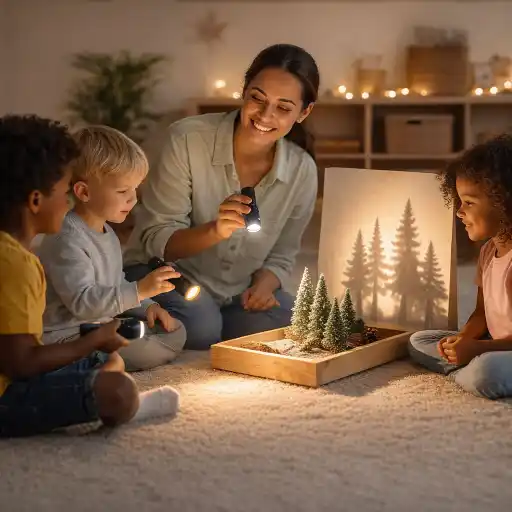
- Explore with a flashlight: In a comfortably lit area, place a flashlight, a pale wall or sheet, and a few large objects nearby. Ask children to move an object closer to or farther from the light and notice how its shadow changes.
- Create a shadow-puppet story: Use large paper shapes, a stable light source, and a screen. Children can invent a story, retell a familiar tale, or simply watch how a puppet’s shadow moves.
- Make a nature collage: Gather safe, accessible natural items such as leaves, twigs, or pinecones on a supervised walk. Arrange and draw them, then notice which items make strong shadows near a window.
- Welcome the light with a lantern: Decorate a clear, shatter-resistant container with tissue paper and use a battery-operated light with a secured battery compartment. Talk about how people use lights in different seasonal celebrations.
- 🌟 Invite children to share a prediction before testing it, then revisit the prediction together.
For related ideas, see NAEYC’s shadow walk suggestions and Science in Pre-K’s open exploration of light and shadows. Both emphasize careful noticing and giving children room to investigate.
How can educators guide children’s inquiry without taking over?
Young children learn a great deal by trying, observing, and trying again. Instead of explaining each result immediately, notice what captures a child’s attention and ask an open-ended question. Pause long enough for the child to respond through speech, movement, drawing, pointing, or a home language. Their first explanation may be incomplete, but it gives you a useful place to begin the next test.
- “What do you notice about the shadow?”
- “What might happen if we move this object closer?”
- “How could we make the shadow bigger or smaller?”
- “What stayed the same, and what changed?”
- “Where do you think the light is coming from?”
Change one feature at a time when possible. Keep the screen still while the child moves an object, then try keeping the object still while moving the flashlight. This makes it easier to compare results. If an experiment does not work as expected, treat that as useful information rather than a failure. Children may need to adjust the angle, reduce competing light, or try another object.
Document a small piece of learning—a child’s exact words, a drawing, or a photo taken under program privacy procedures. Later, revisit it together: “You thought the shadow would get smaller. What did we see?” Responsive teaching also means following children’s interest for as long as it remains meaningful, then adding a new material or question when they are ready.
How can providers keep activities safe, inclusive, and manageable?
Plan the environment so children can see and explore without crowding one another. Use cool LED flashlights and never aim a bright light at anyone’s eyes. Check that battery compartments are secure and inaccessible, and avoid loose button or coin batteries. Do not place fabric, paper, or cellophane over lamps or light fittings. Choose sturdy, age-appropriate materials without sharp edges or small detachable pieces, and actively supervise children throughout.
For outdoor investigations, follow your program’s sun-protection procedures and weather guidance. Children should never look directly at the Sun. If conditions are unsuitable, use an indoor flashlight activity or save the outdoor observation for another day. State requirements vary - check your state licensing agency.
Participation can look different for each child. Offer the choice to watch, move an object, tell a story, draw, or work with a trusted adult. Some children may prefer a brighter room or familiar objects instead of a darkened shadow theater. Provide large, easy-to-hold materials, clear visual choices, extra time, and multiple ways to communicate. An inclusive investigation values each child’s curiosity without requiring everyone to participate in the same way.
Common pitfalls are easy to avoid: don’t rush to deliver a formal explanation, don’t promise that every shadow will change dramatically, and don’t make a seasonal activity dependent on a particular family tradition. Keep the invitation low-pressure, follow children’s cues, and allow discoveries to unfold at their own pace.
Conclusion: How can a simple solstice exploration support young children?
Providers can use the winter solstice as an inviting context for children to investigate light, shadow, and seasonal change. Begin with a simple explanation, offer safe materials, and make time for children to predict, experiment, compare, and share their ideas. A traced outdoor shadow, a flashlight experiment, a nature collage, or a paper lantern can all become meaningful learning when children have room to notice and wonder.
The central goal is not to teach every detail of astronomy in one lesson. It is to help children connect what they see with questions they can explore, while building language, creativity, cooperation, and early scientific reasoning. Keep activities flexible and inclusive, follow safety practices, and let children’s interest guide the next step. For additional support in planning purposeful science experiences, consider Basic Science in Early Childhood Buy Now $25.00.
Related professional learning: Building Early Science Foundations  Buy Now $16.00; Lesson Planning for Preschoolers Buy Now $24.00; Children at the Wheel: Emergent Curriculum Buy Now $25.00; Creating the Natural Outdoor Classroom Buy Now $16.00.
- 1,2,3, Eyes on Me: Classroom Safety
- What Makes Me Special: An Overview of Autism and ADHD
- CDA Bridge Bundle: Family Child Care without Portfolio Review
- CDA Bridge Bundle: Infant/Toddler without Portfolio Review
- CDA Bridge Bundle: Preschool without Portfolio Review
- Positive Attention: Interactions & Supervision for Infants & Toddlers
- Self-Regulation & Change: Helping Children Cope
- Montessori Cultural Activities: Exploring the World Through Play and Learning
- Enhancing STEM Education for Infants and Toddlers
- Supporting Families and Caregivers in Language and Literacy
- CDA Certification en Español: Recursos y Consejos para Educadores Bilingües
- 🔍 ¿Qué ves cuando observas a un niño aprender?
- 🍑 ¿Qué capacitación requiere DECAL cada año para el personal de cuidado infantil en Georgia?
- Cómo usar tu certificación de 90 horas en Maryland para completar tu CDA
- ¿Cuáles son los pasos, requisitos y opciones en línea para la certificación de 90 horas en cuidado de Infantes/Toddlers en Maryland?
- 10 Ejemplos de Cómo la Cultura Influye en el Desarrollo Infantil
- Capacitación en Salud y Seguridad Preventiva en Línea para Proveedores de Cuidado Infantil
- Cómo Empezar una Guardería en Casa: Requisitos y Pasos
- ¿Cómo solicito la licencia para una guardería en California?
- Regulaciones de Licenciamiento de Cuidado Infantil en California para Centros y Hogares de Cuidado Infantil Familiar
- Proporciones de Cuidado Infantil y Tamaños de Grupo por Edad en Maryland (Guía Rápida para Centros y Hogares)
- Proporciones de Cuidado Infantil y Tamaños de Grupo por Edad en Nueva Jersey (Guía Rápida para Centros y Hogares)
- Proporciones de Cuidado Infantil y Tamaños de Grupo por Edad en Virginia (Guía Rápida para Centros y Hogares)
- Lista para Abrir una Guardería en Casa en Dakota del Norte: Cómo Empezar
- Lista para Abrir una Guardería en Casa en Georgia: Cómo Empezar
- Lista para Guardería en Casa en Texas: Cómo Iniciar una Guardería en el Hogar
- Capacitación Previa al Servicio para Proveedores de Cuidado Infantil en Nevada
- Canciones, juegos y preguntas de círculo para niños
- Cómo simplificar la capacitación para sus empleados de daycare
- How Can Child Care Providers Explore Light and Shadows at the Winter Solstice?
