Why does daylight fade earlier in winter—and what helps preschoolers make sense of that change? With simple explanations and hands-on investigations, you can turn seasonal questions into meaningful science learning; Basic Science in Early Childhood Buy Now $25.00 offers focused professional learning to strengthen your classroom practice. For additional strategies to follow children’s questions and plan responsive experiences, explore Children at the Wheel: Emergent Curriculum Buy Now $25.00.
When children notice an early sunset, a long playground shadow, or a sunny patch that has moved across the room, they are already gathering evidence about seasonal change. The winter solstice gives teachers a timely opportunity to build on this natural curiosity without expecting preschoolers to master complex astronomy. A few accurate words, repeated observations, and playful investigations can help children connect what they see with how Earth’s seasons change.
Why is the winter solstice a meaningful topic for preschoolers?
The solstice makes an abstract cycle visible in children’s daily experiences. In the Northern Hemisphere, the winter solstice is the day with the fewest daylight hours and the longest night of the year. Afterward, daylight gradually increases. In the Southern Hemisphere, the seasonal pattern is opposite: December brings the summer solstice. These differences are a helpful reminder that children’s experience of “winter” depends on where they live.
Seasonal inquiry is not only about astronomy. Children can practice noticing, comparing, predicting, describing, and listening to one another. They may compare today’s shadow with yesterday’s, observe changes in the weather, or draw the view from a classroom window. These experiences can build scientific reasoning while strengthening language, early math, creative expression, and cooperation.
There is no need to turn the solstice into a formal lecture. Begin with children’s own questions and observations, and make room for different local climates and family experiences. Some children may associate winter with snow; others may know it as a rainy, mild, or dry season. Learning becomes more relevant when those experiences are welcomed rather than treated as exceptions.
What is a simple, accurate way to explain the solstice?
For preschoolers, connect the explanation to the daylight they can observe. You might say: “Today has less daylight than any other day this year. After today, the days slowly begin to get longer.” If children ask why, explain that Earth is tilted as it travels around the Sun, so different places receive sunlight for different lengths of time during the year. NASA explains that Earth’s tilt—not its changing distance from the Sun—is the main reason for the seasons.
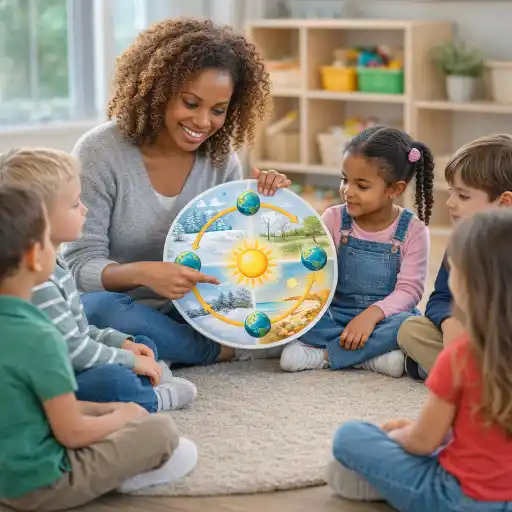
Use a globe or ball and a flashlight to make the idea more concrete. Keep the light stationary and gently tilt the globe to show that the two hemispheres receive sunlight differently. Treat the model as a simplified demonstration, not a perfect miniature of space. Children can observe which part of the ball is illuminated and talk about what they notice.
- Use familiar words such as daylight, nighttime, season, tilt, bright, and dim.
- Explain that December is winter in the Northern Hemisphere but summer in the Southern Hemisphere.
- Clarify that the solstice marks a daylight pattern, not necessarily the coldest day of the year.
- Never ask children to look directly at the Sun; use a model or observe shadows instead.
Avoid saying that the Sun becomes smaller or that Earth is farther from the Sun in winter. Accurate, brief language gives children a sound starting point, while the model and their observations help them build understanding over time.
Which hands-on activities make seasonal change easier to notice?
Choose a small number of activities and give children time to repeat them. The goal is not to complete a craft for every fact, but to help children observe a pattern and share what they think it means. A regular, short observation can be more valuable than a one-day lesson packed with activities.
- Track a shadow: On a sunny day, mark a child’s or sturdy object’s shadow with chalk. Return later, ideally to the same spot, and compare its direction or length. Talk about what changed and what stayed the same.
- Explore flashlight shadows: In a comfortably lit area, let children move a large, safe object between a flashlight and a pale wall or screen. Notice how the shadow shifts or changes size.
- Watch the daylight: At a consistent time, notice where sunlight falls in the classroom. Children can draw the bright patch or describe what they see through a window.
- Make a seasonal nature collage: Collect safe, accessible natural objects during a supervised walk, then sort, draw, or arrange them. Discuss what plants and animals might do as conditions change.
- 🌟 Invite children to make a prediction before testing an idea, then return to it together: “What did we expect? What did we notice?”
Keep the experience connected to children’s local surroundings. A tree, garden bed, or familiar outdoor space can become a source of observations throughout the year. For activity inspiration, see ChildCareEd’s ideas for exploring light and shadows at the winter solstice.
How can teachers support inquiry without giving a lecture?
Offer children time to look, try, and revise their ideas. Rather than announcing the answer as soon as a shadow moves, ask what children noticed and what they would like to test. Their first explanations may be incomplete, but they can guide a useful next step. Treat unexpected results as information: cloudy weather may soften a shadow, and a change in location may affect what children see.
Open-ended prompts help children put observations into words or other forms of communication:
- “What do you notice about the light or shadow?”
- “What do you think might happen if we come back later?”
- “How could we find out whether this shadow is longer?”
- “What stayed the same, and what changed?”
When possible, change one feature at a time. Keep the object in the same place while you compare the shadow at different times, or hold the screen steady while a child moves the object. This makes it easier to notice what may be connected to the result. Document one meaningful observation with a drawing, child quote, or photograph in line with program privacy procedures. Revisiting that documentation later helps children see how their ideas develop.
Inquiry can connect several learning areas naturally: children describe shapes and positions, compare lengths, draw observations, collaborate on a model, and tell a story about the changing light. Follow children’s engagement rather than requiring every child to produce the same answer or project.
How can solstice learning be safe, inclusive, and respectful?
Set up activities so children can participate in ways that suit their abilities and comfort. A child might handle a flashlight, point to a shadow, draw what they see, dictate an idea, observe quietly, or use a home language. Offer large, easy-to-hold materials, clear choices, extra time, and a trusted adult’s support as needed. A darkened room is not essential; some children may prefer a bright, familiar space.
For light investigations, use cool LED flashlights and keep beams away from eyes. Secure battery compartments, keep small batteries and detachable pieces inaccessible, and do not cover lamps or light fittings with fabric, paper, or cellophane. Outdoors, supervise actively, follow weather and sun-protection procedures, and never look directly at the Sun. If conditions are unsuitable, use an indoor model or try again another day. State requirements vary - check your state licensing agency.
Be thoughtful about cultural traditions. Communities around the world mark seasonal changes in different ways, and not every family celebrates the solstice. If sharing traditions, use reliable sources, present practices as diverse rather than universal, and invite families to contribute only if they wish. Keep participation optional and focus on learning about nature, light, and the range of human experiences.
Common pitfalls are easy to avoid:
- Do not expect children to memorize technical terms before they have had a chance to observe.
- Do not assume every child experiences winter as cold or snowy.
- Do not promise that every shadow will change dramatically; conditions and location matter.
- Do not make participation depend on a particular holiday, belief, or family tradition.
Conclusion: How can preschool teachers make seasonal change understandable?
Preschool teachers can explain the winter solstice by starting with what children experience: less daylight, earlier sunsets, changing shadows, and the gradual return of longer days. A short, accurate explanation paired with a globe-and-flashlight model gives children a foundation without overwhelming them. Repeated observations and simple experiments help them build on that foundation through their own questions.
The most useful teaching approach is to invite children to predict, investigate, compare, and share what they notice. Keep materials safe, participation flexible, and cultural discussion respectful. The aim is not to teach all of astronomy at once, but to help children connect everyday observations to the changing seasons and feel that their questions are worth exploring.
To deepen your science-planning strategies, consider Basic Science in Early Childhood Buy Now $25.00. For other relevant professional learning, explore Building Early Science Foundations  Buy Now $16.00, Creating the Natural Outdoor Classroom Buy Now $16.00, and Lesson Planning for Preschoolers Buy Now $24.00.
- 45 Hour Child Growth and Development
- What Makes Me Special: An Overview of Autism and ADHD
- CDA Bridge Bundle: Preschool
- CDA Bridge Bundle: Family Child Care without Portfolio Review
- CDA Bridge Bundle: Infant/Toddler without Portfolio Review
- CDA Bridge Bundle: Preschool without Portfolio Review
- Lesson Planning for Preschoolers
- Texas Director Credential
- CDA Certification en Español: Recursos y Consejos para Educadores Bilingües
- Recursos en Español sobre el Sueño Seguro del Bebé
- Cómo usar tu certificación de 90 horas en Maryland para completar tu CDA
- Cómo ser director de cuidado infantil en Maryland
- 10 Ejemplos de Cómo la Cultura Influye en el Desarrollo Infantil
- ¿Qué preguntas aparecen en el examen CDA para preescolar?
- Reglas de Cuidado Infantil en Illinois
- Proporciones de Cuidado Infantil y Tamaños de Grupo por Edad en Maryland (Guía Rápida para Centros y Hogares)
- Proporciones de Cuidado Infantil y Tamaños de Grupo por Edad en Nueva Jersey (Guía Rápida para Centros y Hogares)
- Proporciones de Cuidado Infantil y Tamaños de Grupo por Edad en Virginia (Guía Rápida para Centros y Hogares)
- Cómo Celebrar el Día Nacional del Kindergarten
- Cómo Trabajar en el Cuidado Infantil en Carolina del Norte: Requisitos y Pasos
- Cómo Ser Maestra de Preescolar en Illinois
- Cómo Ser Maestra de Preescolar en Maryland
- Capacitación Previa al Servicio para Proveedores de Cuidado Infantil en Nevada
- Celebrando la amistad en el cuidado infantil durante el Día de los Mejores Amigos
- Canciones, juegos y preguntas de círculo para niños
- Cómo simplificar la capacitación para sus empleados de daycare
- How Can Child Care Providers Explore Light and Shadows at the Winter Solstice?
- How Can Preschool Teachers Explain the Winter Solstice and Changing Seasons?
