Introduction
Short, focused center time can change learning. A 30-minute block for literacy gives children steady practice with books, sounds, and talking. This article helps #teachers and directors plan easy, strong 30-minute literacy blocks for #preK. You will learn simple steps, ready activities, and ways to manage turns so your #centers hum with learning.
Why this matters: early practice builds lasting skills. Children who get frequent chances to hear words, play with sounds, and handle books grow stronger readers. For classroom tips on setting up a cozy reading nook and routines, see Turn Your Classroom Into a Reading Wonderland from ChildCareEd.
Why do 30-minute literacy centers matter?
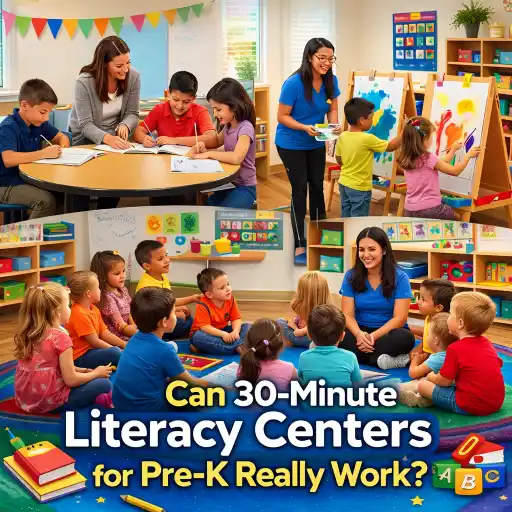
1. Short blocks fit young attention spans. A tight 30-minute routine keeps kids focused and lets you repeat key skills each day.
2. Centers let you give small-group practice. During the teacher-led mini-group children get direct help with letters, sounds, or new words. Research on small-group centers and phonics practice supports this approach — see ideas from Reading Horizons and tips for short phonics blocks at Research and Play.
3. Centers build habits: daily routines teach independence, listening, and sharing. For emergent literacy tools and routines you can use in your program, check Classroom Tools for Emergent Literacy  Buy Now $16.00 at ChildCareEd.
Quick why-it-matters checklist:
- Frequent short practice = better skill growth.
- Teacher-led small groups = targeted support.
- Center routines = smoother transitions and more learning time.
How do I plan a 30-minute center block that fits my day?
Follow these steps to make a plan that works:
- Set a clear schedule (example):
- 0–5 min: whole-class warm-up (songs, rhymes).
- 5–25 min: rotations (two 10-minute rotations or three 6–8-minute rotations).
- 25–30 min: quick regroup and exit activity.
- Use a rotation chart so kids know where to go. Numbered charts and photos make it easy for young children to follow.
- Make one rotation always teacher-led. Other rotations are independent, partner, or tech-supported.
- Keep materials low-prep and in labeled bins so transitions save time.
Tips from practice:
- 🔔 Use a gentle signal (bell or 3 claps) to move groups.
- 📚 Rotate books weekly by theme to keep interest (see Read, Sing, Play for theme ideas).
- ⏱️ Time it. Short timers help kids and adults stay on track.
Remember: state requirements vary - check your state licensing agency.
What activities should each center include to build real skills?
Use 3–5 center types that repeat each week. This helps children practice the same skills in different ways. Here are strong options:
- Teacher-led phonics / guided reading (small group)
- Activity: letter-sound games, decodable picture cards, echo reading.
- Why: teacher can check sounds and guide decoding. See small-group ideas from Reading Horizons.
- Word play center (rhyme, syllable, blending)
- Emoji idea: 🎵 Use rhyming songs and simple matching games (inspired by play ideas at Scholastic).
- Listening & books center
- Activity: audio story, picture retell, puppet prompts. ChildCareEd suggests read-aloud routines in their reading guide.
- Writing / emergent writing center
- Activity: name cards, letter tracing, picture-to-word pages.
- Why: builds print concepts and fine motor skills.
- Choice extension center (games or books)
- Activity: word sorts, magnetic letters, simple decodable readers to reread.
Use hands-on, quick activities so children can finish within a single rotation. For vocabulary-building ideas tie centers to content and use resources from Building Vocabulary Buy Now $16.00 on ChildCareEd.
How do I manage behavior, assessment, and common pitfalls?
Good management keeps 30 minutes full of learning. Follow these steps:
- Set clear rules: 3 simple expectations (listening, gentle hands, share materials).
- Practice rotations without work the first week so kids learn the routine.
- Use quick formative checks: teacher notes, exit tickets, or a 1-minute running record.
- Keep group sizes small (4–6 children). Rotate groups so each child sees the teacher each 2–3 days.
Common mistakes and how to avoid them:
- ❌ Too many centers: Keep 3–5. Too many choices slow transitions.
- ❌ No teacher-led center: Always include a teacher group for targeted help.
- ❌ Materials scattered: Use labeled bins and the same place each day.
For assessment tools and checklists you can use, see ChildCareEd's Developmental Milestones Checklist Buy Now $0.00 and the Student Skills Form Buy Now $0.00.
Conclusion
Yes — 30-minute literacy centers can really work. The keys are a tight routine, one teacher-led group, simple centers that repeat, and quick checks for progress. Keep materials ready, routines practiced, and rotate thoughtfully. Use short warm-ups and a calm signal to move children. For more classroom-ready ideas and training, explore ChildCareEd's courses on emergent literacy Buy Now $16.00 and building vocabulary Buy Now $16.00.
FAQ
- How many centers should I have? 3–5 centers is best for a 30-minute block.
- How long should each rotation be? 6–10 minutes depending on the number of rotations (2 rotations = 10 min each; 3 rotations = 6–8 min each).
- How often should each child see the teacher? Aim for every 2–3 days; more often for children who need extra help.
- Can volunteers run centers? Yes if trained and supervised. Follow your program rules and remember state requirements vary - check your state licensing agency.
- What if transitions take too long? Practice routines, use visuals, and shorten tasks so transitions become quick and smooth.
- 30 hour Texas Director Annual ONLINE
- Teacher & Me Playtime
- CDA Bridge Bundle: Preschool
- CDA Bridge Bundle: Family Child Care
- CDA Bridge Bundle: Family Child Care without Portfolio Review
- CDA Bridge Bundle: Infant/Toddler without Portfolio Review
- CDA Bridge Bundle: Preschool without Portfolio Review
- CDA Bridge Bundle: Infant/Toddler
- Thinking about a career in teaching or working with children in a child care setting?
- What Skills Really Matter for Kindergarten Readiness (and Why Worksheets Aren't the Answer)?
- Requisitos de Cuidado Infantil en Nueva Jersey para Centros y Proveedores de Cuidado Infantil Familiar
- Proporciones de Cuidado Infantil y Tamaños de Grupo por Edad en Nueva Jersey (Guía Rápida para Centros y Hogares)
- Cómo Trabajar en el Cuidado Infantil en Wisconsin: Requisitos y Pasos
- Capacitación Previa al Servicio para Proveedores de Cuidado Infantil en Dakota del Norte
- How can Florida VPK teachers use FAST Star Early Literacy simply and well?
- Can play-based learning and academic readiness work together for New York educators?
- How Can I Improve My Quality Rating in North Dakota?
- Group Training for Child Care Staff: What Directors Need to Know
- Canciones, juegos y preguntas de círculo para niños
- Cómo simplificar la capacitación para sus empleados de daycare
- What simple early literacy activities really work for preschoolers?
- What Kindergarten Readiness Skills Should My Program Build?
- Why Does Self-Regulation Matter More Than ABCs for Minnesota Kindergarten Readiness?
- What simple early literacy activities really help children learn?
- How do I build an effective emergency preparedness plan for my Kansas child care program?
- How can child care programs build strong readers before kindergarten?
- How can we create classrooms where every child feels represented?
