A child’s “She took it!” may be the beginning of a story, not the whole story—and a rushed solution can leave everyone feeling misunderstood. Build practical skills for pausing, paraphrasing, and clarifying with Open Ears: Listening in Child Care  Buy Now $16.00, a focused course that can strengthen your everyday interactions with children. Put these strategies into practice with the free Active Listening Prompt Cards for Conversations with Children Buy Now $0.00, featuring simple prompts to help educators listen, reflect, clarify, and respond thoughtfully. For a broader foundation in children’s communication growth, explore Language Development in Early Childhood Buy Now $16.00 as a next step.
Why does careful listening matter when a child explains a problem?
Preschool disagreements often unfold faster than children can explain them. A child may cry, grab, point, use only a few words, or tell the story from one perspective. When an adult quickly decides what happened or says “Just share,” the immediate noise may stop, but the underlying concern can remain unresolved. A brief pause helps an educator respond to the actual problem rather than to an assumption.
Listening closely communicates that a child’s ideas and feelings matter. It also gives the teacher useful information: Was the child still using the toy? Did someone knock down a structure by accident? Is the child frustrated about waiting, or worried that a peer is repeatedly excluding them? NAEYC’s three-step approach to helping children navigate conflict emphasizes identifying behavior and emotion before guiding children toward a response. That sequence is more effective when the adult first understands what each child is trying to communicate.
Listening is not passive or permissive. Teachers remain responsible for safety and clear boundaries. They can stop unsafe actions while still being curious about each child’s experience. This combination—protecting children and taking their words seriously—turns a disagreement into an opportunity to practice #communication, emotional vocabulary, and problem-solving.
How can teachers pause and show a child they are present?
Children often need an adult’s attention before they can explain what happened. A pause can be very short: stop a non-urgent task, move close without crowding, and turn toward the child. Lowering yourself to the child’s level can feel less intimidating than speaking from across the room. Use a calm tone, an open posture, and natural eye contact when comfortable for the child.
Give the child time to speak, gesture, point, or find words. A few seconds of quiet can be more supportive than a string of rapid questions. If you need to keep supervising other children, be honest and reassuring: “I want to hear you. I’m keeping everyone safe right now, and then I’ll come back to you.” Return when promised whenever possible.
During a disagreement, first address immediate safety: “I won’t let you hit. I’m here.” Then pause before deciding whose account is correct. Notice what is observable—the toy between two children, a toppled tower, a child’s tense body—and invite each child’s perspective when they are ready.
- Get near the child and offer focused attention, even if only briefly.
- Use a steady voice and allow time for the child to respond.
- Notice gestures, facial expressions, tone, and the situation as well as spoken words.
- Keep safety boundaries clear without dismissing the child’s feelings.
These small actions show #respect and make it more likely children will continue communicating rather than escalating to be heard.
How do paraphrasing and reflection help confirm what a child means?
Paraphrasing means restating the main point in your own words; reflecting also names a possible feeling or meaning. Together, they let the child know you are trying to understand and give them a chance to correct you. A useful reflection is tentative, not a verdict.
For example, a child says, “He broke my house!” Instead of immediately deciding who is at fault, try: “You worked hard on that house, and now it’s fallen down. You look upset.” The child may explain, “I was making a garage, and he put the big block there.” That additional detail changes what support may be useful.
Use simple, concrete language and avoid adding motives the child has not expressed. “You’re angry because he did it on purpose” makes an assumption. “You seem angry that the blocks fell” offers a feeling for the child to confirm or correct. If the child says, “No, I’m sad,” accept the correction: “You’re sad. Thanks for telling me.”
- Reflect content: “You were using the red marker and wanted to finish your picture.”
- Reflect a possible feeling: “Waiting seems frustrating.”
- Check your understanding: “Did I get that right?”
- Invite more: “Tell me what happened next.”
As reflective listening guidance for early childhood educators explains, attending to both the message and possible feelings can help a child feel understood. Treat your reflection as a check, not a diagnosis; children remain the experts on what they meant and how they feel.
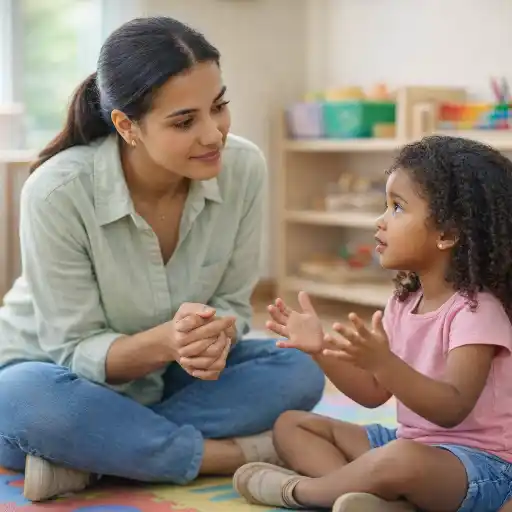
Which clarifying questions help without turning the moment into an interview?
Clarifying questions fill in a missing detail or help children identify what they need. In a tense moment, fewer questions are usually more helpful. Ask one short question, wait for the response, and listen again. Repeated “Why did you do that?” questions can sound blaming and may be difficult for a young child to answer while upset.
Try neutral prompts that invite a child’s account: “What happened?” “What did you want?” “What were you trying to tell Maya?” or “What would help now?” For children with limited spoken language, offer accessible ways to respond: point to the object, show you, use a picture, gesture, sign, or speak in a home language when possible. A child’s silence does not necessarily mean they have nothing to say; they may need more processing time or another way to communicate.
NAEYC’s guidance on questions that spark conversations supports asking questions that fit a child’s developmental and language needs. In a conflict, prioritize understanding over asking a perfect question. The goal is not to cross-examine or obtain a complete adult-style timeline. It is to hear enough to respond safely and help children move forward.
- Ask one clear question at a time and wait for an answer.
- Offer a choice of words only when a child appears to need help: “Were you waiting for a turn, or did you want to play together?”
- Check that the child understood your question; rephrase it if needed.
- Invite the other child’s perspective rather than assuming one account tells the whole story.
Open, respectful questions support #language while keeping the conversation connected to children’s own experience.
How can listening support everyday conversations and conflict resolution?
Active listening belongs in ordinary moments, not only when children are upset. When a child describes a drawing, explains a plan in the block area, or tells you about a difficult transition, paraphrase the important idea and invite them to add more. “You’re building a road to the farm. Tell me where the bridge goes” communicates genuine interest and supports richer back-and-forth talk.
In a conflict, listening also helps children participate in finding a solution. Once everyone is safe and calmer, summarize what you heard: “You wanted to keep building, and you wanted space for your animals.” Ask, “What could work for both of you?” If children need support, offer a few realistic options such as taking turns, trading materials, building together, or choosing another space. NAEYC’s conflict-resolution framework and the ECE Resource Hub’s guidance on problem-solving with others both emphasize adult support that helps children practice skills rather than having every problem solved for them.
Adapt your expectations. A preschooler may suggest a compromise; another child may point to a picture or need the adult to model a phrase. Acknowledge attempts: “You showed me the block you wanted. Let’s figure out a safe way to ask.” In disagreements involving aggression or injury, intervene promptly, attend to safety, and resume problem-solving only when children are ready. Helpful prompt ideas can also be collected in You’re Not My Friend Anymore: Learning Conflict Resolution Buy Now $16.00.
- 🔎 Reflect what each child said before suggesting a solution.
- Make sure the options are safe and understandable to both children.
- Ask whether the plan works, then check back after children try it.
What common listening pitfalls should educators avoid?
Even caring teachers can slip into habits that unintentionally shut down communication. A rushed “You’re fine” can minimize distress; “Just say sorry” may end the conversation without repairing the problem. Rapid questions, correcting a child’s wording, or deciding who is guilty before hearing both children can also make a child feel that the adult is listening for compliance rather than understanding.
Try replacing judgment with observation and curiosity. Rather than “You’re being selfish,” say, “You’re holding the truck, and Luis is reaching for it.” Instead of assuming a child’s meaning, reflect your best understanding and ask for confirmation. Avoid requiring eye contact or a long spoken explanation as proof of listening. Children communicate in diverse ways, and communication styles are shaped by development, culture, language, and individual needs.
Directors can help staff make these practices consistent by selecting a few shared phrases, modeling them in coaching, and reflecting on classroom scenarios together. Notice whether adults pause, hear each child, and clarify before offering solutions. If a child repeatedly struggles to communicate or conflicts remain intense, document objective patterns and collaborate with the family and appropriate supports. State requirements vary - check your state licensing agency when documentation, referrals, or program procedures are involved.
- ❌ Avoid labeling a child or treating one account as the complete story.
- ❌ Avoid lecturing while children are highly upset; prioritize safety and regulation.
- ✅ Use tentative reflections, accessible communication supports, and meaningful wait time.
Conclusion: How can preschool teachers know children feel heard?
Preschool teachers can tell they are listening more effectively when they pause, reflect the child’s message, and clarify meaning instead of rushing to a judgment or solution. These steps do not require a lengthy conference: a calm moment, one accurate paraphrase, and a well-timed question can change the direction of a disagreement or everyday conversation.
Remember the practical sequence: pause and attend; paraphrase the main idea; reflect a possible feeling tentatively; clarify with one simple question; then guide children toward a safe next step. Be ready to adjust for a child’s age, language, culture, and communication style. In doing so, you strengthen #trust, support emotional and language development, and help children learn that problems can be discussed and solved together.
For focused professional learning, revisit Open Ears: Listening in Child Care Buy Now $16.00 and consider the companion course Language Development in Early Childhood Buy Now $16.00. Both can help you carry intentional listening from a difficult moment into the many conversations that make up a preschool day.
- 45 Hour Child Growth and Development
- 45 Hour Preschool Methods and Materials
- CDA Bridge Bundle: Preschool
- Setting the Stage: Story Time
- Working Together: Teachers & Preschoolers
- 45 Hour School Age Methods and Materials
- Art from the Heart for Preschoolers: Open Ended Art Projects that Build Self-Esteem
- Texas Director Credential
- 🔍 ¿Qué ves cuando observas a un niño aprender?
- Cuáles Son las Señales de Alerta en el Desarrollo Infantil que Todo Educador Debe Conocer?
- Cómo ser director de cuidado infantil en Maryland
- ¿Qué preguntas aparecen en el examen CDA para preescolar?
- ¿Qué Preguntas Vienen en el Examen CDA de Nacimiento a los Cinco Años?
- Reglas de Cuidado Infantil en Illinois
- Cómo Celebrar el Día Nacional del Kindergarten
- Lista para Guardería en Casa en Illinois: Cómo Iniciar una Guardería en el Hogar
- Por Qué la Supervisión Activa Es Clave para la Seguridad en el Cuidado Infantil
- Consejos de Supervisión Activa para Salones de Preescolar y el Juego al Aire Libre
- Retraso del Habla en la Guardería: Cómo Pueden Ayudar los Proveedores
- Capacitación Previa al Servicio para Proveedores de Cuidado Infantil en Nevada
- How can preschool teachers use simple classroom management techniques that really work?
- Celebrando la amistad en el cuidado infantil durante el Día de los Mejores Amigos
- How can I make infant and toddler lesson plans that really work?
- How Can Teachers Help Children Rejoin Play After a Conflict?
- How Much Correction Is Too Much During a Preschool Literacy Game?
- How Can Preschool Teachers Help Children Understand the Difference Between Wants and Needs?
- Are Preschool Teachers Really Listening When Children Try to Explain a Problem?
