“Where did my voice go—and why did it come back?” An outdoor echo investigation turns a familiar surprise into an accessible science experience that builds children’s listening, language, and inquiry skills. Explore Building Early Science Foundations  Buy Now $16.00 for deeper strategies to nurture children’s curiosity through age-appropriate exploration, experimentation, and discovery.
Why are outdoor echoes a meaningful science investigation?
An echo is a sound reflection: sound waves travel outward, meet a surface, and some of their energy returns to a listener. Whether children hear a distinct repeat depends on factors such as the surface, the distance, and background noise. In everyday language, children may call any returning or lingering sound an echo; educators can acknowledge their observations while gradually introducing the distinction between a clear echo and reverberation, when reflections overlap and make a sound seem to linger.
Outdoor exploration makes this invisible process tangible. Children can compare how a clap sounds near a wall, beside a fence, or in an open area. They are not expected to master acoustic physics; the learning lies in noticing, wondering, comparing, and revising ideas. The National Science Teaching Association’s discussion of sound activities and investigations with preschoolers emphasizes that young children can investigate sound through observation and experience.
Echo play also supports several learning domains at once: children practice describing sounds, taking turns, remembering what they heard, and connecting an outcome to a location. A simple outdoor question—“Where does our sound come back?”—can make #science feel like a shared discovery rather than a lesson with a predetermined answer. It offers providers a practical way to extend children’s natural curiosity while valuing every thoughtful guess.
How can providers prepare a safe, accessible echo walk?
Choose a familiar, bounded outdoor area with clear sightlines and surfaces that can be explored safely from the ground. A courtyard, schoolyard wall, or sheltered walkway may work; a canyon, road, parking area, or other uncontained location is not necessary. Do not ask children to shout near other groups or people. Clapping, a gentle call, or a teacher-made sound is usually enough, and helps protect everyone’s comfort and hearing.
Before going out, explain the listening goal and agree on simple expectations: stay within the group’s boundary, use a comfortable voice, and pause while others listen. Check the space for hazards and follow your program’s supervision and outdoor policies. Make participation flexible: some children may prefer listening, watching, using a communication device, or making a sound with a partner instead of speaking aloud.
- Bring a clipboard or the Echo Exploration Listening Journal, pencils, and optional picture cards for sound sources.
- Choose two or three safe listening spots with different surroundings, such as a hard wall and an open area.
- Plan a quiet signal and a way for children to move between spots together.
- 🌿 Invite children to listen without requiring them to close their eyes; offer a comfortable seated or standing option.
A few minutes of preparation helps the group focus on the investigation without making the activity feel over-managed. For practical ideas about connecting children with outdoor soundscapes, see Project Learning Tree’s listening activities. Remember that state requirements vary - check your state licensing agency.
What steps help children notice where an echo returns?
Begin with a question, not a demonstration: “What do you think will happen if we clap here?” Give children time to predict. At the first spot, make one gentle, clear sound, then pause long enough for everyone to listen. Invite children to describe what they heard in their own words: Was there one sound, a softer sound after it, or a sound that seemed to stretch?
Repeat the sound from a second location, keeping the sound-maker and action as similar as possible. For example, compare a spot facing a solid wall with a nearby open area. This makes the comparison easier to interpret, though outdoor conditions can still change what children hear. Ask where the sound seemed to come from and whether the second location sounded different. Avoid promising that every surface or place will produce an obvious echo; sometimes the interesting result is that children hear no clear return.
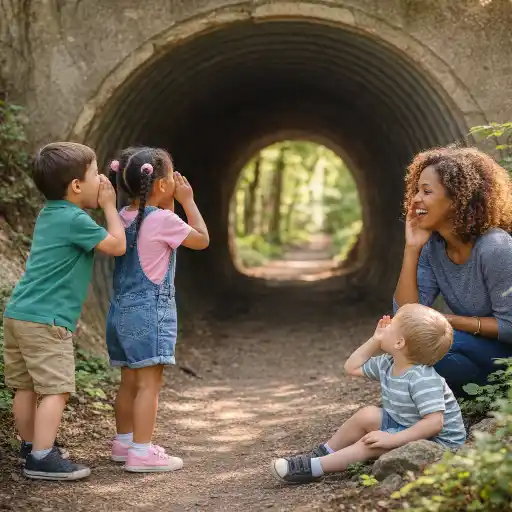
Use the Echo Exploration Listening Journal as a record of thinking, not a test. Children can draw the place, mark a simple “heard it / not sure / did not hear it” choice, dictate a sentence, or point to a picture while an adult writes their words. Revisit the same spot later if attention and schedule allow. Repeat listening supports #observation and lets children compare their ideas with new evidence. Keep the pace unhurried: a short silence can be an important part of the experiment.
How can educators extend children’s questions and vocabulary?
Children’s theories are a valuable starting point. If a child says, “The wall is talking,” respond with interest: “It sounds as if the wall sent your sound back. What makes you think that?” Such language respects the child’s idea while inviting further observation. The NSTA article on preschool sound investigations describes the value of productive questions that focus attention, invite comparison, and help children explain what happened.
Introduce a few words in context rather than front-loading definitions. “Sound” names what children hear; “surface” names the wall, fence, or other material; “reflect” describes sound bouncing back. You might add “loud,” “soft,” “near,” “far,” and “quiet” as children compare experiences. Ask open prompts, then wait: “What did you notice?” “How was this spot different?” “What could we try next?” A thoughtful pause gives children time to formulate a response, including through gesture, drawing, or their home language.
- Invite children to clap once, then listen; compare with a gentle spoken word or tap on a safe object.
- Ask children to draw a sound’s “journey” from the person making it to the surface and back.
- Connect the investigation to a listening walk by noticing birds, wind, footsteps, and nearby human-made sounds.
- Offer small-group roles—sound-maker, listener, recorder—then rotate them so everyone can participate in a preferred way.
Keep the emphasis on wondering and evidence rather than on getting the “right” answer. The aim is growing #inquiry and confidence, not technical mastery.
What common pitfalls should programs avoid?
Outdoor sound investigations are simple, but a few small adjustments can make them more comfortable and useful. A frequent pitfall is expecting a clear echo at every location. Reflections may blend with the original sound, be masked by wind or traffic, or be too faint to distinguish. Treat this variability as part of the investigation: children can compare “clear,” “faint,” and “hard to tell” rather than being told they must hear an echo.
Another pitfall is explaining the science before children have had a chance to listen. A short explanation can help afterward, but begin with children’s observations and questions. Also avoid excessive volume or repeated shouting. Use one gentle sound at a time and keep the group away from people who are not participating. Children with sensory sensitivities should have options to observe from farther away or skip making sounds altogether.
- Too many variables: Compare two locations using the same sound when possible.
- Rushing the listening pause: Wait quietly before asking what children noticed.
- Turning journal pages into a worksheet: Accept drawing, dictation, gestures, or a simple mark as documentation.
- Overlooking access and supervision: Select an accessible route, maintain active supervision, and adapt participation.
Document children’s words and strategies, not just whether they heard an echo. A note such as “Maya moved closer to the wall and tried another clap” captures scientific thinking in action. For broader approaches to nurturing early inquiry, explore ChildCareEd’s article on encouraging scientific thinking through hands-on exploration.
How can providers carry the discovery beyond one outing?
Close with a brief reflection: “What surprised you?” and “Where should we listen next time?” Record a few child comments in the journal and revisit them during circle time. Children might draw the locations they tested, compare the sounds, or make a class map showing where a sound seemed to return. If the group remains interested, repeat the activity on another day and notice whether wind, nearby activity, or a different position changes the experience.
For a related indoor comparison, invite children to listen in a room with different furnishings, without presenting it as a guaranteed echo experiment. Soft materials may absorb some sound, while hard surfaces can reflect more; the result depends on the room. You can also connect this investigation to children’s everyday sound questions, including how animals and technologies use reflected sound, while keeping explanations age-appropriate and clear that human listening is not the same as animal echolocation.
Sound activities offer a natural bridge between outdoor learning and early science. Providers who want additional guidance on planning playful investigations can explore Basic Science in Early Childhood Buy Now $25.00, a course focused on meaningful experiences that support children’s scientific reasoning. For an outdoor environment rich in sensory discoveries, Creating the Natural Outdoor Classroom Buy Now $16.00 is another relevant option. Confirm course details and any training-credit eligibility with the appropriate agency or employer before enrolling.
Conclusion: Where does a child’s voice come back?
A voice or clap may seem to come back when sound reflects from a surface and reaches the listener again. Whether children hear a distinct echo depends on the setting, distance, surface, and surrounding noise—and sometimes the result is subtle or absent. That uncertainty is useful: it gives children something real to notice, compare, and discuss.
For providers, the most effective approach is straightforward: choose a safe and accessible outdoor area, invite predictions, make gentle sounds, leave time to listen, and document children’s ideas in the Echo Exploration Listening Journal. Ask open questions, accept different ways of participating, and treat unexpected results as part of the learning. With thoughtful facilitation, “Where does my voice come back?” becomes a memorable inquiry into sound and a joyful reason to explore together.
To strengthen your planning for playful early science experiences, consider Building Early Science Foundations Buy Now $16.00. It offers providers strategies for supporting developmentally appropriate inquiry, experimentation, and discovery.
- Toddlers and Theories
- CDA Home Visitor Subject Area 2 Part 3 Birth to 5
- Children at the Wheel: Emergent Curriculum
- Pediatric RSV First Aid & CPR/AED
- Creating Environments that Nurture Growth and Community
- Texas Director Credential
- Building Early Science Foundations
- History, Policy, and Practice in ECE
- Enhancing STEM Education for Infants and Toddlers
- Supporting Families and Caregivers in Language and Literacy
- CDA Certification en Español: Recursos y Consejos para Educadores Bilingües
- 🔍 ¿Qué ves cuando observas a un niño aprender?
- 💛🧩 ¿Cómo puedo hacer que mi enseñanza sea inclusiva para los niños con autismo?
- ❄️ ¿Qué actividades al aire libre funcionan bien para los niños de Illinois en cada estación? 🌷🍂
- 👶 ¿Cuáles son las proporciones y grupos requeridos en Dakota del Norte? 🏫
- Cómo Abrir Una Quardería En Casa Sin Dinero?
- Normas de Licenciamiento de Cuidado Infantil en Virginia para Centros Diurnos Infantiles y Hogares Diurnos Familiares
- Proporciones de Cuidado Infantil y Tamaños de Grupo por Edad en Maryland (Guía Rápida para Centros y Hogares)
- Proporciones de Cuidado Infantil y Tamaños de Grupo por Edad en Nueva Jersey (Guía Rápida para Centros y Hogares)
- Proporciones de Cuidado Infantil y Tamaños de Grupo por Edad en Virginia (Guía Rápida para Centros y Hogares)
- Lista para Abrir una Guardería en Casa en Virginia: Cómo Empezar
- Actividades de Otoño Fáciles para Preescolares esta Temporada
- Por Qué la Supervisión Activa Es Clave para la Seguridad en el Cuidado Infantil
- Consejos de Supervisión Activa para Salones de Preescolar y el Juego al Aire Libre
- Las Mejores Ideas de Excursiones para Guarderías en Texas
- Capacitación CDA gratuita en Illinois
- Celebrando la amistad en el cuidado infantil durante el Día de los Mejores Amigos
- Canciones, juegos y preguntas de círculo para niños
- Cómo simplificar la capacitación para sus empleados de daycare
- Where Does My Voice Come Back? How Can Children Explore Outdoor Echoes?
