When a playground section closes, children can still enjoy meaningful outdoor play—but the remaining space needs a fresh plan. Creating Safe & Healthy Child Care Environments  Buy Now $55.00 helps providers build knowledge of hazards, supervision, and environmental safety, while Active Supervision: A Strategy That Works Buy Now $35.00 offers focused learning on attentive supervision practices. Use the practical steps below to reorganize activities, clarify staff roles, and keep play engaging without letting children enter a closed area.
Why does a playground closure call for a new plan?
A closed slide, climbing structure, or yard section changes more than the available equipment. It can shift where children gather, create new traffic patterns, and affect how well adults can see and reach every child. What worked yesterday may no longer provide safe sightlines or enough room for active play.
Outdoor play remains valuable even when the usual layout is unavailable. The CDC notes that outdoor experiences support movement, exploration, and children’s physical and social development. The goal is not to remove all challenge or end outdoor time automatically; it is to offer developmentally appropriate choices in spaces that have been checked and are safe to use.
First, determine why the area is closed and what boundaries are needed. If equipment is damaged or conditions are unsafe, block access physically and make the closure clear to staff and children. A verbal reminder alone is not a reliable barrier. Tell the team what remains open, what is off limits, and who is responsible for monitoring the boundary. This short reset protects children while helping staff feel prepared rather than rushed.
How can staff reorganize activities around the open areas?
Begin with a quick walk-through of the available space. Check for hazards, usable surfacing, clear paths, and enough room for the planned group size. Then create fewer, clearly defined play zones instead of spreading children thinly across every remaining corner. For example, one zone might support movement games, another might offer drawing or nature observation, and a quieter spot could host books or dramatic play.
Choose activities that fit the space rather than trying to recreate the closed equipment experience. Simple materials can make a smaller area feel purposeful: sidewalk chalk, beanbags, large balls, cones, picture cards, or child-safe natural objects. Keep paths between zones open, and avoid placing high-energy games near entrances, fences, or the closure boundary.
- Offer a small set of choices and explain where each activity belongs.
- Use visual markers such as cones or floor spots to define limits.
- Adjust the number of children in each area to avoid crowding.
- Plan a transition activity in case a zone becomes too busy.
Preserving children’s choice matters, too. Invite them to help select among safe options, and explain simply that one area is closed while adults check or repair it. When children understand the new arrangement, they are more likely to stay engaged and respect the boundary.
What supervision changes help keep the adjusted play area safe?
Reorganizing the space should prompt a matching update to the supervision plan. Assign staff to specific zones before children go outside, and make sure each adult can see the children in their assigned area and communicate with colleagues. If the layout creates blind spots or puts too many children in one zone, reduce the usable area further, redistribute groups, or add a staff member when available. Do not assume staff can cover the same amount of space as before.
Use active supervision throughout play: position yourself for clear views, move and scan, listen for changes in children’s activity, anticipate where they may go next, and engage when support is needed. Count children at the classroom exit, on arrival outdoors, during any move between zones, and before returning inside. A brief staff huddle can confirm names, assignments, first-aid responsibilities, and the closed boundary.
- 👀 Stand where you can monitor both the play zone and nearby access points.
- Keep staff attention on children; set aside phones, paperwork, and nonessential conversations.
- Tell every staff member—including substitutes—which sections are closed.
- Move children away immediately if the barrier shifts or the boundary becomes unclear.
For more practice with supervision principles, ChildCareEd’s Effective Supervision in Child Care Buy Now $25.00 course explores watching, listening, interacting, and monitoring children across care settings.
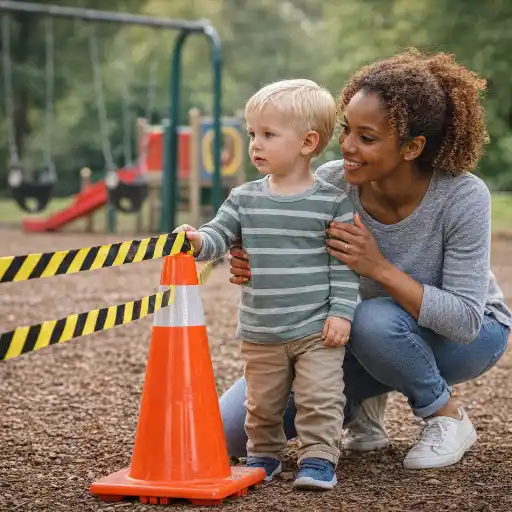
How can a checklist and closure process support safety?
A consistent inspection routine helps staff make decisions based on current conditions rather than yesterday’s observations. ChildCareEd’s Playground Safety Made Simple: Daily Outdoor Play Checklist Buy Now $1.49 provides a place to record the date, time, area, staff member, surface and equipment conditions, weather concerns, supervision readiness, and follow-up actions. Use it to check the open areas and document why a section remains unavailable.
When staff find a hazard, move children away, block access, notify the director or designated maintenance lead, and record the specific issue and action taken. For example, document “north climbing structure closed due to loose handrail” rather than simply “playground problem.” Keep a clear return-to-use process: a responsible person verifies that the hazard has been addressed before removing the barrier.
- Inspect before each outdoor play period and again after weather or maintenance activity, according to program policy.
- Record the affected section and the remaining safe play zones.
- Communicate changes in the staff huddle and to any staff member taking over.
- Document near-misses as well as injuries; both can reveal gaps in the plan.
State requirements vary - check your state licensing agency. Follow your program’s written policies and any applicable equipment, maintenance, and reporting procedures.
What common mistakes should programs avoid?
Under pressure to preserve the normal schedule, staff may be tempted to use a closed structure “just for a minute,” rely on children to remember a spoken warning, or leave one adult covering a larger area than can be supervised effectively. These are understandable shortcuts in a busy day, but they weaken the closure plan. Treat the boundary as firm and make the safe alternative easy to follow.
Another common misstep is moving activities without considering the new traffic flow. A ball game beside a narrow path, for instance, can send children through another group’s activity or toward the restricted section. Walk through the setup at children’s eye level and consider how children are likely to move, gather, and transition. If staff cannot maintain clear sight and access, simplify the setup or bring the group indoors.
- Avoid: relying on a sign or verbal reminder as the only barrier. Instead: use a secure, visible physical boundary.
- Avoid: keeping the original group size in a smaller space. Instead: redistribute groups or reduce crowding.
- Avoid: treating a closure as only a maintenance issue. Instead: revise activities, staffing positions, counts, and communication together.
Directors can support staff by keeping closure supplies available, posting a simple zone map, and reviewing what worked after outdoor time. A calm, non-blaming review helps the team improve its routine and sustain children’s access to safe, enjoyable play.
How can programs maintain outdoor play while a section is closed?
When part of the playground closes, the safest response is a coordinated adjustment—not improvisation at the last minute. Inspect the available space, create a few clearly bounded activities, assign staff to zones, and increase attention to counts and sightlines. Use the daily checklist to capture conditions and follow-up, and keep the closed area inaccessible until an authorized person confirms it is ready for use.
These steps let providers protect children while retaining outdoor opportunities for movement, discovery, and social play. The key takeaways are straightforward: adapt the activity to the space, adapt supervision to the new layout, and communicate the closure consistently. ChildCareEd’s Building and Physical Premises Safety Buy Now $10.00 course can further support staff learning about recognizing hazards and preventing risk in child care environments.
When a familiar playground section is unavailable, thoughtful planning helps children keep playing safely and helps staff feel confident about the plan.
- Safe and Sound: Creating Healthy Environments for Every Child
- 1,2,3, Eyes on Me: Classroom Safety
- Healthy Starts: Safety, Nutrition, and Wellness in Child Care
- Texas Director Credential
- CDA Subject Area 1
- 10 Hour Health and Safety Orientation Training
- Preventative Health and Safety
- CDA: Curriculum Alignment & Materials
- CDA Infants/Toddlers: Smart Nutrition & Feeding
- Family Child Care: Building, Premises, and Outdoor Safety
- CDA Certification en Español: Recursos y Consejos para Educadores Bilingües
- 🥦✨ ¿Cómo apoyar a los niños selectivos a probar nuevos alimentos sin presión?
- ❄️ ¿Qué actividades al aire libre funcionan bien para los niños de Illinois en cada estación? 🌷🍂
- Juegos de Motricidad Gruesa
- Recursos en Español sobre el Sueño Seguro del Bebé
- ¿Cuáles son las mejores actividades del Día de la Tierra para niños en casa o en el aula?
- 10 Ejemplos de Cómo la Cultura Influye en el Desarrollo Infantil
- Proporciones de Cuidado Infantil y Tamaños de Grupo por Edad en Virginia (Guía Rápida para Centros y Hogares)
- Por Qué la Supervisión Activa Es Clave para la Seguridad en el Cuidado Infantil
- Consejos de Supervisión Activa para Salones de Preescolar y el Juego al Aire Libre
- How can Florida early childhood educators protect children from poisonous plants, bugs, and outdoor hazards?
- Celebrando la amistad en el cuidado infantil durante el Día de los Mejores Amigos
- Canciones, juegos y preguntas de círculo para niños
- How can child care programs keep playgrounds safe every day?
- How can child care programs create safe climbing and movement experiences for toddlers?
- Cómo Planificar Actividades al Aire Libre Seguras Durante el Calor y la Mala Calidad del Aire
- What’s Happening Outside? Fall Science Adventures for Preschoolers
- Active Supervision Examples: 10 Real Classroom Scenarios—Safe or Unsafe?
- How Can Child Care Providers Teach Scissor Skills Safely and Developmentally?
- When Part of the Playground Closes: How Can You Adjust Outdoor Play Safely?
