November’s focus on gratitude can become more than a chorus of “say thank you” when children experience what kind words do in real relationships. Explore practical ways to model courteous language during everyday routines, and consider Words That Make Us Kind: Practicing Polite Language in the Classroom Buy Now $1.75 for short read-alouds and flexible participation ideas you can use with children. For a broader professional learning next step, Viewing Guidance in a Positive Light  Buy Now $24.00 offers a three-hour online training on developmentally appropriate guidance and classroom practices that support social-emotional growth.
Why is meaningful polite language more than good manners?
“Please,” “thank you,” “sorry,” “excuse me,” and “you’re welcome” are useful social tools. Yet a child can repeat a phrase without understanding its purpose or feeling the emotion behind it. NAEYC’s discussion of raising a thankful child distinguishes learning a social script from developing genuine appreciation: meaning grows through adults’ modeling and through children’s experience of being appreciated themselves.
That distinction matters in November, when classroom conversations often turn toward gratitude. The goal is not to make children perform thankfulness on cue. Rather, educators can help them notice how people contribute, how words acknowledge those contributions, and how respectful communication supports cooperation. A child might communicate gratitude with a smile, gesture, drawing, home-language phrase, or spoken “thank you.” Each can be a meaningful response.
Think of polite language as one part of a broader social skill: noticing another person, communicating a need or response, and participating in a caring community. When providers model this respectfully, children get a practical example they can adapt—not a test they must pass.
- Model the words in authentic exchanges with children and colleagues.
- Describe the meaning: “I thanked Sam for carrying the books; that helped us get ready.”
- Give children time and multiple ways to respond without withholding care or participation.
Where do November routines create natural opportunities to practice?
Routines repeat, which makes them especially useful for language learning. The Victorian early childhood language toolkit notes that arrivals, caregiving moments, meals, and transitions offer predictable opportunities for interaction and repeated language. Instead of adding a separate manners lesson to a crowded November schedule, choose familiar moments and make your own language intentional.
At arrival, greet each child and model a friendly response: “Good morning, Leila. I’m glad you’re here.” During snack, thank a colleague for setting out cups or invite children to request a serving with words, gestures, or picture cues. In dramatic play, children can practice welcoming a guest, asking for a turn, or responding when a friend helps. At cleanup, say, “Thank you for putting the animals in the basket. Now they’re ready for everyone.”
- Arrival: practice greetings and responses, including gestures and home-language words.
- Meals: model requests, offers, refusals, and appreciation without pressuring children to eat.
- Play: rehearse “May I use that when you’re finished?” and “Would you like help?”
- Transitions: acknowledge cooperation and invite children to thank helpers in their own way.
Keep routines responsive rather than turning them into recitations. A warm adult example, repeated in real contexts, gives children a useful pattern to notice and try.
How can educators model words and explain what they mean?
Children learn polite language most clearly when adults use it sincerely and connect it to the effect of an action. Rather than prompting “What do you say?” after every exchange, narrate your own communication: “May I have the marker, please?” or “Thank you for waiting. That gave me time to finish helping Noah.” This communicates that courtesy belongs to everyone in the community, not only children addressing adults.
Short explanations help make the words purposeful. “Excuse me” can signal that someone needs to move through a space; “sorry” may begin an effort to repair after an accidental bump; “you’re welcome” can acknowledge a thank-you. For an apology, help the child notice what happened and consider a next step: “You bumped her block tower. Let’s see whether she wants help rebuilding.” Avoid requiring a rote apology as a substitute for repair or empathy.
Shared staff language helps children hear consistent examples. Head Start’s guidance on behavior expectations recommends stating expectations positively, planning for routines, and acknowledging children when they show the expected behavior. A team can agree on a small set of natural phrases, then use them with warmth and flexibility.
- Use specific, descriptive language: “You held the door while Eli came through.”
- Explain the social purpose: “We ask before taking so everyone has a choice.”
- Let children observe, listen, point, sign, use a communication device, or speak.
Children’s attempts may be brief or imperfect. Treat them as emerging communication and respond to the meaning, not just the exact wording.
How can the classroom welcome different languages and communication styles?
Politeness is expressed in more than one language and through more than speech. Families may use particular greetings, gestures, ways of showing respect, or expectations about how children speak with adults. Providers can introduce classroom phrases while remaining curious about family practices. Avoid assuming that one expression or communication style is universal—or that a child who does not say a phrase aloud is being rude.
Ask families which words or gestures their child uses at home for greeting, gratitude, apology, or requesting help. Include familiar languages on picture cards or in a class-made collection of kind words, checking pronunciation with family members when appropriate. Offer visual choices, gestures, signs, and communication devices as valid participation. Some children may prefer to observe before joining a role-play; that, too, can be part of learning.
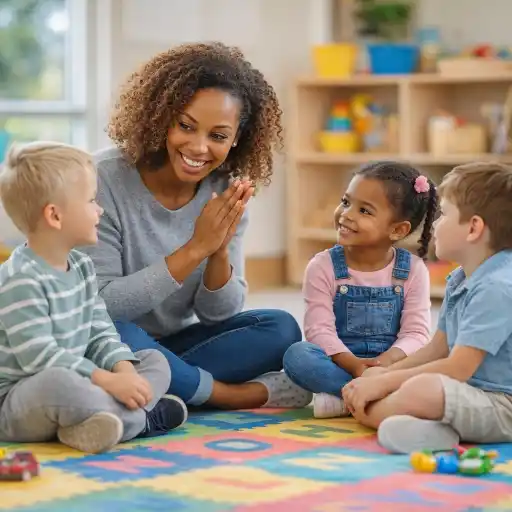
Adapt expectations to each child’s developmental level and abilities. A toddler may point toward a desired item while an adult models a request. A preschooler may act out a scenario with a puppet or suggest a phrase for a story character. Focus on the purpose—communicating respectfully and safely—rather than enforcing identical words from every child.
- Invite family knowledge without asking one child to represent a whole culture.
- Use images and demonstrations alongside spoken directions.
- Accept a child’s “no thank you” or other respectful refusal; courtesy should not erase agency.
These choices help build belonging and ensure polite-language practice is accessible to the whole classroom.
What November activities help children connect kind words with caring actions?
November themes can invite reflection without assuming every family celebrates the same holiday or expresses gratitude in the same way. Keep activities rooted in everyday experiences: people who help in the classroom, a friend who shares space, or a caregiver who welcomes children each morning. The related ChildCareEd article on teaching kindness through everyday moments offers further ideas for weaving empathy into routines and relationships.
Try a “words that help” read-aloud using familiar situations, then invite children to show what a character might say or do. The 14-page ChildCareEd resource Words That Make Us Kind Buy Now $1.75 provides short classroom stories about everyday expressions, with options for children to respond by speaking, pointing, choosing a picture, using a gesture, or communicating with a device.
- Make a classroom “kind words” book: children draw or dictate phrases that help people feel welcome.
- Use puppets to act out asking for a turn, offering help, or repairing an accidental mistake.
- Invite children to notice a helpful act and describe its effect, without making kindness a competition.
- 😊 Create a thank-you studio where children can draw, dictate, or make a message for someone who supports the group.
Keep sharing voluntary and provide alternatives to speaking in front of the group. The purpose is practice and reflection, not a display of who is most grateful. State requirements vary - check your state licensing agency when adapting program policies or staff training.
How can teams avoid turning courtesy into pressure?
Even well-intended manners teaching can become stressful if adults demand a phrase before giving a child something they need, correct children publicly, or treat “thank you” as proof of gratitude. These approaches can shift attention from connection to compliance. NAEYC’s reflection on gratitude cautions that scripts alone do not ensure meaningful appreciation. A more supportive approach is to model, explain, invite, and give children room to respond.
Common pitfalls are manageable with a few team agreements. Choose a small set of phrases that fit real routines, consider how children with different communication needs can participate, and plan how adults will respond when a child does not use the expected words. Use neutral coaching rather than shame: “You can ask for a turn, or I can help you find another one,” instead of “That was rude.”
- Avoid withholding food, comfort, materials, or help until a child says “please” or “thank you.”
- Avoid forcing apologies; support repair and check what the other child needs.
- Avoid assuming silence means disrespect; allow processing time and alternative communication.
- Reflect at a staff meeting: Are adults using the same courtesy we expect children to use?
To deepen staff practice, consider Viewing Guidance in a Positive Light Buy Now $24.00, which focuses on positive guidance strategies, classroom expectations, and social-emotional development. This online course may help teams align their responses; check state licensing agency guidance for applicable training requirements.
Conclusion: What helps polite language become meaningful?
Meaningful polite language grows through authentic examples, repeated practice, and relationships in which children feel respected. During November routines, providers can model greetings, requests, appreciation, and repair while explaining how words support the people around us. Children do not need to produce a perfect phrase each time; they need accessible chances to notice, try, and communicate in ways that fit their development.
Begin with one routine and one intentional adult phrase. Use a warm greeting at arrival, name a helpful act during cleanup, or model a sincere “thank you” at snack. Include family languages and communication supports, invite children’s ideas, and avoid turning gratitude into a performance. The goal is not simply to hear “say thank you”; it is to help children understand and experience how respectful words can contribute to a caring classroom community.
- Healing Young Hearts: Stress and Grief
- Moving About the Classroom: Effective Transitions for Everyday
- Positive Attention: Interactions and Supervision of Infants and Toddlers: For Workforce Solutions
- Language and Literacy Foundations in Pre-K
- Using AI Language Models for Trainers
- Positive Attention: Interactions & Supervision for Infants & Toddlers
- Texas Director Credential
- Supporting Families and Caregivers in Language and Literacy
- Ways to Serve: Leadership
- Professional Integrity in Child Care
- 💛🧩 ¿Cómo puedo hacer que mi enseñanza sea inclusiva para los niños con autismo?
- Requisitos Para Ser Maestra Principal En Un Daycare: Lo Que Necesitas Para Empezar
- ¿Cómo Crear Rutinas Saludables Para Niños Pequeños (sin estrés)?
- Recursos en Español sobre el Sueño Seguro del Bebé
- 10 Ejemplos de Cómo la Cultura Influye en el Desarrollo Infantil
- Regulaciones de Licenciamiento de Cuidado Infantil en California para Centros y Hogares de Cuidado Infantil Familiar
- Proporciones de Cuidado Infantil y Tamaños de Grupo por Edad en Maryland (Guía Rápida para Centros y Hogares)
- Proporciones de Cuidado Infantil y Tamaños de Grupo por Edad en Nueva Jersey (Guía Rápida para Centros y Hogares)
- Proporciones de Cuidado Infantil y Tamaños de Grupo por Edad en Virginia (Guía Rápida para Centros y Hogares)
- Lista para Guardería en Casa en California: Cómo Iniciar una Guardería en el Hogar
- Lista para Guardería en Casa en Texas: Cómo Iniciar una Guardería en el Hogar
- Cómo Ayudar a Niños con Retraso del Habla en el Cuidado Infantil
- Apoyo en Preescolar para Retrasos del Habla: Estrategias Simples que Ayudan
- Retraso del Habla en la Guardería: Cómo Pueden Ayudar los Proveedores
- Celebrando la amistad en el cuidado infantil durante el Día de los Mejores Amigos
- Canciones, juegos y preguntas de círculo para niños
- Cómo simplificar la capacitación para sus empleados de daycare
- ¿Todos los niños deben participar en el tiempo de círculo?
- ¿Faltan Materiales o Falta una Nueva Estrategia? Cómo Revisar los Rincones del Aula
- How Can Providers Model Meaningful Polite Language During November Routines?
