Bright lights, flashing signs, huge screens — the Las Vegas Strip is full of sensory surprises. That spectacle can help us think about how lighting, sound, and busy visuals make children feel in learning spaces. This short article helps child care providers and direct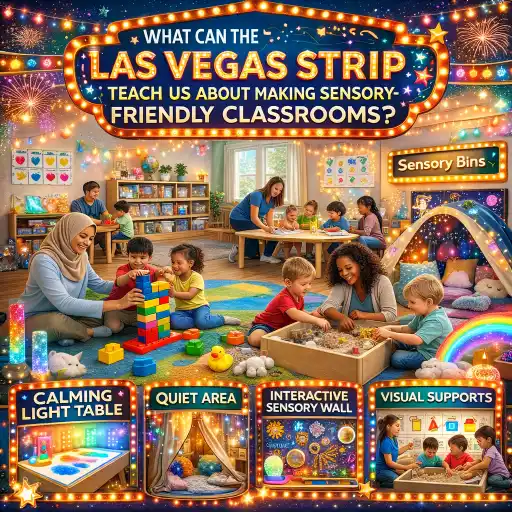 ors learn simple, practical ideas from Vegas-style lighting and design to make kinder, calmer, and more # lighting-smart # sensory-friendly #classrooms for #children so they can feel #calm and ready to learn. State requirements vary - check your state licensing agency.
What can the Las Vegas Strip teach us about classroom lighting?
The Strip shows us how powerful light can be. Big signs and changing colors grab attention quickly — that’s why venues like the Sphere use huge LED screens and sound to create strong reactions (see a visitor guide to the Sphere for an overview) (Sphere guide). In classrooms, we want some of that power but in a calm way.
Key lessons from lighting experts:
- Match light to the task. Warm, softer light helps calm; cooler, brighter light can help focus on tasks like cutting or reading. Research about color temperature shows warmer tones (around 2700K–3500K) feel calmer, while cooler light supports alertness.
- Avoid flicker and buzz. Fluorescent lights can flicker or hum and bother sensitive children. Experts recommend LEDs or indirect lighting that reduce flicker and glare (Eaton).
- Use change thoughtfully. In Vegas, lights change for effect. In classrooms, tunable or dimmable lights can shift the mood gently for different activities, like circle time or nap time.
Tip: Simple upgrades like dimmer switches, frosted bulbs, or lamps with warm tones can make a huge difference for kids with sensory needs. Pair lighting choices with fewer wall distractions — a principle explored in child care design guides like The “Less is More” Playroom.
How do bright lights and busy visuals affect children's behavior?
Bright, busy spaces can feel exciting for adults but overwhelming for some children. Research shows that too many visuals can distract children and lower learning gains. A study found children learned more in sparsely decorated rooms than in heavily decorated ones (APS). That matters in early childhood, where focus is fragile.
Common reactions to visual and light overstimulation include:
- Difficulty paying attention or staying on task.
- Irritability, quicker meltdowns, or withdrawal.
- Increased noise and movement as children try to cope.
For some children, especially those with autism or sensory sensitivities, bright lights, flicker, or sudden visual change can cause pain, headaches, or shutdowns. Sources explain how light sensitivity appears for autistic learners and why flicker matters (SimplyPsychology) and (SuperBrightLEDs case study). ChildCareEd resources also highlight sensory triggers and ways to reduce them in everyday classrooms (sensory breaks) and (inclusion for autism).
Why this matters: children who feel overwhelmed can’t learn easily. Thoughtful lighting and less visual clutter help teachers spend time teaching — not managing overload.
What practical changes can child care programs make right now?
You can make many helpful changes with small budgets. Here are easy steps to improve lighting and reduce overload in your #classrooms:
- 💡 Start with light bulbs: choose warm-color, flicker-free LEDs and add dimmers to group areas. Vendors and guides explain the benefits of LEDs for sensory-friendly spaces (SuperBrightLEDs).
- 🪑 Create zones: separate quiet areas from active areas so light and visuals match the activity (quiet corners with soft lamps; active areas with brighter task light).
- 📦 Declutter walls and shelves: keep only purposeful displays. The “Less is More” approach shows how simplifying improves focus (ChildCareEd).
- 🔄 Rotate materials: limit choices out at once and rotate toys/centers to reduce visual clutter and keep interest high.
- 🧸 Add calm choices: provide soft lamps, noise-reducing rugs, headphones, and a small calm corner with predictable lighting. ChildCareEd offers resources for calm spaces and sensory breaks (sensory breaks).
- 📚 Train staff: practice setting lighting and routines each morning. Use brief coaching to help teachers choose light levels for activities (ChildCareEd outcome guide).
Small checklist: 1) test dimmers, 2) replace flickering lamps, 3) clear one display wall each week, 4) label quiet and active zones. And remember: state requirements vary - check your state licensing agency when you add wiring, lamps, or new furniture.
How do we avoid common mistakes and involve families and staff?
Common mistakes happen when good ideas are used the wrong way. Here are pitfalls and fixes:
- 🚫 Mistake: Over-decorating to look “fun.” ✅ Fix: Display only meaningful items at child height and rotate visuals so the room stays calm. See the APS study for why less is often better (APS).
- 🚫 Mistake: Using calm corners as time-outs. ✅ Fix: Teach the calm space as a choice and practice using it during calm moments (ChildCareEd).
- 🚫 Mistake: One-size lighting. ✅ Fix: Offer options—task lamps, dimmers, and soft night lights—so individual children can find what helps.
Involve families and staff:
- 🤝 Share photos and simple lighting plans with families and ask about home sensitivities. That builds trust and helps plan individual supports.
- 👩🏫 Train staff together on sensory signs, transitions, and how lighting affects behavior. Use ChildCareEd inclusion resources for staff learning (inclusion).
- 📋 Document what works and share it at drop-off with a one-line note for families (e.g., “Today we used warm lamps during story time; Ella chose the calm corner.”).
Quick FAQ
- Q: How bright should classroom lights be? A: Use warm, moderate light for calm activities and brighter task light for focused work. Avoid hard fluorescents and flicker.
- Q: Do we need expensive lights? A: No. Start with warm LED bulbs, dimmers, and lamps before big upgrades.
- Q: What if a child still struggles? A: Add individual supports, partner with families, and consult an occupational therapist if needed.
- Q: Where to learn more? A: ChildCareEd offers practical articles and trainings on sensory-friendly classrooms and inclusion (ChildCareEd #sensory-friendly).
Making classrooms more sensory-friendly takes small, steady steps: change bulbs, calm the walls, create choices, and work with families. The Strip teaches us that light moves people — in your classroom, let light and visuals help children feel safe, calm, and ready to learn.
Selected resources: The “Less is More” Playroom, What Are Sensory Breaks, Inclusion for Autism, Eaton lighting guidance, Zumtobel Limbic® Lighting, SuperBrightLEDs guides, and the APS study on classroom displays.
- Viewing Guidance in a Positive Light
- The ABCs of Behavior: Turning Challenges into Learning Opportunities
- Moving About the Classroom: Effective Transitions for Everyday
- Effective Approaches for Autism and Inclusion
- Play with Purpose: Supporting Children with Autism
- Texas Director Credential
- Anxiety: Signs & Strategies
- Moving About the Classroom: Effective Transitions for Everyday
- Technology as a Classroom Tool
- CDA Certification en Español: Recursos y Consejos para Educadores Bilingües
- ⏰ Cómo puedo facilitar las transiciones y las rutinas diarias en mi aula?
- 😅❌ ¿Cómo Puedo Manejar a un Niño que Dice “¡NO!” a Todo en el Aula?
- 😤💬 ¿Qué Le Digo a un Niño que Acaba de Morder a Otro?
- 🚌🌄 Ideas de excursiones atractivas en Nevada
- Recursos en Español sobre el Sueño Seguro del Bebé
- ¿Cuáles son las mejores actividades del Día de la Tierra para niños en casa o en el aula?
- 10 Ejemplos de Cómo la Cultura Influye en el Desarrollo Infantil
- Normas de Licenciamiento de Cuidado Infantil en Virginia para Centros Diurnos Infantiles y Hogares Diurnos Familiares
- Proporciones de Cuidado Infantil y Tamaños de Grupo por Edad en Maryland (Guía Rápida para Centros y Hogares)
- Proporciones de Cuidado Infantil y Tamaños de Grupo por Edad en Nueva Jersey (Guía Rápida para Centros y Hogares)
- Actividades de Otoño Fáciles para Preescolares esta Temporada
- Retraso del Habla en la Guardería: Cómo Pueden Ayudar los Proveedores
- Cómo Trabajar en el Cuidado Infantil en Carolina del Norte: Requisitos y Pasos
- Cómo Ser Maestra de Preescolar en Illinois
- Best Daycare Field Trip Ideas in Nevada
- Celebrando la amistad en el cuidado infantil durante el Día de los Mejores Amigos
- What Can the Las Vegas Strip Teach Us About Making Sensory-Friendly Classrooms?
- Canciones, juegos y preguntas de círculo para niños
- Las Vegas-Level Alertness: Preventing Serious Injuries in Nevada Child Care Through Reporting, Supervision, and Safer Routines
