Educational apps can introduce children to new ideas, but their value depends on what they displace in the preschool day. Use the Indoor & Outdoor Kids Activity Calendar Buy Now $1.25 as a starting point for planning varied experiences, then ask what an app would add and which activity would lose time. For a practical framework for choosing purposeful, balanced media, explore Technology as a Classroom Tool  Buy Now $16.00, a course that helps providers understand media’s developmental effects and use technology to support lessons. Read on for ways to make thoughtful app choices while protecting time for relationships, movement, and hands-on discovery.
Why does the question of replacement matter?
When a tablet appears at a center, it does not enter an empty space. It occupies time that might otherwise hold a conversation, a block-building challenge, a shared book, or a child-led game. The key question is therefore not simply whether an app teaches a skill, but whether it offers a worthwhile learning experience compared with the activity it replaces.
Research suggests that well-designed apps can support particular learning goals, including early literacy and numeracy. Yet app quality varies, and an “educational” label alone does not establish educational value. Studies of preschool apps identify differences in learning goals, feedback, interaction, and language quality; reviewers also note that many commercial offerings have not been adequately evaluated.
For providers, this is a matter of intentional curriculum, not a referendum on technology. Digital media can be one resource among many, while play, relationships, movement, and exploration remain central. NAEYC’s discussion of technology and media in early childhood education similarly emphasizes active, engaging, empowering use connected to children’s interests and developmentally appropriate practice.
What experiences might an app displace?
An app most directly replaces another use of the same minutes. Depending on the schedule, that could mean solitary or shared play, conversation with a teacher, peer collaboration, outdoor activity, manipulatives, art materials, or reading aloud. The concern is not that every screen session causes harm; it is that repeated substitutions may narrow the range of experiences children get to practice.
Preschool learning is embodied and social. Children test ideas with their hands, negotiate roles with peers, hear language in context, and revise plans when a tower falls or a pretend shop runs out of apples. A screen can support a concept, but it cannot fully reproduce the sensory feedback, spontaneous dialogue, and responsive interaction of these experiences.
- 🧱 After a shape-matching app, invite children to find and build shapes with blocks.
- 📚 After a digital story, reread a print book together and ask children to retell or act it out.
- 🔍 After a short nature clip, look for leaves, insects, or shadows outdoors.
- 🎨 After creating a digital picture, offer paper, paint, or loose parts for a new version.
These follow-ups make the screen a doorway to investigation rather than the whole activity. ZERO TO THREE advises educators to connect media to real-world experiences and provide adult context; its guidance on using technology in early education settings also recommends short, intentional experiences that complement hands-on learning.
Can an app replace a teacher, peer, or shared book?
No app can replace the responsive relationship that develops when an adult notices a child’s question, waits for an answer, and builds on the child’s thinking. An app can give immediate feedback or repeat a word, but it generally cannot read a child’s expression, connect an idea to family experience, or adapt conversation with the same sensitivity as a familiar educator.
Evidence comparing digital and print reading reinforces the value of looking beyond engagement. In one study of children ages three to five, children had slightly higher posttest scores after an adult read a print book than after hearing the same story with tablet narration. Engagement was similar, but children in the e-book condition talked more about the device. This does not mean e-books are inherently ineffective; it suggests that features and adult interaction matter. See the study, Digital or Print? A Comparison of Preschoolers’ Comprehension, Vocabulary, and Engagement.
Shared reading offers opportunities to pause, ask open-ended questions, explain unfamiliar words, and relate the story to children’s lives. If using an e-book, sit with children, limit distracting hotspots, and make the conversation about the story rather than the device. Similarly, app play is stronger when peers compare strategies, take turns, and explain their choices. The adult remains the facilitator of learning, not merely the person who starts the app.
How can providers tell whether an app adds learning value?
Start with a specific goal and a particular group of children. “This app is educational” is too broad to guide a classroom decision. Ask what children will practice, what kind of thinking the app invites, and what they can do afterward away from the screen. Research on app evaluation often considers the content, learning supports, user experience, and technical features; the “four pillars” framework emphasizes active, engaged, meaningful, and socially interactive learning.
Before introducing an app, preview it from beginning to end. Notice whether the child can control the pace, whether feedback is clear and useful, whether ads or purchases appear, and whether its images and language represent children inclusively. NAEYC’s guidance on selecting apps to support children’s learning recommends considering the child, setting, individualization, accessibility, and whether multiple children can participate.
- Does the app support a clearly stated learning goal, rather than rely on repetition or rewards alone?
- Does it encourage exploration and thinking, with manageable instructions and limited distractions?
- Can children use it with a peer or adult, and can they stop or exit easily?
- Is the content age-appropriate, inclusive, privacy-conscious, and free of inappropriate commercial prompts?
- What hands-on activity, conversation, or play will extend the learning?
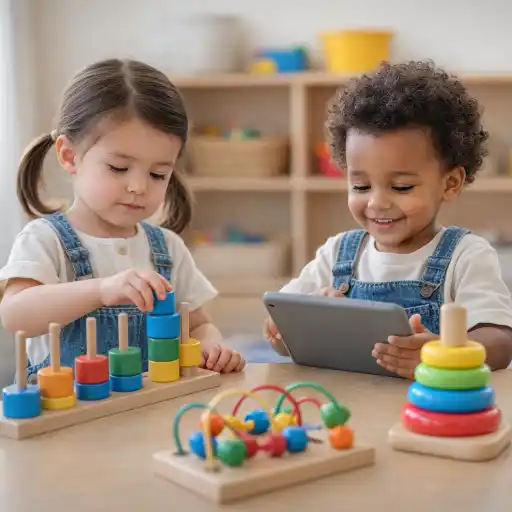
Use observation to make the final decision. If children spend most of the session tapping randomly, waiting for rewards, or talking about the device rather than the topic, the app may not be serving the intended purpose. A short trial and staff reflection can help determine whether to adapt, discontinue, or keep it.
How can a preschool program keep technology in balance?
Balance is not a strict contest between screens and “traditional” materials. It is the intentional design of a day rich in relationships, movement, open-ended materials, and varied ways to represent ideas. Digital experiences should be limited, purposeful, and connected to curriculum rather than used automatically to fill transitions or manage distress.
Directors can support consistent practice by setting shared expectations for selecting, previewing, supervising, and documenting child-facing media. Staff should know the purpose of each use, how to participate with children, and what extension follows. Keep meals, rest periods, and core play opportunities screen-free unless applicable program guidance or a specific need indicates otherwise. State requirements vary—check your state licensing agency.
Family partnership matters, too. Explain the learning goal and the practical limits behind classroom decisions, and invite families to share their preferences, languages, and concerns. The American Academy of Pediatrics Early Childhood Development and Screen Time Toolkit offers professional and family-facing materials that can support these conversations.
- Write a brief classroom media plan: what is used, why, when, and with what adult support.
- Keep sessions focused on a clear question, skill, or project, then transition to hands-on exploration.
- Observe children’s attention, language, peer interaction, and ability to use the idea away from the device.
- Review the plan with staff and families, making adjustments based on children’s responses.
What common mistakes can programs avoid?
A frequent pitfall is treating every app with an educational label as an effective teaching tool. There is no universal guarantee of quality, so previewing content and identifying a learning purpose are essential. Another is selecting an app because it occupies children quietly. Quiet engagement may be useful at moments, but it is not evidence by itself of learning or developmental value.
Programs can also miss the point by letting digital activity stand alone. Without adult conversation or a real-world extension, children may practice tapping and remembering app-specific cues without connecting the idea to their environment. On the other hand, rejecting all technology can overlook opportunities for children to create, document, explore, or access information that is otherwise difficult to bring into the classroom. The goal is thoughtful discernment, not an all-or-nothing rule.
- Mistake: Using an app without previewing ads, purchases, content, or exit controls. Try instead: Maintain an approved list and check updates before use.
- Mistake: Extending screen time because children seem absorbed. Try instead: Set a planned endpoint and prepare a smooth transition.
- Mistake: Assuming individual app use is automatically individualized instruction. Try instead: Match the task to each child’s interests, language, abilities, and learning needs.
- Mistake: Measuring success by time on task alone. Try instead: Notice children’s explanations, questions, collaboration, and transfer to play.
For ongoing professional learning, Balancing Active Play in Child Care Buy Now $16.00 supports providers in planning a varied day that includes active, creative, and sedentary experiences. The Best Promotion is Play Buy Now $24.00 explores how play supports children’s cognitive, physical, social, and emotional development. For literacy-rich alternatives and extensions, Setting the Stage: Story Time Buy Now $25.00 offers strategies for engaging read-alouds.
Conclusion: What should educational apps replace?
Educational apps should not be expected to replace the human, sensory, and social foundations of preschool learning. Their best role is to add something purposeful—a new way to investigate, create, document, or revisit an idea—while leaving ample room for conversation, shared reading, movement, outdoor discovery, and child-led play.
For every app, ask what it adds, what it displaces, and how children will carry the idea into real life. Choose quality over labels, participate alongside children, and follow digital moments with meaningful experiences away from the screen. The goal is not simply less or more technology; it is a preschool day in which technology serves children’s learning rather than taking the place of the relationships and play through which they learn.
Explore five relevant ChildCareEd courses
- Technology as a Classroom Tool Buy Now $16.00
- Balancing Active Play in Child Care Buy Now $16.00
- The Best Promotion is Play Buy Now $24.00
- Setting the Stage: Story Time Buy Now $25.00
- Classroom Tools for Emergent Literacy Buy Now $25.00
References
- Technology and Media in Early Childhood Education
- Digital or Print? A Comparison of Preschoolers’ Comprehension, Vocabulary, and Engagement
- Using tablets and apps to enhance emergent literacy skills in young children
- Assessing the educational potential and language content of touchscreen apps for preschool children
- Selecting Apps to Support Children’s Learning
- Technology as a Classroom Tool course information Buy Now $16.00
- 45 Hour Child Growth and Development
- 45 Hour Preschool Methods and Materials
- Bienvenido! Welcoming All Families
- Engaging Indoor Activities for Inclement Weather
- CDA Bridge Bundle: Family Child Care without Portfolio Review
- CDA Bridge Bundle: Infant/Toddler without Portfolio Review
- CDA Bridge Bundle: Preschool without Portfolio Review
- Creating Environments that Nurture Growth and Community
- Texas Director Credential
- 😫🧸 ¿Qué hacer cuando un bebé no quiere dormir la siesta en el aula?
- 🚨 Reporte Obligatorio en Nevada
- Qué capacitación se requiere para ser director de cuidado infantil en Texas?
- Recursos en Español sobre el Sueño Seguro del Bebé
- Que es Título 22 en California?
- Capacitación en Salud y Seguridad Preventiva en Línea para Proveedores de Cuidado Infantil
- ¿Cómo solicito la licencia para una guardería en California?
- Regulaciones de Licenciamiento de Cuidado Infantil en California para Centros y Hogares de Cuidado Infantil Familiar
- Proporciones de Cuidado Infantil y Tamaños de Grupo por Edad en Maryland (Guía Rápida para Centros y Hogares)
- Lista para Guardería en Casa en California: Cómo Iniciar una Guardería en el Hogar
- Lista para Guardería en Casa en Texas: Cómo Iniciar una Guardería en el Hogar
- Consejos de Supervisión Activa para Salones de Preescolar y el Juego al Aire Libre
- Cómo Ser Maestra de Preescolar en Dakota del Norte
- Cómo Ser Maestra de Preescolar en Wisconsin
- Capacitación Previa al Servicio para Proveedores de Cuidado Infantil en Dakota del Norte
- Can technology help preschool classrooms teach better?
- How can child care programs balance screen time, educational technology, and active-learning alternatives?
- How Much Screen Time Is Appropriate for Preschool Children?
