A wordless picture book can turn storytime into a lively exchange where children notice, imagine, and shape what happens next. With a few thoughtful prompts, you can welcome different interpretations while supporting children’s language, narrative thinking, and confidence; ChildCareEd’s Language Development in Early Childhood  Buy Now $16.00 offers practical strategies for building those skills in everyday care.
Why make room for different interpretations?
When a book has no written narration, children and adults construct meaning from the illustrations together. A character’s expression, a hidden object, or a change in the setting can suggest more than one possibility. One child may see a character as worried; another may think the character is curious. These responses offer a chance to explore how readers use visual clues and personal experience to create meaning.
This openness is not a barrier to literacy. Shared conversations around pictures can invite children to describe, explain, predict, and connect events. Research comparing wordless and text-based books suggests the formats can prompt different kinds of language: wordless books may encourage more child participation, while books with text can expose children to varied vocabulary and more complex sentence structures. Both belong in a balanced classroom library.
For providers, the aim is not to identify the one “correct” story. It is to help children express an idea, listen to another perspective, and notice details that support their thinking. This strengthens #language, #creativity, #listening, #storytelling, and #perspective-taking through an accessible, enjoyable routine.
How can you begin a shared reading without taking over?
Start by looking slowly. Invite children to examine the cover, characters, setting, and details before you suggest a plot. Some children will begin narrating right away; others may point, gesture, use a sound, or simply watch. Each is a valid way to join the experience.
Use a responsive rhythm: observe what draws a child’s attention, wait long enough for a response, and listen carefully. Following the child’s lead makes the interaction feel like a conversation rather than a quiz. A pause after turning a page can be more productive than a string of questions.
- Try prompts such as “What do you notice?” or “What might be happening here?”
- Reflect and extend the child’s contribution: “You think she is looking for her friend. I notice she is carrying a little bag.”
- Offer language for actions, feelings, and relationships without insisting that children repeat it.
- Accept speech, home-language contributions, pointing, drawing, and dramatic movement as meaningful participation.
Open-ended questions work especially well when they grow from children’s interests. “What else could happen?” leaves room for several possibilities; “Is the character happy?” may narrow the exchange too quickly. The goal is to support children’s ideas, not to test whether they have guessed an adult’s interpretation.
How can one book generate three possible endings?
Choose a wordless story with a clear sequence and a moment of uncertainty: a character finds an unusual object, reaches a fork in a path, or approaches someone new. Read through the pictures together, stopping before the final scene. Briefly review what the group has noticed, then invite children to imagine three distinct ways the story might end.
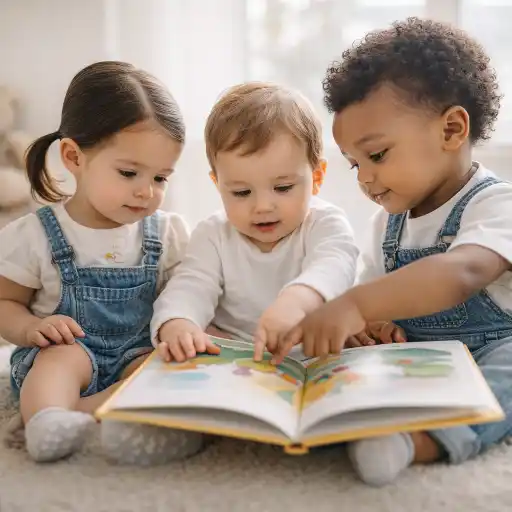
Offer a simple framework so children can organize ideas without being confined by it:
- Ending one: A helpful solution. The character asks for help, shares an object, or works with another character.
- Ending two: An unexpected turn. A new character appears, the setting changes, or the object has a surprising purpose.
- Ending three: An open possibility. The story pauses at a choice, leaving readers to decide what might happen later.
Children can tell, draw, act, or build their endings with props. A storyboard can help them place the beginning, key event, and ending in order. Conversation cards can give educators prompts such as “What clue helped you decide?” and “What might the character do next?” If children offer conflicting outcomes, represent each neutrally and explore them in turn rather than choosing a winner. The same images can support several plausible narratives.
As a practical classroom tool, the Three Endings Storyboard and Conversation Cards can help structure this activity while preserving room for children’s own ideas. Use the sequence flexibly; it should support storytelling, not turn open interpretation into a worksheet task.
How do you guide discussion while honoring every child’s idea?
Facilitation is a balance: keep the exchange connected to the illustrations while showing respect for children’s imaginative additions. If a child says a character can fly, you might respond, “That would be an exciting ending. In this picture, I see the character standing on the ground. What could happen next in your version?” This acknowledges the idea and distinguishes what the image shows from what the child is inventing.
Invite children to explain their reasoning, but do not require a defense of every choice. A gentle prompt—“What did you notice that gave you that idea?”—supports inference. Children may refer to facial expressions, body positions, color, objects, or what happened on an earlier page. These details help them connect events and build a coherent narrative.
In group settings, establish a climate where different accounts can coexist. Reflect each contribution fairly, make space for quieter children, and provide ways to participate beyond speaking aloud. A child might add a picture, choose a card, point to a clue, or act out a moment. Avoid framing the activity as a competition for the “best” ending; the learning is in creating, sharing, and reconsidering possibilities together.
Open-ended reading prompts can spark creative thinking, as NAEYC notes in its discussion of questions that invite children’s ideas. Offer children sufficient wait time, and let their answers shape the next prompt rather than following a fixed sequence.
How can providers adapt the activity and avoid common pitfalls?
Adapt the experience to children’s ages, language abilities, interests, and communication styles. Younger children may focus on naming, actions, and simple cause-and-effect. Older preschoolers may be ready to discuss motives, compare outcomes, or connect a character’s feelings to an event. For multilingual children, welcome home languages and invite families to share words or storytelling traditions. Visuals, gestures, and props can make participation more accessible.
Keep the group small enough for children to see the pages and contribute. Revisit the same book another day; familiarity can free children to notice details and develop more elaborate stories. You can also document children’s exact words or sketch their ideas, then return to the story during dramatic play or art.
Common pitfalls are easy to address:
- Asking too many questions: Pause, comment, and follow children’s observations instead of interrogating them.
- Correcting every imaginative detail: Distinguish visual evidence from invented possibilities without shutting down creativity.
- Expecting one polished retelling: Accept short phrases, gestures, drawings, and partial sequences as meaningful contributions.
- Rushing to reveal an ending: Allow children time to imagine before moving on or supplying an adult conclusion.
For a deeper foundation in children’s communication and language-rich practice, explore ChildCareEd’s Language Development in Early Childhood Buy Now $16.00, Reading Aloud and Storytelling Buy Now $16.00, Language and Literacy Foundations in Pre-K Buy Now $16.00, Building Vocabulary Buy Now $16.00, and Play Safe, Think Big: Literacy Through Play Buy Now $10.00. These English-language trainings focus on related early language and literacy practices; review each course for details. State requirements vary - check your state licensing agency if you plan to apply training toward a requirement.
Conclusion: What can three endings teach us about one story?
A wordless book gives children room to interpret illustrations, connect events, and make a story their own. When educators invite several possible endings, children practice oral language, sequencing, inference, creativity, and respectful listening—all without needing to agree on a single answer.
Choose an engaging book, pause before the final scene, and invite children to share different ways the story might conclude. Listen for their reasoning, use prompts that extend rather than test, and welcome spoken, visual, and nonverbal contributions. The most valuable ending may be the conversation itself: a shared moment in which children discover that the same pictures can inspire many thoughtful stories.
- 45 Hour Child Growth and Development
- CDA Home Visitor Subject Area 3 Part 3 Birth to 5
- CDA Home Visitor Subject Area 2 Part 3 Birth to 5
- The ABCs of Behavior: Turning Challenges into Learning Opportunities
- Pediatric RSV First Aid & CPR/AED
- 45-Hour Infant and Toddler Curriculum
- Texas Director Credential
- Access for All: Inclusion and the ADA
- Supporting Families and Caregivers in Language and Literacy
- CDA Certification en Español: Recursos y Consejos para Educadores Bilingües
- 💛🧩 ¿Cómo puedo hacer que mi enseñanza sea inclusiva para los niños con autismo?
- 👶😴¿Es Normal que los Niños Griten o Lloren al Despertarse?
- 😅❌ ¿Cómo Puedo Manejar a un Niño que Dice “¡NO!” a Todo en el Aula?
- Requisitos Para Ser Maestra Principal En Un Daycare: Lo Que Necesitas Para Empezar
- 10 Ejemplos de Cómo la Cultura Influye en el Desarrollo Infantil
- Normas de Licenciamiento de Cuidado Infantil en Virginia para Centros Diurnos Infantiles y Hogares Diurnos Familiares
- Proporciones de Cuidado Infantil y Tamaños de Grupo por Edad en Nueva Jersey (Guía Rápida para Centros y Hogares)
- Proporciones de Cuidado Infantil y Tamaños de Grupo por Edad en Virginia (Guía Rápida para Centros y Hogares)
- Cómo Trabajar en el Cuidado Infantil en Carolina del Norte: Requisitos y Pasos
- Cómo Ser Maestra de Preescolar en Carolina del Norte
- Celebrando la amistad en el cuidado infantil durante el Día de los Mejores Amigos
- Canciones, juegos y preguntas de círculo para niños
- La mejor manera de hacer seguimiento a la capacitación de su equipo de daycare How to Organize Staff Training for Your Child Care Center Cómo organizar la capacitación del personal para su centro de cuidado infantil
- Cómo simplificar la capacitación para sus empleados de daycare
- How Can You Build a Preschool Literacy Center Without Spending Hours Planning?
- What Should You Do When Children Disagree with a Storybook’s Ending?
- How Can You Set Up a Reading Corner Preschoolers Can Use Independently?
- How Can One Wordless Book Lead to Three Different Endings?
