Thanksgiving themes can turn everyday classroom moments into lively opportunities for children to talk, listen, tell stories, and explore print. With a few intentional activities, providers can nurture early language while honoring children’s experiences; the ChildCareEd Reading Aloud and Storytelling  Buy Now $16.00 course offers practical strategies for making shared books and oral storytelling more engaging. Read on for adaptable ideas you can use with your group right away.
Why does Thanksgiving literacy belong in early childhood programs?
Early literacy is much broader than recognizing letters or completing worksheets. It includes speaking, listening, vocabulary, understanding stories, noticing print, and experimenting with drawing and writing. Seasonal themes can make these foundations concrete: children can describe a meal, retell a familiar story, contribute an idea to a shared book, or notice the first sound in a word.
These experiences are most valuable when they are playful, responsive, and connected to children’s interests. NAEYC describes reading aloud, rhyming, singing, conversation, and play as meaningful supports for language and literacy development. Instead of expecting every child to produce the same answer, educators can listen closely, build on a child’s words, and offer inviting ways to participate.
Thanksgiving can also be a sensitive topic. Families may celebrate differently, may not observe the holiday, or may hold varied perspectives on its history. Focus on broad themes such as harvest, family and community, sharing, and gratitude—and make room for children to speak about what is meaningful in their own lives. Thoughtful playful, literacy-rich classroom practices can support both language growth and belonging.
How can shared reading spark richer language?
Choose picture books that invite participation through repeated phrases, rhyme, vivid illustrations, or an engaging problem. Preview the book and identify a few useful words—such as harvest, gather, generous, feast, or thankful. Introduce them naturally as you read rather than pausing so often that the story loses its momentum.
Make a read-aloud interactive without turning it into a quiz. Pause to notice what children are attending to, invite predictions, and allow time for responses in speech, gesture, signs, or communication devices. When a child says, “Big turkey,” you might expand: “Yes, the turkey has enormous feathers. Where do you think it will go next?” This models richer language while respecting the child’s contribution.
- Read a favorite book more than once; familiarity helps children join in and notice new details.
- Ask open questions: “What do you notice?” “How might the character feel?” “What could happen next?”
- Connect story ideas to children’s experiences, without assuming every family celebrates Thanksgiving.
- Offer picture choices, props, or simple story pieces so children with different communication styles can participate.
For an additional professional learning step, explore ChildCareEd’s Language Development in Early Childhood Buy Now $16.00 course, which addresses strategies for supporting young children’s language and communication. Shared reading can become a welcoming conversation—not just a time when an adult reads and children listen.
Which hands-on activities build vocabulary and conversation?
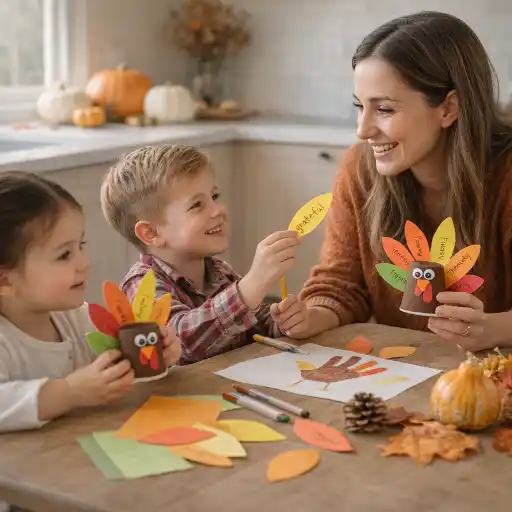
Choose activities that give children a real reason to communicate. A vocabulary basket might include safe toy or picture representations of seasonal items, such as a leaf, squash, basket, or bread. Invite children to name, describe, sort, compare, and explain their choices. Model precise words while keeping the exchange relaxed: “You chose the smooth, orange squash. What could we put beside it?”
A collaborative “I’m thankful for…” booklet is another flexible option. Children can draw, dictate, use picture symbols, or make marks to share something important to them. An adult can write the child’s words beneath the drawing, then read the page aloud with the child’s permission. ChildCareEd’s Thanksgiving booklet activity describes ways to connect a simple booklet with page sequence, alphabet knowledge, emergent writing, and storytelling.
- Set up a dramatic-play gathering with menus, labels, order pads, and pretend foods to encourage purposeful talk.
- Invite children to describe a favorite food, a seasonal change, or a way people help one another.
- Make a class gratitude tree with leaves bearing children’s dictated words, drawings, or chosen images.
- 🎵 Sing a repetitive seasonal song or poem, pausing for children to supply a word, sound, or movement.
Keep materials accessible and avoid pressuring children to disclose personal or family information. These playful opportunities can strengthen #vocabulary, listening, expressive language, and confidence while recognizing every child’s voice.
How can educators adapt activities for different ages and abilities?
Start with children’s developmental levels, interests, and preferred ways of communicating. Infants can explore board books, safe textures, familiar voices, and simple naming games. Toddlers may enjoy repetitive phrases, pointing to pictures, handling large materials, and choosing between two objects. Preschoolers can contribute to a group story, sort picture cards by initial sound, dictate sentences, or sequence events from a book.
For mixed-age groups, offer several ways to engage with the same idea. A younger child might choose a picture for the class booklet while an older peer dictates a caption. Provide chunky crayons, adaptive grips, pre-cut pieces, large picture cards, and communication supports as needed. Reduce noise or offer a quiet space when group activities feel overwhelming. Small items and craft supplies require close supervision, particularly for children under three.
Representation matters as much as access. Select books that portray Indigenous peoples and other communities respectfully, include contemporary perspectives, and avoid presenting a single simplified version of Thanksgiving history. Invite family knowledge and honor families who do not celebrate. These choices strengthen cultural responsiveness and communicate that children’s identities belong in the classroom.
Observe rather than compare. Notice whether a child joins a refrain, communicates a choice, uses a new word, or shows interest in print. Those observations help providers adapt the next experience and support each child’s growing #communication skills.
How can providers turn activities into intentional learning?
Begin with a modest goal, such as supporting children to describe an object, take a conversational turn, recognize a repeated phrase, or dictate an idea for a shared page. Select an activity that creates genuine opportunities to practice the goal, then plan a few prompts that can extend children’s thinking without directing every move.
During the activity, use responsive strategies: wait long enough for children to answer, repeat and expand their words, introduce new vocabulary in context, and invite children to respond through their preferred communication modes. Afterward, jot down brief observations. For example: “Maya chose the leaf picture and said ‘red leaf’; after I modeled ‘crimson,’ she repeated the new word.” This kind of note can guide an appropriate next step.
- Record children’s comments, questions, drawings, or dictated words, following program privacy practices.
- Use observations to plan a follow-up read-aloud, rhyme game, storytelling circle, or writing invitation.
- Share a brief learning note with families and invite them to contribute words, stories, or traditions if they wish.
- Check whether each activity offers meaningful participation for children with varied language, sensory, and motor needs.
Common pitfalls include relying on worksheets, correcting children’s speech in ways that interrupt communication, or treating gratitude as an answer children must provide. Keep the focus on warm exchanges and authentic choices. The Classroom Tools for Emergent Literacy Buy Now $16.00 course offers further approaches, including interactive read-alouds, vocabulary supports, reading buddies, and classroom print.
What are the key takeaways for Thanksgiving literacy?
Thanksgiving literacy activities build early language skills when children have meaningful chances to speak, listen, ask questions, tell stories, notice print, and share ideas. Shared reading, songs, a seasonal vocabulary basket, dramatic play, and a collaborative booklet can all support these goals. The strongest activities are not necessarily elaborate; they are intentionally planned, open to different ways of participating, and responsive to what children say and do.
Keep the content inclusive by centering themes such as community, seasonal change, and sharing without assuming every family celebrates the same way. Use respectful books and invite children to contribute only what they feel comfortable sharing. Observe their language and interests to guide follow-up experiences, and adapt materials so every child can take part.
Ultimately, the answer to the article’s question is that holiday activities can nurture early language when educators use them as invitations to communicate—not as tasks with one right response. For more practical support, explore ChildCareEd’s Science of Reading Foundations in the Pre-K Classroom Buy Now $16.00, which covers foundational literacy areas including vocabulary, phonological awareness, print knowledge, read-alouds, and storytelling. State requirements vary—check your state licensing agency.
- CDA Subject Area 2
- CDA Home Visitor Subject Area 2 Part 3 Birth to 5
- Language Development in School Age
- Language and Literacy Foundations in Pre-K
- Building Early Science Foundations
- Birth to Five CDA Credential with Portfolio Review
- Texas Director Credential
- Building Bridges for Dual Language Learners
- Growing the Whole Child: Health, Emotions & Early Learning
- Supporting Families and Caregivers in Language and Literacy
- Thanksgiving Booklet Activity
- CDA Certification en Español: Recursos y Consejos para Educadores Bilingües
- 🍑 ¿Qué capacitación requiere DECAL cada año para el personal de cuidado infantil en Georgia?
- 👶 ¿Cuáles son las proporciones y grupos requeridos en Dakota del Norte? 🏫
- Apoyo en Español para Capacitaciones Grupales Presenciales y por Zoom en Cursos Selectos
- Retraso del Habla en la Guardería: Cómo Pueden Ayudar los Proveedores
- Cómo Trabajar en el Cuidado Infantil en Carolina del Norte: Requisitos y Pasos
- Celebrando la amistad en el cuidado infantil durante el Día de los Mejores Amigos
- Canciones, juegos y preguntas de círculo para niños
- Cómo simplificar la capacitación para sus empleados de daycare
- What Are Age-Appropriate Ways to Teach Gratitude Before Thanksgiving?
- What Should You Review Before Sending Home a Thanksgiving Activity?
- How Can Preschool Thanksgiving Activities Avoid Stereotypes?
- How Can Child Care Providers Strengthen Family Partnerships During Thanksgiving?
- How Can Child Care Providers Strengthen Family Partnerships During Thanksgiving?
- How Can Thanksgiving Literacy Activities Build Early Language Skills?
- How Can Child Care Providers Create Inclusive Thanksgiving Activities That Celebrate Different Families and Traditions?
- How Can Thanksgiving Classroom Activities Teach Nutrition and Healthy Eating?
- How Can Thanksgiving Family Projects Support Children’s Early Learning?
- How Can November Classroom Activities Help Preschoolers Build School Readiness Skills?
