Thanksgiving family projects can turn a seasonal moment into meaningful practice in language, early math, creativity, and belonging—without adding a complicated event to your already-full schedule. Explore practical ways to invite families into children’s learning, and consider Building a Community of Families  Buy Now $16.00 to strengthen the communication and partnership skills that make these projects welcoming and purposeful.
Why can family projects make learning more meaningful?
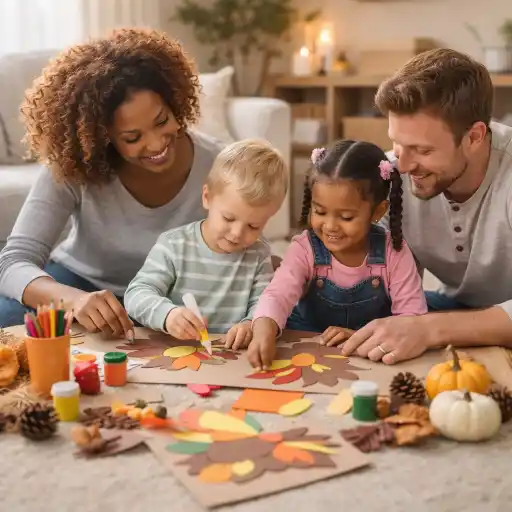
A project created at home and shared in a child care setting connects children’s everyday experiences with classroom learning. Children can talk about family routines, make choices, compare ideas, and see their work valued by peers. The project need not be elaborate: a family-decorated paper feather, a gratitude drawing, or a page for a class book can provide plenty to notice and discuss.
Family participation should be an invitation, not a test of time, money, materials, or availability. Families have different schedules, traditions, languages, and comfort levels. Offer multiple ways to contribute—including a brief conversation, a drawing completed at school, or a take-home option—and make participation voluntary. This reflects the principle that families are children’s first and lasting teachers, and that engagement can support children’s development and learning (Administration for Children and Families: Family Engagement).
When educators begin with children’s interests and invite families’ perspectives, the project can nurture #belonging while giving staff a natural opportunity to observe what children know and wonder about.
What early learning goals can a Thanksgiving project support?
A project is most useful when adults can name the learning it may invite while remaining open to children’s ideas. A family feather project, for example, can prompt children to describe a picture, dictate a caption, count or sort colors, and compare details. A gratitude tree can spark conversations about relationships, feelings, and acts of care. A small booklet can support page order, drawing, emergent writing, and storytelling; the Thanksgiving booklet activity offers examples of ways to extend these skills.
- Language and literacy: Invite children to name, describe, dictate, retell, or make marks that carry meaning.
- Early mathematics: Count project pieces, sort by attributes, notice patterns, or compare quantities.
- Fine-motor development: Drawing, tearing, folding, gluing, and threading provide purposeful hand practice. Keep age-appropriate lacing activities supervised and adapted.
- Social-emotional learning: Children practice choice-making, sharing materials, listening, and expressing appreciation.
These are possibilities, not performance targets. Focus on children’s process, conversation, and developing strategies rather than identical finished products.
How can providers invite families in ways that feel inclusive?
Clear, flexible communication helps families understand the purpose and decide whether and how to participate. Explain the project’s learning goals, what materials are optional, when work is due, and how children will share it. Send information in families’ preferred languages when possible, and avoid wording that assumes every household celebrates Thanksgiving or follows the same traditions.
Keep access equitable. Use inexpensive, readily available supplies, provide classroom materials for children who prefer to work at school, and make digital sharing optional. A child can contribute by dictating an idea to an educator, choosing from picture cards, or simply talking about a family routine. The study on preschool home learning highlights that many parents want more information from teachers about children’s progress and activities, while some may feel less confident supporting particular learning areas such as mathematics (Sonnenschein, Stites, and Dowling, 2021). A short, encouraging note can make the learning visible without placing responsibility for instruction on families.
- Offer a simple prompt: “What is something your family enjoys doing together?”
- Provide a classroom alternative and a no-cost materials option.
- Invite families to share only what feels comfortable; never ask one child to represent a culture or community.
Family engagement is strongest when it is reciprocal: educators learn from families, and families receive useful insight into children’s learning.
How can you plan a project that is playful and developmentally appropriate?
Start with one or two observable goals, then choose a flexible format. For preschoolers, a family project might be a decorated feather that represents a favorite activity or a contribution to a shared class book. Children can draw, dictate words, select images, or add collage materials. At school, invite them to explain their choices and help assemble the shared display. This makes the project a starting point for conversation and inquiry rather than a product adults complete on children’s behalf.
Offer choices and adapt the task to children’s ages and abilities. Younger children may explore large, safe materials with adult support; older preschoolers may sequence pages, label a picture, or count elements. Provide adaptive tools such as thicker crayons, pre-cut shapes, and picture choices. For activity ideas that bridge home and classroom participation, see the Thankfulness Tree.
Keep materials safe and manageable: supervise scissors, check for allergies, and avoid small objects for children under three. A process-focused art approach can help educators value exploration and decision-making over matching a sample; ChildCareEd’s Art from the Heart for Preschoolers Buy Now $35.00 offers further learning about open-ended art and children’s self-esteem.
How can educators make Thanksgiving projects culturally thoughtful?
Seasonal projects can be joyful while acknowledging that families experience Thanksgiving differently and that its history is more complex than a simple story of universal friendship. Avoid stereotyped costumes, crafts, or reenactments, and do not suggest that one activity or menu represents all families. If children ask about the holiday’s history, use clear, age-appropriate language and reliable, specific resources; the Smithsonian National Museum of the American Indian’s Rethinking Thanksgiving Celebrations guide supports educators in reviewing common assumptions and finding Native perspectives.
Choose learning goals that do not depend on reenacting historical identities: gratitude, seasonal change, food and where it comes from, family traditions, kindness, and caring for the natural world. Let children share—or pass. Review books, images, and templates before using them, and represent Indigenous peoples as diverse and contemporary communities, not as a single group from the past.
Family projects can also help children notice that communities contain many perspectives. Ask open questions such as, “What does your family enjoy doing together?” rather than asking children to explain an entire culture. Thoughtful choices support curiosity and #respect without taking the fun out of making and sharing.
How can you extend learning and reflect on children’s growth?
Use the project as the beginning of a short learning sequence. After children share their work, invite peers to notice details, ask respectful questions, or tell a related story. Follow their interests: a child’s drawing of a garden might lead to a conversation about plants, while a family food picture could inspire sorting, counting, or a read-aloud about harvest foods. Project-based learning can connect classroom inquiry with family and community knowledge when adults plan accessible ways for caregivers to contribute (PBLWorks: Project-Based Learning in Early Childhood).
Observe rather than grade the keepsake. Note whether a child explains an idea, uses new vocabulary, counts objects with one-to-one correspondence, persists with a motor task, or listens to a peer. Save a brief anecdotal note or photograph according to program policy and family permissions, then use those observations to plan the next invitation. Shared play and family input can inform curriculum design and strengthen children’s learning experiences (Family-school-community partnership supporting play-based learning).
- Ask children what they enjoyed, found challenging, or would like to try next.
- Share a specific learning observation with families, not only a picture of the finished work.
- Reflect as a team: Who had meaningful ways to participate, and what could be made more accessible next time?
Keep safety and local policy in view; state requirements vary—check your state licensing agency.
Conclusion: How do Thanksgiving family projects support early learning?
Thanksgiving family projects support early learning when they connect children’s interests, classroom goals, and family knowledge through accessible, playful experiences. Simple projects can encourage language, early math, fine-motor practice, creativity, and social-emotional learning, while offering educators useful opportunities to observe children’s developing skills.
The strongest projects are flexible, voluntary, culturally thoughtful, and focused on children’s process—not polished products or a single version of family life. Communicate the purpose clearly, provide multiple ways to participate, review materials carefully, and extend children’s questions into follow-up play. In short, a Thanksgiving family project can become a meaningful bridge between home and classroom when every family’s participation is welcomed on its own terms.
Explore related professional learning:
- Building a Community of Families Buy Now $16.00
- Family Voices Matter: Tools for Meaningful Collaboration Buy Now $55.00
- Families, Communities, and Classrooms: Working Together for Children Buy Now $55.00
- Art from the Heart for Preschoolers: Open-Ended Art Projects that Build Self-Esteem Buy Now $35.00
- From Play to Planning: Building Culturally Competent, Child-Centered Curriculum Buy Now $55.00
- CDA Home Visitor Subject Area 3 Part 3 Birth to 5
- Bienvenido! Welcoming All Families
- Pediatric RSV First Aid & CPR/AED
- CDA Bridge Bundle: Family Child Care
- CDA Bridge Bundle: Family Child Care without Portfolio Review
- Art from the Heart for Preschoolers: Open Ended Art Projects that Build Self-Esteem
- Building Bridges for Dual Language Learners
- Wellness in Action: Teaching Healthy Habits to Children
- Supporting Families and Caregivers in Language and Literacy
- Thanksgiving Booklet Activity
- CDA Certification en Español: Recursos y Consejos para Educadores Bilingües
- 💛🧩 ¿Cómo puedo hacer que mi enseñanza sea inclusiva para los niños con autismo?
- 10 Ejemplos de Cómo la Cultura Influye en el Desarrollo Infantil
- Proporciones de Cuidado Infantil y Tamaños de Grupo por Edad en Virginia (Guía Rápida para Centros y Hogares)
- Cómo Trabajar en el Cuidado Infantil en Carolina del Norte: Requisitos y Pasos
- Celebrando la amistad en el cuidado infantil durante el Día de los Mejores Amigos
- Canciones, juegos y preguntas de círculo para niños
- What Are Age-Appropriate Ways to Teach Gratitude Before Thanksgiving?
- What Should You Review Before Sending Home a Thanksgiving Activity?
- How Can Preschool Thanksgiving Activities Avoid Stereotypes?
- How Can Child Care Providers Strengthen Family Partnerships During Thanksgiving?
- How Can Child Care Providers Strengthen Family Partnerships During Thanksgiving?
- How Can Thanksgiving Literacy Activities Build Early Language Skills?
- How Can Child Care Providers Create Inclusive Thanksgiving Activities That Celebrate Different Families and Traditions?
- How Can Child Care Providers Maintain Consistent Classroom Routines During Thanksgiving Celebrations?
- How Can Thanksgiving Classroom Activities Teach Nutrition and Healthy Eating?
- How Can Thanksgiving Family Projects Support Children’s Early Learning?
- How Can November Activities Help Children Learn to Work Together Inclusively?
