A tower leans, a leaf collage takes an unexpected turn, and “Good job!” can leave a child wondering what the adult actually noticed. Specific feedback helps children see their own strategies, choices, and persistence—skills they can carry into the next creation. For a deeper foundation in supportive classroom practice, explore Viewing Guidance in a Positive Light  Buy Now $24.00, a three-hour online course that examines positive guidance and developmentally appropriate responses; the companion Power of Art: Building Self-Esteem & Positive Behavior for All Abilities Buy Now $24.00 connects creative experiences with inclusive guidance.
Fall invites children to build with blocks, arrange natural materials, mix colors, and investigate what happens when a plan changes. These activities are rich opportunities to notice and describe learning—not just admire a finished product. The practical aim is simple: observe what a child does, name the meaningful action, and leave room for the child to continue thinking.
Why does specific feedback matter during fall play?
“Good job” may communicate warmth, but it gives little information about what the child did. A specific observation can help a child connect an action with its effect: “You put the wide blocks at the bottom, and the tower stayed up.” That kind of language recognizes a strategy without making the adult the judge of whether the work is beautiful or correct.
Fall building and art activities naturally involve experimentation. Children may test how a bridge holds, layer leaves in a collage, or notice that two colors blend into a new shade. When educators describe these actions, they make children’s thinking visible and support motivation, problem-solving, and persistence. NAEYC’s article on mastery motivation and problem-solving emphasizes offering worthwhile challenges, allowing children to make choices, and recognizing the process of working through difficulty.
Specific feedback is also more respectful than labels such as “You’re a natural artist” or comparisons between children. It focuses on what a child actually tried, which matters in classrooms where children have different abilities, experiences, communication styles, and ways of participating. The goal is not to eliminate joy or celebration; it is to make adult attention informative and sincere.
- Describe what you observed rather than rating the child or artwork.
- Connect the action to a strategy, discovery, effort, or contribution.
- Leave space for the child’s own interpretation and next idea.
How can teachers notice effort without taking over?
Begin by watching and listening before speaking. In block play, notice whether a child compares pieces, changes the base, or asks a peer to help. In art, observe how a child selects tools, presses a leaf into paint, or changes a plan after seeing the mark it makes. An intentional pause often reveals more than an immediate compliment.
Then offer a brief, accurate observation. For example: “You turned the block around and tested it again,” or “You tried the leaf first, then chose the sponge.” This makes the process visible without telling the child what to make. NAEYC’s guidance on using observation to guide teaching highlights watching, listening, and using what educators learn to adapt support and plan responsive experiences.
After an observation, decide whether a question would genuinely extend the child’s thinking. One open prompt—“What do you notice?” or “What might you try next?”—can invite reflection. Avoid firing off questions like a quiz; children may prefer to show, point, gesture, or keep working rather than explain aloud. For a child who communicates differently or uses a home language, allow those forms of expression and offer visual or material cues when useful.
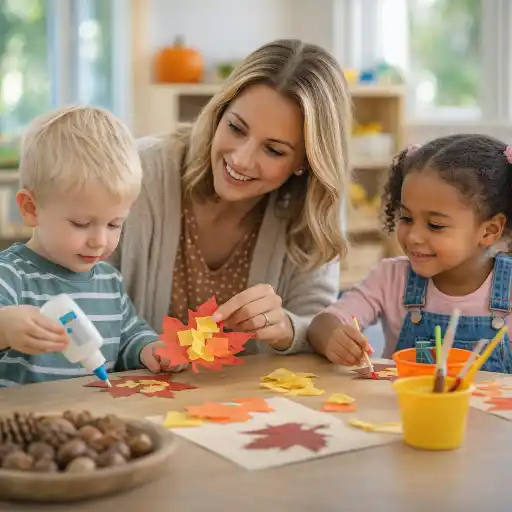
In open-ended art, avoid treating a recognizable picture as the measure of success. Fall process art is often about exploration and choice, not reproducing a sample. As children explore leaves, paint, blocks, and other safe materials, a teacher can notice texture, movement, color mixing, or how a child adapts a plan.
What words work well during building and art activities?
A practical pattern is Notice, Name, Invite. First, notice an observable action. Next, name the strategy or learning it reflects. Then, when it fits the moment, invite the child to reflect or continue. This is a flexible prompt for educators—not a script that must interrupt every moment of play.
- Building: “You added a wide block at the bottom. What do you think that changed?”
- Problem-solving: “The bridge tipped, and you tried a different base. What could you test next?”
- Art: “You pressed the leaf into the paint and made a veined print.”
- Color exploration: “You mixed yellow and red and noticed the color changed.”
- Collaboration: “You held the paper while your friend added the leaves. That helped you both keep creating.”
- Persistence: “You stayed with the collage and tried another way to make the pieces stick.”
Short phrases are often enough. Responsive Classroom’s discussion of teacher language emphasizes being direct and genuine, focusing on actions, keeping words brief, and knowing when silence gives children room to think. A quiet smile or a pause can be meaningful feedback, too.
Choose language that accurately reflects what happened. Do not say “You worked so hard” if you did not observe that effort, or suggest every challenge was overcome. “You are trying another plan” is honest and encourages children to continue without promising a particular result. These practices help build #confidence while respecting children’s agency.
How can feedback support different children fairly?
Specific feedback should be individualized, not delivered identically to every child. Some children enjoy a cheerful comment in front of peers; others feel more comfortable with a quiet observation, a gesture, or a private exchange. A child may respond through speech, sign, a communication device, pointing, or action. The educator’s task is to communicate respect and useful information in a way the child can receive.
Pay attention to who gets noticed and what kinds of learning count. Adults may naturally comment on tall structures, elaborate pictures, or children who speak readily. Also look for quieter contributions: a child who carefully sorts materials, watches before joining, keeps a shared space organized, or experiments with one tool repeatedly. Vanderbilt’s guidance on providing positive feedback recommends that feedback be descriptive, sincere, and individualized to children’s strengths, needs, and preferences.
Feedback can acknowledge an attempt without making a child perform for adult approval. For instance, “You placed the pinecones in a line from small to large” describes an observable choice. Then pause. The child may explain the idea, change the arrangement, or move on. A question is optional—not a requirement to demonstrate learning on demand.
- Use children’s names when appropriate, but avoid singling anyone out in a way that causes discomfort.
- Notice growth, strategy, curiosity, and contribution—not only polished products.
- Make participation accessible by adapting tools, language, time, and ways to respond.
- Consider culture and family preferences around public praise and adult-child communication.
Fairness does not mean giving every child the same sentence. It means ensuring each child has a genuine opportunity to be seen and supported. That approach strengthens belonging and helps feedback remain connected to learning rather than comparison.
What common feedback pitfalls should educators avoid?
One common pitfall is replacing “Good job” with a longer evaluation: “That is the most beautiful leaf picture ever!” The wording is more elaborate, but it still ranks or judges the product and offers little insight into how the child worked. Instead, name a visible action: “You layered the red and yellow leaves and left some space between them.”
Another pitfall is interrupting concentration. Children who are deeply engaged may not need a running commentary. Offer a short observation when it will support connection or learning, then give the child time to continue. Also avoid turning every comment into a question; too many prompts can make play feel like an assessment.
Do not compare children, use fixed-trait labels, or praise only the result. “You’re the best builder” can create a ranking, while “You’re so talented” may imply ability is fixed. Instead, describe the child’s choices and the process: “You tested two ways to connect the blocks.” If a structure falls or paint spills, avoid shame or exaggerated reassurance. A calm statement—“The tower fell; what could we try for the base?”—keeps the focus on what happened and a possible next step.
- 🙂 Avoid comparison: recognize a child’s own decisions and progress rather than who finished first.
- Avoid inaccurate praise: say only what you actually observed.
- Avoid taking over: offer a small prompt or scaffold, then return the work to the child.
- Avoid ignoring safety: set a clear limit when materials or actions could cause harm.
Finally, feedback cannot replace thoughtful activity design. Make materials accessible, provide manageable choices, and allow enough time for exploration. If the activity is frustrating or inaccessible, consider adapting the setup rather than expecting praise to solve the difficulty.
How can directors help staff make feedback a daily habit?
Directors can frame specific feedback as shared professional practice, not a correction of individual teachers. Start with one familiar routine—perhaps fall block building or leaf collage—and invite staff to notice the language they already use. Then agree on a small set of stems, such as “I noticed…,” “You tried…,” and “What do you notice?” A few usable phrases are more likely to become natural than a long list of required scripts.
Use brief peer reflection or coaching to connect language to children’s responses. After an observation, a director might ask, “What strategy did you notice the child using?” or “How did the child respond when you paused?” These questions focus on practice and evidence rather than blame. NAEYC’s observation guidance underscores that educators can use what they observe to adjust teaching and design learning experiences.
Teams can try a short improvement cycle:
- Choose one focus, such as persistence during construction or experimentation in art.
- Practice two or three descriptive feedback phrases together.
- Observe whose strategies and contributions are being noticed across the group.
- Reflect on children’s responses and adapt language for individual preferences.
Directors should model the same strengths-based approach with staff that they hope staff will use with children. Keep documentation objective and respectful, and involve families as partners when discussing children’s interests and communication preferences. State requirements vary - check your state licensing agency.
For a quick classroom reference, the Teacher Language Cheat Sheet: Positive Guidance & Preschool SEL Phrases Buy Now $2.49 includes examples for common preschool moments, including effort, mistakes, frustration, and independence.
Conclusion: How can providers move beyond “Good job”?
During fall building and art activities, providers can move beyond “Good job” by observing closely, describing children’s actual actions, and connecting those actions to strategies, choices, or discoveries. Keep comments brief and sincere; invite reflection when it is helpful, and let children decide how to continue. Specific feedback supports learning without taking ownership away from the child or ranking one creation above another.
Remember the core practice: notice, name, and—when appropriate—invite. Adapt how you communicate to each child’s preferences and abilities, attend to less visible contributions, and protect the open-ended nature of creative play. For more structured professional learning, the linked ChildCareEd courses offer a fuller exploration of positive guidance and the role of art in supporting children’s self-esteem and positive behavior.
Five relevant ChildCareEd courses
- 45 Hour Child Growth and Development
- What Makes Me Special: An Overview of Autism and ADHD
- Staff Supervision, Observation & Feedback
- Teacher Mentoring in ECE
- 45 Hour Infant and Toddler Methods and Materials
- Pediatric RSV First Aid & CPR/AED
- Art from the Heart for Preschoolers: Open Ended Art Projects that Build Self-Esteem
- Staff Supervision, Observation & Feedback
- Texas Director Credential
- Effective Coaching & Mentoring in ECE
- Nature’s Classroom: Why Fall Is the Best Season for Sensory Learning Outdoors
- CDA Certification en Español: Recursos y Consejos para Educadores Bilingües
- Apoyo en Español para Capacitaciones Grupales Presenciales y por Zoom en Cursos Selectos
- ¿Cuáles son las mejores actividades de primeros auxilios para adultos?
- Actividades de Motricidad Gruesa que Desarrollan el Equilibrio, la Coordinación y la Fuerza
- Capacitación en Salud y Seguridad Preventiva en Línea para Proveedores de Cuidado Infantil
- Proporciones de Cuidado Infantil y Tamaños de Grupo por Edad en Maryland (Guía Rápida para Centros y Hogares)
- Proporciones de Cuidado Infantil y Tamaños de Grupo por Edad en Virginia (Guía Rápida para Centros y Hogares)
- Consejos de Supervisión Activa para Salones de Preescolar y el Juego al Aire Libre
- Las Mejores Ideas de Excursiones para Guarderías en Dakota del Norte
- Cute Fall Picture Ideas Teachers Can Try in the Classroom
- How can New York childcare providers build self-confidence in toddlers?
- Calabazas, hojas y manzanas: actividades de otoño para preescolares
- Rainy Fall Day? 12 Indoor Activities Preschoolers Won’t Want to Stop
- How Can Preschool Teachers Use Fall Activities to Strengthen Family Engagement?
- How Can Child Care Providers Make Fall Activities Inclusive for Every Child?
- How Can Child Care Providers Teach Fall in Warm Climates Without Red Leaves or Cold Weather?
- How Can Child Care Providers Strengthen Family Engagement in November?
- How Can Fall Collage Activities Support Children Still Learning to Use Scissors?
- How Can Providers Give Specific Feedback During Fall Building and Art Activities?
