Keeping babies safe while they sleep is one of the most important jobs in child care. This guide helps New York providers follow clear rules and practical steps. Read this with your team and families. State requirements vary - check your state licensing agency.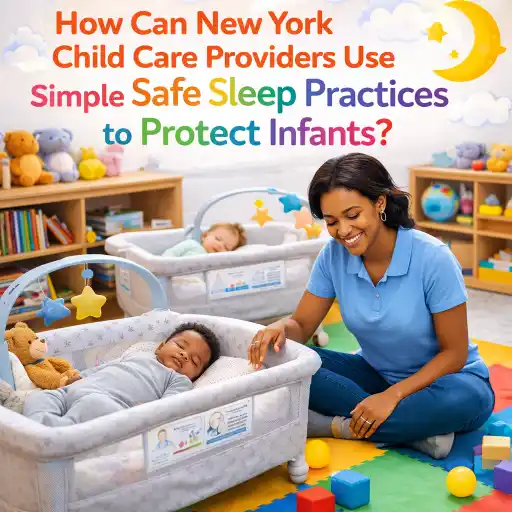
Why it matters:
1) Safe sleep rules lower the risk of #SIDS and other sleep harms.
For a plain-language explanation of the biological risk factors and practical temperature and environmental recommendations that help reduce SIDS risk, see SIDS Science: What Every Parent Needs to Know About Safe Sleep.
2) Following New York training and reporting rules keeps your program licensed and families calm. For the New York course and OCFS guidance, start with ChildCareEd's NY safe sleep guide and the course pages for training: Prevention of SIDS and Safe Sleep Practices  Buy Now $8.00. You will see simple, evidence-based steps to keep every #infant #safe during #sleep in your #crib.
What are the core safe sleep rules I must follow in New York?
Follow these key rules every nap and night. They come from AAP and CDC guidance and are reflected in New York resources.
- Always place infants on their back for sleep (naps and overnight). See the CDC overview: Providing Care for Babies to Sleep Safely (CDC).
- Use a firm, flat mattress in a safety-approved crib or play yard. Only a fitted sheet on the mattress.
- Keep the sleep space empty: no blankets, pillows, bumpers, or toys. ChildCareEd explains the "Bare is Best" rule in Safe Sleep Practices for Infants in Child Care.
- Room-share if possible, but never bed-share. Keep the baby in their own crib in the same room with caregivers nearby.
- Avoid overheating: dress infants in light layers and watch for signs like sweating or flushed skin.
These are simple, life-saving steps. For a practical checklist you can use in your program, see ChildCareEd's facility checklist: Creating a SIDS-Safe Environment.
How should I set up and check the sleep area each day?
Set up your infant's sleep area so it is safe every single time. Use this step-by-step routine to make checks fast and easy.
- 🛏️ Inspect equipment: Ensure cribs meet CPSC safety and are in good repair. The CPSC has new rules on infant sleep products: CPSC rule summary.
- ✅ Mattress check: Firm mattress, mattress fits crib, fitted sheet only.
- 🔎 Remove extras: No blankets, bumpers, stuffed animals, wedges, or loose items. ChildCareEd free resources and posters can help show families: Safe Sleep Resources.
- 👀 Visibility: Arrange cribs so caregivers can see all sleeping infants at a glance. Use a posted crib checklist in the room.
- ⏱️ Monitoring: Do regular visual checks per your policy (follow OCFS guidance). Document checks if your licensing requires it.
Note: Move infants from swings, car seats, or bouncers to a crib for sleep as soon as practical. Many states and safety groups warn that inclined sleepers and some infant sleep products are unsafe; follow current CPSC and AAP guidance and remove unsafe products from use.
How do I train staff, track hours, and make sure courses count in New York?
Training and documentation protect babies and your license. Use these practical steps to plan and track staff learning.
- Find approved courses: Start with ChildCareEd NY pages for OCFS‑approved trainings: Where can New York childcare providers find online infant safe sleep training....
- Enroll staff in a course like Safe Sleep Training Buy Now $16.00 or Prevention of SIDS Buy Now $8.00. These award CEUs after passing assessments.
- 📁 Add Aspire IDs: Add each staff member's Aspire Registry ID to their ChildCareEd account so hours upload automatically. ChildCareEd explains how credits post to Aspire in their New York help pages.
- 📅 Schedule learning: Plan training over months so you meet biennial or annual hour requirements without a last-minute rush.
- 🗂️ Keep records: Save PDFs of certificates, log course title, date, hours, and OCFS topic area in a staff file.
If you are unsure whether a course counts for OCFS credit, verify the provider's approval statement or contact your licensing representative. ChildCareEd's NY guide explains reporting to Aspire and OCFS: ChildCareEd NY guide. Remember: state requirements vary - check your state licensing agency.
How do I work with families, handle medical exceptions, and avoid common mistakes?
Working with families kindly keeps everyone on the same page. Here are practical steps and common mistakes to avoid.
- 🤝 Communicate policy at enrollment: Give families your written safe sleep policy. Share posters and handouts from ChildCareEd: Safe Sleep for Babies resources.
- 📘 Use calm scripts: Example—"In our program, we place babies on their backs in an empty crib unless a doctor gives us a written order."
- 📝 Medical exceptions: Accept only a written, signed doctor order that clearly states the medical reason and alternative sleep position. Keep the note in the file and follow it exactly.
- 📞 Talk through requests: If a parent asks for a different practice, explain safety reasons and offer alternatives like sleep sacks or room-sharing tips.
- 🔁 Train everyone the same way: Staff, substitutes, and volunteers must follow the same policy. Run refresh trainings and spot checks.
Common mistakes and how to avoid them:
- ❗ Taking non‑approved courses. Fix: Confirm OCFS/Aspire approval before enrolling.
- ❗ Letting loose blankets, bumpers, or toys stay in cribs. Fix: Use sleep sacks and one-piece sleepers.
- ❗ Not adding Aspire IDs, so credits don't post. Fix: Add IDs before staff take courses.
- ❗ Using inclined sleepers or allowing long sleep in swings. Fix: Move sleeping infants to cribs immediately.
For teaching tools and printable posters to share with families and staff, see ChildCareEd's Safe Sleep poster and handouts: Safe Sleep Training Resources.
Summary and FAQ
Quick action checklist:
- ✅ Use a back sleep, a firm mattress, and an empty crib every time.
- ✅ Train staff with OCFS/Aspire‑approved courses (see ChildCareEd NY pages).
- ✅ Add Aspire IDs and save certificates in staff files.
- ✅ Share clear policy with families and accept only written medical orders for exceptions.
FAQ
- Q: Does online safe sleep training count for OCFS? A: Yes, if the course is OCFS/Aspire‑approved. Verify on the course page or with your licensing rep. See ChildCareEd's NY guide.
- Q: Can a baby have a blanket if cold? A: No. Use a wearable blanket or sleep sack instead.
- Q: What if a parent insists on tummy sleep? A: Follow your policy and request a doctor’s signed order to change position. If none, place the baby on its back.
- Q: Are monitors enough to supervise? A: Monitors help, but active visual checks and clear sight lines are required.
- Q: When can we stop back-sleeping? A: Follow AAP guidance—usually until 12 months unless a doctor says otherwise.
You do important work every day. Keep the rules simple, train the team, and talk kindly with families. For more tools, courses, and printable posters, start at ChildCareEd: ChildCareEd resources. Your steady care protects every #infant and keeps your program in good standing.
- 45 Hour Child Growth and Development
- Safe Sleep Training
- SIDS: Saving Babies: A Change of Position, A Change in Tradition
- Basic Health & Safety and Breastfeeding Awareness
- Health and Safety Orientation
- Pediatric RSV First Aid & CPR/AED
- Family Child Care Health Essentials
- Texas Director Credential
- Prevention of Sudden Infant Death Syndrome and Use of Safe Sleep Practices
- Why Safe Sleep Training Matters: Preventing SIDS and Promoting Infant Well-Being
- Recursos en Español sobre el Sueño Seguro del Bebé
- Capacitación en Salud y Seguridad Preventiva en Línea para Proveedores de Cuidado Infantil
- Proporciones de Cuidado Infantil y Tamaños de Grupo por Edad en Maryland (Guía Rápida para Centros y Hogares)
- Proporciones de Cuidado Infantil y Tamaños de Grupo por Edad en Virginia (Guía Rápida para Centros y Hogares)
- Capacitación Previa al Servicio para Proveedores de Cuidado Infantil en Nevada
- What do I need to know to provide child care in New York?
- How Can New York Childcare Educators Support Children After Trauma?
- What age-appropriate learning activities should we use for infants, toddlers & preschoolers in New York?
- What Should We Do When a Child in New York Daycare Arrives Exhausted Every Day?
- Where can New York childcare providers find online infant safe sleep training that meets OCFS requirements?
- How can New York child care providers use simple safe sleep practices to protect infants?
- What are the best infant care practices for New York child care providers?
- What Do Child Care Providers Need to Teach Families About New York’s Stop Online Predators Act and Kids’ Tech Use?
- How do I get OCFS-ready for publicly funded programs: training and recordkeeping steps?
- What are the supervision basics for child care programs in New York?
- How can child care programs meet licensing and compliance requirements?
- How do New York day care supervision and ratio rules keep children safe?
- How should New York child care providers respond to a measles exposure?
- How can we manage nap and rest time in small New York child care spaces?
