Infants and toddlers show us who they are through cues, routines, and emerging skills—and families hold vital knowledge for understanding those signals. Strengthen everyday care with practical partnership and gratitude strategies, and deepen your skills through CDA Infant/Toddler: Parent Relationships  Buy Now $16.00, a focused course on trust, attachment, and separation that can inform more responsive family collaboration.
For a broader learning experience in individualized interactions and developmental planning, explore Early Learning with Infants and Toddlers Buy Now $24.00. Together, these learning options can help you translate family knowledge into thoughtful, relationship-based care while you continue reading for practical ideas to use with children and families.
Why do family partnership and gratitude matter in infant-toddler care?
Partnership is not an extra task added to caregiving; it is one way we learn who each child is. Families know a child’s history, preferences, home language, and familiar ways of seeking comfort. Educators observe the child in a group setting and contribute knowledge of development and early learning. When these perspectives meet with mutual respect, care can become more consistent and individualized.
Consistency matters because infants and toddlers rely on trusted adults to interpret and respond to their signals. A shared understanding of feeding, sleep, soothing, or transitions may help adults provide predictable care. Relationship-based and responsive practice supports children’s sense of security, which provides a foundation for exploration and learning. NAEYC emphasizes reciprocal partnerships in which family expertise is actively sought and valued, rather than treating families as passive recipients of information.
Gratitude fits naturally into this relationship-centered approach. For very young children, it is not a demand to say “thank you” on cue. It begins with adults noticing care, kindness, and connection and expressing appreciation in warm, concrete language. A provider might say, “I’m glad you told me what helps Maya settle,” or narrate, “You brought the book to your friend; that was thoughtful.” These exchanges make respect visible and help build a caring community.
Strong partnerships can also support families’ confidence and help educators understand children’s strengths and needs in context. As the Head Start guidance on building partnerships notes, productive relationships grow over time through mutual respect, trust, and shared commitment to the child’s well-being.
How can providers build trust through everyday communication?
Trust grows through ordinary interactions: welcoming greetings, careful listening, and reliable follow-through. A brief conversation at arrival can offer important context about a child’s sleep, mood, or new interest. At pickup, a specific observation can help families picture the child’s experience: “He watched the other children roll the ball, then reached for it and tried.” This is more informative than a general “good day.”
Communication should be two-way and work for each family. Ask which channel and timing are practical—an in-person check-in, phone call, text, translated note, or scheduled conference. Some families may have little time during drop-off and pickup; offer alternatives rather than interpreting limited availability as limited interest. NAEYC recommends varied forms of regular communication and language support when needed. Children should not be used as interpreters for sensitive conversations.
- Ask families what helps the child feel safe, how the child communicates needs, and which routines matter at home.
- Share strengths and learning moments consistently, not only when a concern arises.
- Use plain, respectful language; explain developmental terms and invite questions.
- Follow through on promised updates and record agreed next steps for staff continuity.
- 📧 Offer more than one response option, including choices that do not require attending an event or using an app.
Gratitude can support this exchange without becoming performative. Thank families for sharing useful information, and be specific: “Thank you for telling us the song that comforts him; we tried it during the transition.” Acknowledging family contributions communicates that their knowledge shapes care. Keep messages confidential and follow program policies for images, records, and digital communication.
How can families and educators coordinate support for development?
Start with a shared picture of the child, not a list of deficits. Families can describe interests, home routines, language, and comforting strategies. Educators can add observations from play, movement, communication, and interactions with peers. Together, identify one realistic goal that matters in daily life.
For example, if a toddler is beginning to request help with gestures or words, adults might agree to pause briefly, notice the signal, name it, and respond warmly. The wording can reflect the family’s preferred language and routine. For an infant, adults may exchange observations about early cues of fatigue or overstimulation and coordinate calm transitions. These are not rigid scripts; they are shared approaches that can be adjusted as the child changes.
Observe before interpreting. Record what the child did, the context, and what followed. Instead of saying “She is behind” or “He is difficult,” describe a concrete moment: “During two recent transitions, he held the caregiver’s hand and cried for about a minute; he then accepted a familiar toy.” Specific observations invite discussion without labeling or diagnosing. The CDC’s Watch Me! guidance encourages listening closely to families and discussing developmental observations and milestones collaboratively.
- Choose one shared goal and agree how home and care can each support it.
- Notice and celebrate progress in small, meaningful steps.
- Check in after trying an approach: What did the child do? What felt useful to the family?
- Adjust the plan when the child’s needs, family routines, or circumstances change.
Developmental milestones are guides, not tools for comparing children. If a concern arises, share observations respectfully, follow program procedures, and partner with the family to consider appropriate next steps or referrals. CLI Engage’s Birth to 3 classroom resources also remind providers that milestone checklists are guides and that families should receive concrete information about children’s progress.
How can providers make gratitude developmentally appropriate?
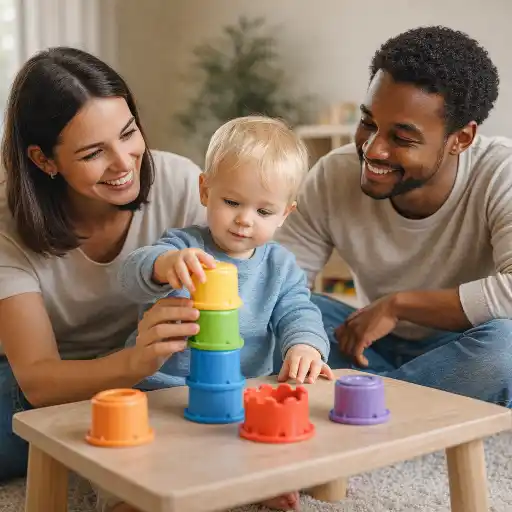
Gratitude develops through relationships and repeated experiences, not through pressure to perform polite words. Infants experience appreciation through responsive care: adults notice their cues, provide comfort, and use warm, predictable interactions. Providers can model simple language such as, “I’m happy you’re here,” or, “Thank you for showing me you’re ready.” The central lesson is that people notice and respond to one another.
Toddlers can begin to notice helpful actions and shared experiences. Narrate what happened: “You handed Eli the cup; he can reach it now,” or, “I appreciated how you waited while I helped your friend.” If a child does not want to say thank you or join an activity, do not force it. Adults can model appreciation while respecting the child’s communication, temperament, and developing autonomy.
Keep gratitude practices inclusive and brief. They do not need to be tied to a holiday or a particular belief system. A daily moment of noticing—who helped, what felt enjoyable, or what the group cared for—can invite connection without requiring every child to share publicly. Children may respond with words, gestures, a drawing, or attentive listening.
- Model specific appreciation for care, effort, kindness, and shared moments.
- Use books, songs, family photographs, and familiar routines to prompt conversation.
- Offer choices: a child may speak, draw, point, participate quietly, or pass.
- Recognize children’s attempts without turning gratitude into a reward or compliance test.
Providers can connect these small moments to family partnership by asking what expressions of appreciation feel natural at home. Avoid assuming that every family uses the same words or customs. A strengths-based, culturally responsive approach makes space for different ways of showing care while helping children experience warm, attentive relationships.
How can programs make partnerships culturally responsive and sustainable?
Each family brings knowledge, relationships, strengths, and ways of caring for young children. Culturally responsive partnership begins with curiosity rather than assumptions. Ask families about language preferences, caregiving practices, important relationships, and hopes for their child. Do not presume that a cultural identity predicts a family’s routines or preferences. Welcome home languages, photographs, songs, and stories when families choose to share them.
Participation should be practical and voluntary. Work schedules, transportation, technology access, disability, and privacy concerns may affect how families connect with a program. Offer flexible meeting times, brief conversations, accessible materials, and multiple ways to contribute. Family engagement is not measured only by event attendance. Everyday communication, shared decisions, and feedback are meaningful forms of participation.
Directors can make the work more sustainable by establishing shared expectations for confidentiality, communication, interpretation, and follow-up. Build staff time for reflection and coordination across shifts so that families receive consistent messages. Consider asking: Whose perspectives are represented? Are we contacting families mainly when something is wrong? Do our participation options work for caregivers with different schedules and access needs?
- Ask families what would make communication and participation easier, then act on what you learn.
- Use qualified language support when needed; do not rely on children to interpret.
- Review whether program materials and practices welcome different family structures and caregiving roles.
- Recognize and thank families for contributions without expecting them to represent an entire culture.
These practices align with the responsive, respectful, relationship-based approach to infant and toddler care, which centers children’s and families’ strengths, cultures, preferences, and needs. State requirements vary - check your state licensing agency, especially for rules that affect documentation, privacy, communication, or program participation.
What common pitfalls can providers avoid?
Good intentions do not automatically create equitable partnerships. One common pitfall is one-way communication: staff send updates but do not invite family knowledge or questions. Add an open prompt and allow time for a response. Another is contacting families mainly about problems. Share positive, specific observations routinely so that a challenging conversation is not the family’s only signal from the program.
Gratitude can also become uncomfortable if adults require children to say “thank you,” make public sharing compulsory, or treat participation as proof of good character. Instead, model appreciation, offer alternatives, and accept a child’s choice to observe or pass. Do not use gratitude to minimize a family’s concern or to imply that families should feel thankful for services. Respectful partnership includes honest discussion and shared problem-solving.
- Pitfall: Assuming every family can use the same communication channel. Try: Ask about preferred, accessible ways to connect.
- Pitfall: Treating event attendance as the only measure of engagement. Try: Offer flexible, low-pressure routes to contribute.
- Pitfall: Comparing children’s milestones or labeling behavior. Try: Share objective observations and discuss context.
- Pitfall: Requiring children to perform gratitude. Try: Model it naturally and honor children’s communication and choice.
When concerns arise, listen first, clarify what each person has observed, and agree on a manageable next step. Keep the child’s dignity and family privacy central. A reflective team can revisit whether its practices are strengthening trust or unintentionally creating pressure.
Conclusion: How can providers combine partnership, gratitude, and development?
Family partnership and gratitude support infant-toddler development when they are rooted in responsive relationships, shared knowledge, and respect for each child’s pace. Families bring essential understanding of their children; providers contribute careful observation and developmental knowledge. Together, they can create continuity across home and care, coordinate realistic support, and help children experience dependable, attentive relationships.
Start with small practices: ask a family what helps a child settle, share one specific positive observation, thank a caregiver for insight, or model appreciation for a child’s kind action without demanding a response. Offer accessible ways to communicate and participate, make room for different languages and family experiences, and use concrete observations when discussing development. These everyday choices make partnership visible and gratitude genuine—supporting belonging, trust, and learning for infants and toddlers.
Five ChildCareEd courses to explore
- CDA Infant/Toddler: Parent Relationships Buy Now $16.00 — strategies related to family relationships, separation, and attachment.
- Early Learning with Infants and Toddlers Buy Now $24.00 — individualized interactions and developmentally informed planning.
- Opportunity for Growth: Emotional Development Buy Now $16.00 — emotional development as a foundation for empathy and social skills.
- Bridging Cultures: Family Communication & Collaboration Buy Now $55.00 — culturally and linguistically responsive communication strategies.
- Let’s Talk: Effective Communication Buy Now $24.00 — two-way communication and family involvement in infant-toddler care.
- Reducing the Risk of Sudden Infant Death Syndrome
- 45 Hour Infant and Toddler Methods and Materials
- Pediatric RSV First Aid & CPR/AED
- CDA Infants/Toddlers: Brain Development and Gene Expression
- CDA Bridge Bundle: Infant/Toddler without Portfolio Review
- CDA Bridge Bundle: Infant/Toddler
- Positive Attention: Interactions & Supervision for Infants & Toddlers
- Risk Reduction: Infants and Toddlers in Family Child Care
- CDA Infants/Toddlers: Stages of Development
- 45-Hour Infant and Toddler Curriculum
- CDA Certification en Español: Recursos y Consejos para Educadores Bilingües
- 🔍 ¿Qué ves cuando observas a un niño aprender?
- 💛🧩 ¿Cómo puedo hacer que mi enseñanza sea inclusiva para los niños con autismo?
- ¡Obtén Tu Certificación de Cuidado Infantil de 90 Horas En Línea!
- Cómo usar tu certificación de 90 horas en Maryland para completar tu CDA
- 45 horas para infantes y niños pequeños: cómo certificarse en línea
- ¿Cuáles son los pasos, requisitos y opciones en línea para la certificación de 90 horas en cuidado de Infantes/Toddlers en Maryland?
- Proporciones de Cuidado Infantil y Tamaños de Grupo por Edad en Nueva Jersey (Guía Rápida para Centros y Hogares)
- Proporciones de Cuidado Infantil y Tamaños de Grupo por Edad en Virginia (Guía Rápida para Centros y Hogares)
- Cómo Trabajar en el Cuidado Infantil en California: Requisitos y Pasos
- Cómo Ser Maestra de Preescolar en Maryland
- Capacitación Previa al Servicio para Proveedores de Cuidado Infantil en Maryland
- Celebrando la amistad en el cuidado infantil durante el Día de los Mejores Amigos
- Mawlid Around the World: How Kids Can Explore Different Traditions and Celebrations
- What Are Age-Appropriate Ways to Teach Gratitude Before Thanksgiving?
- How Can Children Recognize and Appreciate the Supportive Adults in Their Lives?
- How Can Child Care Providers Strengthen Family Partnerships During Thanksgiving?
- How Can Child Care Providers Strengthen Family Partnerships During Thanksgiving?
- How Can Family Partnership and Gratitude Support Infant-Toddler Development?
