Fall conferences are most meaningful when families leave with a vivid, specific picture of their child’s learning—not just a checklist. Strengthen your observation and assessment practice with Preschool Assessments & Observations  Buy Now $24.00, a course that helps providers make objective observations, choose assessment tools, and use evidence to plan for children. Read on for practical ways to turn ordinary play moments into clear, affirming conference conversations.
Why does evidence from play matter in fall conferences?
Families may see a child building, pretending, or exploring outdoors and wonder what learning is happening. Providers can bridge that gap by sharing evidence from real play episodes. A child arranging blocks may be comparing sizes, testing balance, revising a design, and explaining an idea. This is more informative than a general comment such as “She had a great day.”
Evidence-based conversations also help educators avoid relying on memory, assumptions, or comparisons among children. NAEYC explains that observation and assessment should be ongoing, purposeful, and responsive to children’s development, language, culture, and experience. When you share dated examples, work samples, and children’s words, you give families a grounded view of what their child can do and how you plan to support what comes next.
Play documentation communicates that learning is not limited to worksheets or adult-led activities. It makes children’s thinking visible and gives families something concrete to respond to. As described in documentation and assessment for communication with families, portfolios and documentation can help families see authentic examples of children’s capabilities and progress.
What evidence should educators bring to a conference?
Choose a small set of examples that capture the child’s actions, words, and thinking across more than one occasion or setting. A carefully chosen observation is more useful than a thick folder of disconnected notes. Include evidence that reflects the whole child: strengths, interests, emerging skills, relationships, communication, and approaches to challenges.
- Brief, dated, objective observations that describe what you saw and heard.
- Children’s exact words, dictation, drawings, writing, or work samples.
- Photos showing a process—planning, trying, revising—not only a finished product, with family permission and according to program policy.
- Examples from varied experiences, such as block building, pretend play, art, outdoor exploration, routines, and peer interactions.
- A simple note about a possible next step for classroom learning or optional home connection.
For example, instead of “Maya is good at problem-solving,” bring a note such as: “During block play on October 8, Maya placed wide blocks at the base, tested the bridge with a toy car, and said, ‘It needs more support.’” Then explain the learning you infer—planning, testing, and adjusting—while keeping the observation separate from your interpretation. The ChildCareEd guide to anecdotal notes and examples offers a helpful model for recording factual snapshots.
How can you explain learning through play in plain language?
Start with what the child did, then connect the action to learning in accessible language. Families should not need to decode professional terminology to understand their child’s progress. Describe the evidence and name the developing abilities—such as counting, vocabulary, coordination, persistence, negotiation, or flexible thinking.
A simple three-part explanation can keep the conversation natural:
- Describe: “At the pretend grocery store, Leo sorted the food, made a list, and asked a friend to help.”
- Connect: “He was practicing categorizing, early writing, conversation, and cooperation.”
- Invite: “What kinds of sorting or pretend games does he enjoy at home?”
For a block-building episode, you might explain that a child compared sizes, tried different supports, and kept working after the structure fell. Rather than saying “This activity supports executive function,” translate the idea: “She remembered her plan, noticed what was not working, and changed her approach.” Guidance on making learning behind play visible emphasizes concrete examples and family-friendly explanations.
Be ready to acknowledge that families may have different expectations about what learning looks like. Listen first, affirm their hopes, and then share evidence that connects play to those goals. This respectful approach makes the conversation collaborative rather than defensive.
How do you prepare and lead a strengths-based conference?
Preparation helps you make good use of limited meeting time and helps families feel welcomed into the conversation. Before the conference, review observations and invite families to share questions or priorities. Arrange a private, comfortable setting; provide language support or interpretation when needed; and have a concise set of examples ready.
- Begin with a genuine strength, interest, or recent accomplishment.
- Share two or three specific examples, including the context and date where useful.
- Explain what the play revealed about the child’s skills, strategies, or interests.
- Ask open-ended questions: “What are you noticing at home?” or “What would you like us to learn more about?”
- Agree on one or two achievable next steps and decide how you will reconnect.
Family expertise matters: skills can appear differently across settings, languages, and relationships. Ask about the child’s routines, home languages, interests, and experiences rather than assuming you have the full picture. A two-way exchange reflects the NAEYC Five Rs for positive family engagement, including respect, responsiveness, relationship, reciprocity, and reflection.
Keep developmental concerns factual and separate from diagnosis. If you need to discuss a concern, follow program procedures, share specific observations, invite the family’s view, and identify appropriate next steps. State requirements vary—check your state licensing agency.
What common pitfalls can providers avoid?
Even thoughtful educators can unintentionally make conferences feel like a rating session or a one-way report. A few deliberate choices help keep the focus on the child’s capabilities and the partnership with the family.
- Vague praise: Replace “doing great” with a specific action, quote, or example.
- Jargon-heavy explanations: Use plain language and explain technical terms only when they are necessary.
- Conclusions without evidence: Keep observations factual, then clearly identify interpretation as a professional reflection—not a diagnosis.
- Only discussing challenges: Include interests, accomplishments, and emerging skills alongside areas where support may help.
- Overloading families with paperwork: Select a few meaningful samples rather than presenting every record collected.
- One-way communication: Pause, listen, and invite the family’s knowledge and questions.
- Sharing without protecting privacy: Use a private setting, secure records, and follow photo permissions and program policy.
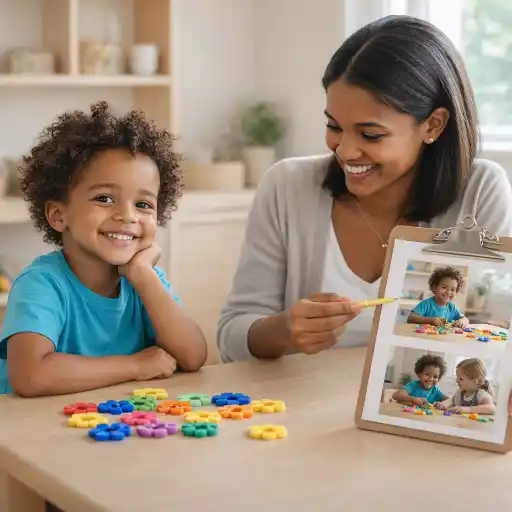
Directors can make evidence-sharing more consistent by offering a brief conference template, shared prompts for objective observations, and time for staff to reflect together. A resource such as the ChildCareEd guide to documenting child progress can help teams connect what they observe with thoughtful planning and family communication.
How can conferences lead to meaningful next steps?
A conference should end with a manageable plan, not a long list of assignments for families or educators. Choose one or two goals that build on the child’s current interests and abilities. Clarify what the program will try, what the family might choose to do, and when you will check in. Home ideas should be simple, optional, and realistic—such as inviting a child to help sort socks or build a bridge with household items.
Write down the shared plan in plain language. For instance: “We will add ramps and varied blocks to the construction area and observe how Jordan tests movement. At home, the family may notice what objects roll or slide.” This keeps the goal connected to authentic play and makes follow-up practical.
Documentation is most useful when it informs teaching as well as conversation. Review evidence after the conference and ask: What materials or questions might extend this child’s exploration? What context might help the child demonstrate a skill in another way? NAEYC’s guidance on observing, documenting, and assessing children’s development stresses that assessment should guide curriculum and interactions while recognizing individual variation.
For deeper professional learning, consider these relevant English-language ChildCareEd courses:
- Tracking Progress, Shaping Futures: Observation & Assessment Skills Buy Now $55.00 — practice objective observation and turning assessment information into goals.
- The Best Promotion is Play Buy Now $24.00 — explore how play supports children’s development and classroom practice.
- Culture, Communication, and Collaboration in Assessment Buy Now $55.00 — strengthen responsive assessment and family-centered conversations.
- Family (or Parent) Conferencing: Developing Trust ONLINE Buy Now $24.00 — build skills for planning and facilitating conferences.
Conclusion: How can fall conferences show what children can do through play?
Fall conferences can make children’s learning through play clear when providers bring a few specific observations, explain what the evidence may show, and invite families to share their own perspective. Lead with strengths, use plain language, protect privacy, and avoid treating a single moment or checklist as the whole story. Then agree on a small next step and follow up.
The central goal is not to persuade families that play matters through abstract claims; it is to show them their child’s thinking in an authentic moment. With purposeful documentation and reciprocal conversation, families can recognize what children can do, and educators can plan what will help them grow next.
- Many Colors, One Canvas: MD ECE Conference
- Pillars of Health and Safety in Child Care
- CDA Bridge Bundle: Preschool
- CDA Bridge Bundle: Family Child Care
- Family (or Parent) Conferencing: Developing Trust ONLINE
- CDA Bridge Bundle: Infant/Toddler
- Texas Director Credential
- Bienvenido! Welcoming All Families
- Families, Communities, and Classrooms: Working Together for Children
- IEPs and IFSPs in Family Child Care
- CDA Certification en Español: Recursos y Consejos para Educadores Bilingües
- 💛🧩 ¿Cómo puedo hacer que mi enseñanza sea inclusiva para los niños con autismo?
- Recursos en Español sobre el Sueño Seguro del Bebé
- ¿Cómo puedo usar escenarios de juego de roles de primeros auxilios en mi aula?
- 10 Ejemplos de Cómo la Cultura Influye en el Desarrollo Infantil
- Capacitación en Salud y Seguridad Preventiva en Línea para Proveedores de Cuidado Infantil
- Proporciones de Cuidado Infantil y Tamaños de Grupo por Edad en Maryland (Guía Rápida para Centros y Hogares)
- Proporciones de Cuidado Infantil y Tamaños de Grupo por Edad en Nueva Jersey (Guía Rápida para Centros y Hogares)
- Proporciones de Cuidado Infantil y Tamaños de Grupo por Edad en Virginia (Guía Rápida para Centros y Hogares)
- Actividades de Otoño Fáciles para Preescolares esta Temporada
- Lista para Guardería en Casa en Illinois: Cómo Iniciar una Guardería en el Hogar
- Celebrando la amistad en el cuidado infantil durante el Día de los Mejores Amigos
- Canciones, juegos y preguntas de círculo para niños
- Cómo simplificar la capacitación para sus empleados de daycare
- How can I build a simple assessment system for my North Dakota program?
- How Can Providers Show Families the Learning Behind Play?
- Why Might a Child Show Different Skills at Home and at Preschool?
- How Can Child Care Providers Involve Families in Observing Children’s Growth During Fall?
- How Can Preschool Providers Observe Early Number Recognition During Math Play?
- How Can Fall Conferences Use Evidence to Show What Children Can Do Through Play?
