Looking for a short, respectful way to bring Kwanzaa into your early childhood program that supports learning, identity, and community? This article offers practical strategies, sample activities, and family‑engagement steps you can use this season. For ready-to-use professional learning that supports culturally responsive celebrations, consider ChildCareEd's Cultures in the Classroom  Buy Now $24.00 and Strength in Differences: Cultural Diversity Buy Now $24.00 — courses that help staff plan inclusive lessons and meet continuing education goals.
Why does celebrating Kwanzaa in early childhood matter?
Kwanzaa introduces children to values—Umoja, Kujichagulia, Ujima, Ujamaa, Nia, Kuumba, and Imani—that map directly to social-emotional growth and civic learning. Teaching these principles helps children practice cooperation, language for feelings, and pride in cultural identity. When done thoughtfully, Kwanzaa activities build connections between home and program, strengthen relationships among peers, and reinforce developmentally appropriate routines.
Why it matters in practice:
- It situates cultural knowledge in everyday classroom life (songs, stories, shared meals, and cooperative projects).
- It supports family partnership and respectful representation rather than tokenism.
- It links to concrete learning goals for math, literacy, fine motor skills, and #socialemotional development.
Include these five focus words as classroom prompts: #Kwanzaa #unity #culture #classroom #children. Remember: state requirements vary - check your state licensing agency.
What are the core elements of Kwanzaa I should share with young children?
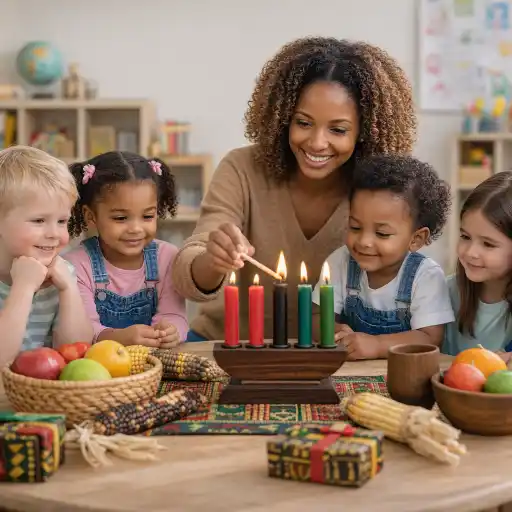
Keep the explanation brief, concrete, and activity-based. For preschoolers use visuals (a kinara image, a mkeka mat, and a simple word poster) and one short phrase per principle: e.g., "Umoja means we help each other." Children understand best through doing: lighting a pretend candle, saying the day’s principle, and practicing one classroom promise.
Practical pieces to include in your classroom display or lesson rotation:
- Symbols: kinara (candleholder), mishumaa saba (7 candles), mkeka (mat), kikombe cha umoja (unity cup), and mazao (fruits/harvest).
- Colors: black, red, and green — use them in art, patterns, and sorting games.
- Daily ritual: a 3–5 minute circle time for candle count, a simple story, and one 'helping' action to practice.
For classroom-ready printables and symbol activities see Kwanzaa Classroom Activities Buy Now $0.00 as part of your lesson planning toolkit.
How can I design developmentally appropriate Kwanzaa activities that teach skills?
Design each day around one principle and one measurable learning target. Keep activities short (10–20 minutes for preschool centers) and offer choices so children with different attention spans can participate meaningfully.
Activity examples that link to skills:
- Fine motor & art: make a mkeka collage with torn red/black/green paper (scissor practice, pattern recognition).
- Literacy: use a Kwanzaa words minibook and new-word picture cards to build vocabulary and emergent reading (Kwanzaa Words Minibook Buy Now $0.00).
- Math: candle counting, pattern strips (red/black/green), or a Kwanzaa roll-and-graph for data talk (Kwanzaa Roll & Graph Buy Now $0.00).
Classroom routine tip: demo (1 min) → child practice (8–12 min) → share (2 min). Offer sensory options and alternative seating so every child can join. Consider pairing this planning with training like From Play to Planning Buy Now $55.00 to tighten the connection between play and learning outcomes.
How do I keep Kwanzaa celebrations inclusive, respectful, and family-centered?
Inclusion means accuracy, opt-in participation, and family collaboration. Start by notifying families: explain the learning goals, invite input or artifacts, and offer opt-in formats (crafts, songs, display items) so families never feel pressure to participate in religious or cultural rituals they do not observe.
Practical steps:
- Send a clear family note describing what you will teach and asking for contributions (photos, songs, stories).
- Use non-flammable materials (felt kinara, battery tea lights) and follow your allergy and safety policies — state requirements vary - check your state licensing agency.
- Center voices from the community: invite a family member or local cultural presenter when possible, or use vetted resources and books from reliable sites (Scholastic, Official Kwanzaa Website).
- Focus on universal themes—community, generosity, creativity—so children from all backgrounds feel included.
For staff communication strategies and family partnership approaches, the course Bridging Cultures: Family Communication & Collaboration Buy Now $55.00 offers practical templates and family-engagement tools.
What are common mistakes and how can I avoid them? (Plus an FAQ teachers ask)
Common pitfalls are easy to avoid with brief planning and reflection.
- ❌ Overloading activities: don’t run long lectures—keep centers to 10–20 minutes.
- ❌ Relying on stereotypes or one-dimensional props: choose culturally accurate materials and avoid tokenizing imagery.
- 😀 Emphasize participation, not performance: invite children to contribute in ways they enjoy rather than forcing presentations.
- ❌ Skipping family input: always give families opt-in choices and request permission before sharing photos or family stories.
How to avoid pitfalls: plan one principle per day, set clear materials tubs, and assign one staff member to coordinate family communications and safety checks. Consider supplemental staff training such as Building Bridges for Dual Language Learners Buy Now $25.00 to support multilingual families and inclusive communication.
Frequently asked questions
- Q: Can we light real candles? A: No—use battery tea-lights in classrooms to eliminate fire risk and comply with most licensing rules.
- Q: What if some families don’t want their child to participate? A: Offer opt-in stations and calm-table alternatives; never single out a child in front of the group.
- Q: How can Kwanzaa fit during winter when schedules are short? A: Use short daily rituals (3–5 minutes) and center activities that repeat a skill across the week.
- Q: Where do I find culturally accurate books and song lyrics? A: Scholastic lists and the Official Kwanzaa Website are reliable starting points; cross-check local community recommendations.
- Q: Will celebrating Kwanzaa require special licensing approvals? A: Usually no, but state rules vary—state requirements vary - check your state licensing agency.
Conclusion
When planned with cultural accuracy, short rituals, family partnership, and curricular alignment, Kwanzaa week can strengthen classroom community and build meaningful skills. Keep activities hands-on, choose one principle each day, invite family voice, and use safe materials. If your team wants deeper training to support inclusive celebrations and stronger family partnerships, explore ChildCareEd offerings like Cultures in the Classroom Buy Now $24.00, Strength in Differences Buy Now $24.00, and Bridging Cultures Buy Now $55.00. Thoughtful celebration teaches children about #community, nurtures #identity, and builds classroom belonging—go forward with curiosity and respect.
- 45 Hour Child Growth and Development
- CDA Home Visitor Subject Area 3 Part 3 Birth to 5
- Professional Presence in Early Childhood
- Family Connections: Creating Inclusive Relationships
- Bienvenido! Welcoming All Families
- 24 Hour Texas Pre-Service
- CDA Bridge Bundle: Family Child Care without Portfolio Review
- CDA Bridge Bundle: Infant/Toddler without Portfolio Review
- CDA Bridge Bundle: Preschool without Portfolio Review
- Celebrating Diverse Cultures: Upcoming Holidays from Around the World
- CDA Certification en Español: Recursos y Consejos para Educadores Bilingües
- 👶 ¿Cuáles son las proporciones y grupos requeridos en Dakota del Norte? 🏫
- Cómo Abrir Una Quardería En Casa Sin Dinero?
- Celebrate Together: Fun Activities for Kwanzaa Week
- Recursos en Español sobre el Sueño Seguro del Bebé
- Proporciones de Cuidado Infantil y Tamaños de Grupo por Edad en Virginia (Guía Rápida para Centros y Hogares)
- Retraso del Habla en la Guardería: Cómo Pueden Ayudar los Proveedores
- Cómo Trabajar en el Cuidado Infantil en Carolina del Norte: Requisitos y Pasos
- Cómo Ser Maestra de Preescolar en Illinois
- Cómo Ser Maestra de Preescolar en Maryland
- Celebrando la amistad en el cuidado infantil durante el Día de los Mejores Amigos
- Canciones, juegos y preguntas de círculo para niños
- How Can I Use Fun Math Activities for Preschoolers Every Day?
- Cómo simplificar la capacitación para sus empleados de daycare
- How can I use simple math activities for preschoolers every day?
- How Can You Celebrate Black Culture and Music Effectively in Your Program?
- How Can I Celebrate Lunar New Year Respectfully and Effectively in My Classroom?
- How can early childhood programs celebrate Kwanzaa respectfully and effectively?
- How Can We Celebrate Every Family and Create a Classroom Where Everyone Is Represented?
