A camera can preserve a tender moment, but raising it at the wrong time may interrupt the very interaction you want to understand. Learn how to recognize an infant’s cues, document thoughtfully, and keep responsive care at the center; Observing & Assessing in Child Care  Buy Now $16.00 offers practical learning about observation, documentation, and using assessment to plan individualized experiences. Read on for ways to capture meaningful evidence without making the photo more important than the relationship.
Why can a photo interrupt an infant’s interaction?
Infants communicate through gaze, movement, facial expression, vocalization, and changes in attention. A caregiver’s phone or camera can shift the infant’s focus, alter the adult’s posture, or pause a back-and-forth exchange. Even a quick photograph may interrupt a moment when a child is studying a caregiver’s face, reaching toward a toy, or responding to a familiar voice.
This does not mean photographs are inherently harmful or that documentation should be abandoned. Rather, it asks educators to consider what the child is experiencing in that moment. Responsive relationships develop through adults noticing and answering children’s cues; the ECE Resource Hub describes this as serve-and-return interaction. If the adult turns away to frame an image, the return may be delayed or missed.
Observation supports individualized, responsive care, as explained in Head Start’s guidance on child observation. The aim is to understand the infant—not simply to produce a record.
- A camera may redirect attention from the child’s cue to the adult’s task.
- Repeated posing or prompting can change spontaneous behavior.
- A photo freezes one instant; it may not show the context or sequence that gives the moment meaning.
How can providers decide whether to take the photo now?
Before reaching for a device, pause and ask: Is the infant engaged with me or another person? Is this exchange unfolding in a way that benefits from my undivided attention? Can I document it later from memory, with a brief note, or through another planned observation?
Pay attention to the infant’s cues. Sustained gaze, leaning in, reaching, smiling, vocalizing, or taking turns in sounds may indicate an active interaction. Looking away, becoming still, turning the body, or showing distress may signal a need for less stimulation. These behaviors are contextual, not fixed rules; learn each infant’s communication style and consider their temperament, culture, and experience.
When a meaningful interaction is underway, staying present is often the best professional choice. You can make a short note afterward: record the setting, who was present, what the infant did or communicated, and how the adult responded. The Head Start guidance on responding based on observation connects observing and reflecting with responsive action.
- Keep supervision and immediate care needs first.
- Notice the infant’s engagement and nonverbal cues before documenting.
- Choose the least disruptive method that can answer your observation question.
- 📷 If a photo is appropriate, take it briefly and return your attention to the infant.
What alternatives preserve the interaction and the evidence?
Photographs are only one documentation method. A quick written jotting, anecdotal record, or reflection completed after the interaction can preserve useful evidence without changing the moment. Head Start’s overview of documenting observations explains that the method should fit what educators want to learn, what is happening, and the time and energy available.
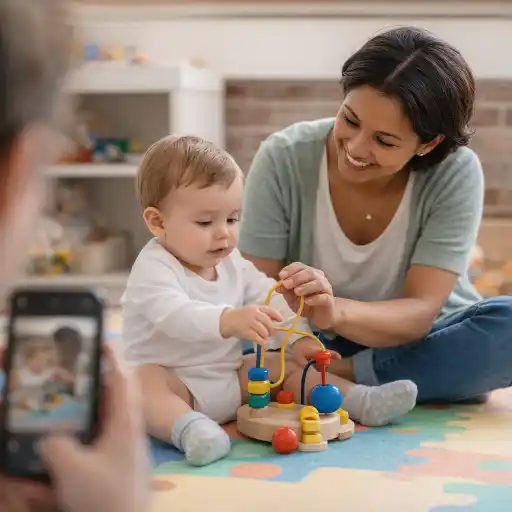
For example, after a caregiver and infant share a vocal exchange, write a factual note: “During floor play, Noor looked toward the educator, vocalized twice, and smiled when the educator repeated the sound.” Later reflection can consider whether Noor initiated a turn, how the adult responded, and what might be observed in another routine. Keep observation separate from interpretation so a single moment does not become a broad claim about the child.
Short notes can be developed into fuller documentation when staffing and supervision allow. Teams can also plan observation coverage, take turns recording, or use approved tools in a way that does not pull an adult away from care. The goal is balanced, useful documentation—not the largest collection of images.
- Use brief jottings to preserve exact actions, sounds, or gestures.
- Record context: routine, materials, people present, and what happened next.
- Review observations over time and across settings before drawing conclusions.
- Include family perspectives when they can clarify the infant’s communication or preferences.
How can programs use photographs ethically and safely?
Photographs of infants require deliberate attention to consent, privacy, dignity, and purpose. Follow program policy and applicable rules for obtaining family permission, using images, storing files, and sharing them. Consent for one purpose—such as a private family update—should not be assumed to cover other uses, such as public posts or staff training. Limit access to authorized people and use program-approved devices and systems.
Ethical observation also respects the child’s perspective. The ethical guidelines for observing children emphasize privacy, respectful distance, non-intrusive documentation, and careful handling of images and records. Infants cannot provide adult-style consent, so providers should remain especially attentive to their cues and avoid staging or repeatedly prompting them for a desired image.
Directors can support staff by making expectations clear and realistic. Establish who may take photos, which devices are permitted, how images are labeled and secured, how long records are kept, and how families can ask questions about use. State requirements vary - check your state licensing agency.
- Use an image only for the stated, authorized purpose.
- Protect identifying details and avoid sharing through personal accounts or devices.
- Do not interrupt care, feeding, soothing, or a meaningful interaction to obtain a photo.
- Ask whether a written observation would serve the purpose better.
How can documentation lead to more responsive care?
Documentation becomes valuable when it helps educators understand an infant and make thoughtful decisions. After recording a moment, reflect: What did the infant communicate? What seemed to sustain engagement? How did the adult’s timing or response shape the exchange? What could we observe again in a familiar routine? These questions keep attention on the infant’s interests, strengths, and relationships.
Repeated observations can reveal patterns that a single photo cannot. Perhaps an infant often initiates vocal turns during diapering, studies the caregiver’s face during feeding, or reaches for a familiar object after a song. Those patterns can guide small, responsive choices: allow more wait time, repeat a familiar song, adjust the environment, or share observations with the family and learn what they notice at home.
Keep conclusions cautious and evidence-based. A photo or note is a snapshot, not a diagnosis or complete account of development. Combine observations across times and contexts, consider family knowledge, and follow program procedures if a concern arises. The ChildCareEd course Tracking Progress, Shaping Futures: Observation & Assessment Skills Buy Now $55.00 offers broader learning on objective documentation, multiple assessment methods, and using evidence for planning. For ethical documentation and confidentiality, see Privacy Matters: Documentation and Observation in Early Learning Buy Now $55.00.
What common photography pitfalls can providers avoid?
Providers are often balancing family communication, classroom documentation, and hands-on care. It is understandable to want to capture a meaningful milestone or share a sweet interaction. A few practical safeguards can keep this goal from crowding out the infant’s experience.
- ❌ Photographing automatically: pause and identify the documentation purpose first.
- ❌ Asking an infant to repeat or pose during an interaction: preserve spontaneous engagement instead.
- ❌ Treating an image as the whole story: add factual context, or choose a written record.
- ❌ Looking at the screen while the infant is seeking a response: put the device away and reconnect.
- ❌ Sharing without checking permission or policy: verify the approved purpose and audience.
- ❌ Letting documentation compete with active supervision: use brief notes or planned coverage.
Teams can use a reflection prompt after a photo or observation: “Did documenting this moment support our understanding, or did it change the interaction?” Discussing this without blame helps staff improve systems and strengthens professional judgment.
Conclusion: How can providers document without interrupting an infant’s interaction?
When taking a photo risks interrupting an infant’s interaction, stay present and choose another way to document. Notice the infant’s cues, prioritize responsive engagement and supervision, and use a brief factual note or a carefully planned photograph when appropriate. Follow consent, privacy, and program procedures, and treat every image as one piece of evidence rather than the complete story.
The central question is not simply whether a moment is worth capturing, but whether capturing it serves the infant’s care and learning. Thoughtful observation, reflection, and follow-up help providers turn everyday exchanges into responsive practice while protecting the relationship at their heart. Strengthen these skills through Observing & Assessing in Child Care Buy Now $16.00 and explore the observation and assessment course Buy Now $55.00 for a more in-depth learning experience.
Related resource: The Observation, Documentation, and Reflection guide Buy Now $0.00 offers additional support for recording infant and toddler learning and using observations to inform care.
- Birth to Five CDA Credential with Portfolio Review
- CDA Bridge Bundle: Preschool
- CDA Infant/Toddler Credential with Portfolio Review
- CDA Bridge Bundle: Family Child Care
- CDA Bridge Bundle: Family Child Care without Portfolio Review
- CDA Bridge Bundle: Infant/Toddler without Portfolio Review
- CDA Bridge Bundle: Preschool without Portfolio Review
- CDA Bridge Bundle: Infant/Toddler
- Texas Director Credential Renewal
- Texas Director Credential
- CDA Certification en Español: Recursos y Consejos para Educadores Bilingües
- Cómo Abrir Una Quardería En Casa Sin Dinero?
- Recursos en Español sobre el Sueño Seguro del Bebé
- Capacitación en Salud y Seguridad Preventiva en Línea para Proveedores de Cuidado Infantil
- Regulaciones de Licenciamiento de Cuidado Infantil en California para Centros y Hogares de Cuidado Infantil Familiar
- Proporciones de Cuidado Infantil y Tamaños de Grupo por Edad en Maryland (Guía Rápida para Centros y Hogares)
- Proporciones de Cuidado Infantil y Tamaños de Grupo por Edad en Virginia (Guía Rápida para Centros y Hogares)
- Lista para Abrir una Guardería en Casa en Virginia: Cómo Empezar
- Lista para Guardería en Casa en Illinois: Cómo Iniciar una Guardería en el Hogar
- Lista para Guardería en Casa en Texas: Cómo Iniciar una Guardería en el Hogar
- Cómo Trabajar en el Cuidado Infantil en Carolina del Norte: Requisitos y Pasos
- Cómo Trabajar en el Cuidado Infantil en California: Requisitos y Pasos
- Capacitación Previa al Servicio para Proveedores de Cuidado Infantil en Dakota del Norte
- Celebrando la amistad en el cuidado infantil durante el Día de los Mejores Amigos
- Cómo simplificar la capacitación para sus empleados de daycare
- Teacher-Directed or Child-Directed? Finding the Right Classroom Balance
- How Can Child Care Providers Help Children Join Play Without Taking Over?
- What Is Child-Led Play, and Why Does It Matter?
- Why Does a Child Become the Rule Keeper When an Adult Joins Play?
- When Does Taking a Photo Interrupt an Infant’s Interaction—and What Can Providers Do Instead?
