A pretend creek, a few autumn materials, and a toy that needs to cross can turn ordinary play into a memorable engineering investigation. Pair the activity with Building Early Science Foundations  Buy Now $16.00 to strengthen your understanding of play-based inquiry, and explore Basic Science in Early Childhood Buy Now $25.00 for practical strategies to support children’s scientific reasoning. Then invite children to build, test, notice what happens, and try again—the most important discovery may be what their first bridge teaches them.
The leaf bridge challenge for Pre-K offers a useful seasonal starting point: children investigate with familiar natural materials while practicing observation and redesign.
Why does a pretend-creek bridge make retesting meaningful?
A pretend creek gives children a clear, understandable purpose: a toy animal, car, or figure needs a way across. This small story turns construction into a real design problem. Children must make a structure that spans a gap, then discover whether it stays in place when tested. Their bridge may sag, slide, or fall apart. Those outcomes are not wasted effort; they are information children can use to improve a new version.
Retesting helps preschoolers connect an action with an observable result. If a child adds a support beneath the middle and the bridge bends less, the child has a concrete reason to consider how the change mattered. This is early engineering thinking, not a demand for formal technical explanations. The important habits are to notice, make a plan, try it, observe, and revise.
The activity naturally integrates several areas of development:
- Science: observing material properties, movement, balance, and stability.
- Engineering: designing, testing, and changing a structure to address a problem.
- Math: comparing lengths, counting supports, and measuring the pretend creek.
- Language and social learning: describing plans, listening to peers, and explaining results.
Children also practice #persistence when they return to a design after a disappointing test. A bridge that needs work is an invitation to think again—not a judgment on the builder.
How can you set up a safe, inviting fall construction challenge?
Keep the materials purposeful and manageable. A small selection makes it easier for children to focus on the design question, while still leaving room for different solutions. You might set out dry leaves, short sturdy twigs, craft sticks, cardboard strips, blocks or boxes for supports, and a lightweight toy to cross. Add paper and crayons if children want to sketch or record what they notice.
Place two stable supports a short distance apart to create the creek. Introduce the challenge with a simple invitation: “The animals need to cross without touching the ground. What could we build?” Let children examine the materials and offer ideas before showing a model. If children need inspiration, use a story, a photograph of a real bridge, or a quick walk to observe bridges nearby—without presenting one design as the answer.
Use safe, age-appropriate materials and supervise collection and construction. Inspect natural items for sharp edges, mold, contamination, or other hazards; avoid unknown plants and small parts that may pose a choking risk. Keep the structure low and use lightweight test objects. State requirements vary - check your state licensing agency for guidance on supervision and classroom materials.
- Offer a few materials first; add more when children have explored the initial choices.
- Choose a consistent gap and toy so later trials can be compared.
- Use accessible surfaces, larger pieces, or adaptive tools where helpful.
- Invite children to participate as builders, testers, observers, photographers, or storytellers.
The goal is a welcoming invitation to build—not a perfect craft or a single correct bridge.
What does the design-and-retest cycle look like with preschoolers?
Preschool engineering is most useful when the process is brief, visible, and flexible. A simple cycle can guide the experience: identify the problem, imagine a design, build and test, then improve. Children do not need a formal blueprint. They can point to materials, arrange pieces on the table, draw a few marks, or tell a partner what they hope to build.
- Notice the problem: Name the gap and who needs to cross it.
- Plan: Ask children what materials might help and invite predictions.
- Build and test: Give children time to construct, then try the same toy or load.
- Reflect and revise: Ask what happened and what they might change for another attempt.
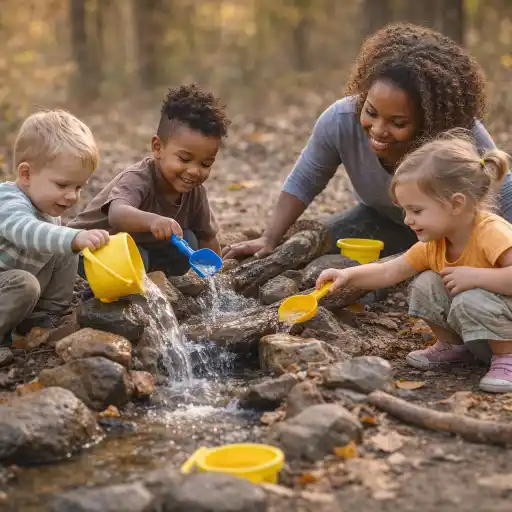
As children work, use prompts that make their thinking visible without taking over: “What do you notice?” “Where did the bridge move?” “What might help it stay steady?” Then pause. A little wait time gives children space to think, communicate in their own way, and decide what to try next.
Model useful words in context: span, support, balance, sturdy, bend, connect, wider, and redesign. Children can take part through speech, gestures, drawings, home languages, or construction itself. The focus is not on saying the vocabulary perfectly; it is on having meaningful ways to express an idea.
If a structure collapses, avoid rebuilding it for the children. You might say, “The middle dipped when the toy crossed. What did you notice?” Then support their next choice with a question or by making relevant materials available. Treating a setback as useful evidence supports #curiosity and keeps ownership with young designers.
How can you make bridge tests fair and extend the learning?
A predictable test helps children compare what happens across trials. Keep the distance between supports the same, use the same toy, and add it in a similar way each time. Ask children to watch closely: Does the bridge bend in the middle? Does one end slip? Can the toy cross without the structure touching the pretend creek?
After the first trial, invite a change and retest. For example, children might add a twig under the middle, use a wider leaf, overlap two materials, or secure the ends. Change one feature at a time when possible. This makes it easier for children to notice whether that particular adjustment seemed to affect the result. The purpose is not a scientific laboratory protocol; it is a clear, age-appropriate comparison.
Offer extensions when interest continues:
- Compare bridges made with leaves, craft sticks, or cardboard.
- Change the creek’s width and predict what might happen.
- Count how many large blocks a bridge can hold, adding one at a time under adult supervision.
- Compare a narrow design with a wider design.
- Invite two partners to combine their ideas and describe what changed.
Document simply: take a photo, record a child’s comment, or mark a picture chart showing “first try” and “next try.” This makes children’s #observations visible and helps staff plan a follow-up. The bridge-bending investigation also offers useful prompts for noticing where a structure first moves and using that clue to guide another test.
How can providers make the experience inclusive and avoid common pitfalls?
One construction challenge can welcome children with different strengths when participation is flexible. A child may select materials, steady a support, place the toy, watch for movement, draw a plan, or narrate the test. Offer visual cards for “plan, build, test, improve,” a shorter gap, larger pieces, a nonslip surface, or a seated work area as appropriate. Children who prefer not to touch leaves or rough twigs can use tongs, gloves, or alternative materials.
Use collaboration as part of the design process. Invite partners to share ideas, take turns testing, and compare what they noticed. Accept responses through words, gestures, drawing, or home-language discussion. These options help children contribute without requiring everyone to build or communicate in the same way.
Common pitfalls are understandable, especially when the classroom is busy. Watch for these avoidable patterns:
- Turning the challenge into a craft with one expected result. Instead, welcome multiple designs.
- Offering too many materials at once. Begin with a focused selection and add options later.
- Calling a collapse a failure. Describe what happened and ask what children learned from it.
- Changing several parts between tests. Invite one manageable change so comparisons are clearer.
- Stepping in too quickly. Observe, ask one open question, and give children time to respond.
For a broader professional learning foundation, Building Early Science Foundations Buy Now $16.00 explores ways to encourage developmentally appropriate inquiry, while Basic Science in Early Childhood Buy Now $25.00 focuses on meaningful science experiences and children’s reasoning. Check with your program or licensing agency about whether a course meets a particular training requirement.
Conclusion: What can children learn by building across a pretend creek?
A pretend creek makes the bridge challenge concrete, playful, and easy to revisit. Children learn by choosing materials, building a first design, testing it under consistent conditions, and using what they observe to make a change. The process supports early engineering, science, math, language, collaboration, and confidence.
Keep the invitation safe, inclusive, and open-ended. Offer a manageable set of materials, use questions instead of supplying solutions, and treat a bend or collapse as information for the next attempt. A quick photo or child quote can help you remember what children noticed and plan a meaningful follow-up.
So, how can fall construction play encourage retesting? Give children a reason to build, enough time to try again, and an adult who trusts their ideas. Each new bridge is a chance to learn that thoughtful redesign is part of being a capable #engineer.
- CDA Subject Area 2
- Balancing Physically Active Play in Child Care
- The ABCs of Behavior: Turning Challenges into Learning Opportunities
- Birth to Five CDA Credential with Portfolio Review
- Math Foundations in Early Childhood
- Building Equity: Inclusionary Practices in Preschool
- Building Early Science Foundations
- Balancing Active Play in Child Care
- Montessori Cultural Activities: Exploring the World Through Play and Learning
- Every Moment Matters: Schedules and Transitions
- CDA Certification en Español: Recursos y Consejos para Educadores Bilingües
- 🪁¿Cómo puede el juego apoyar de manera poderosa a los niños con autismo?🧩
- 💛🧩 ¿Cómo puedo hacer que mi enseñanza sea inclusiva para los niños con autismo?
- Curso de Comunicación de 9 Horas de Maryland
- ¿Cómo puedo usar escenarios de juego de roles de primeros auxilios en mi aula?
- Actividades de Motricidad Gruesa que Desarrollan el Equilibrio, la Coordinación y la Fuerza
- 10 Ejemplos de Cómo la Cultura Influye en el Desarrollo Infantil
- Proporciones de Cuidado Infantil y Tamaños de Grupo por Edad en Virginia (Guía Rápida para Centros y Hogares)
- Actividades de Otoño Fáciles para Preescolares esta Temporada
- Cómo Trabajar en el Cuidado Infantil en Carolina del Norte: Requisitos y Pasos
- Calabazas, hojas y manzanas: actividades de otoño para preescolares
- Celebrando la amistad en el cuidado infantil durante el Día de los Mejores Amigos
- Diversión fresca de verano: actividades del Día Nacional del Helado para niños
- Canciones, juegos y preguntas de círculo para niños
- La mejor manera de hacer seguimiento a la capacitación de su equipo de daycare How to Organize Staff Training for Your Child Care Center Cómo organizar la capacitación del personal para su centro de cuidado infantil
- Cómo simplificar la capacitación para sus empleados de daycare
- Cómo Planificar Actividades al Aire Libre Seguras Durante el Calor y la Mala Calidad del Aire
- How Can a Pumpkin Delivery Game Turn Fall Movement Into Real Problem-Solving?
- What Should You Record During Child-Led Fall Play?
- How Can a Pretend Creek Turn Fall Construction Play into a Lesson in Retesting?
