When a child writes a repair ticket for a torn cape or makes a sign for the shop, writing becomes part of a meaningful story—not a separate assignment. Build a lively costume repair center while strengthening children’s language, early writing, and planning; Lesson Planning for Preschoolers  Buy Now $24.00 offers practical guidance for connecting purposeful goals with developmentally appropriate experiences. For additional ideas on making writing authentic in play, explore Classroom Tools for Emergent Literacy Buy Now $25.00.
Why does a costume repair shop make writing purposeful?
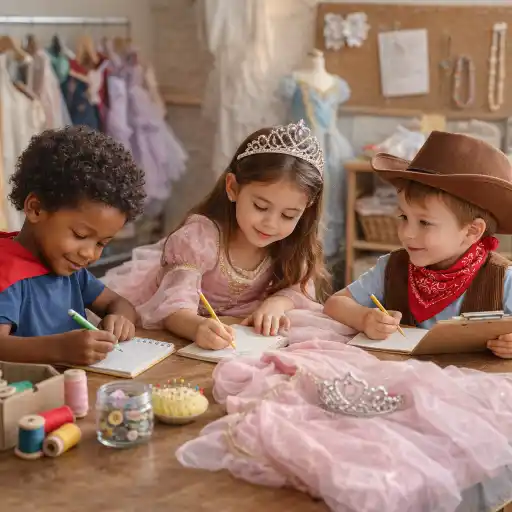
A dramatic-play costume repair shop gives children a reason to communicate through marks, drawings, letters, and words. A customer may explain that a superhero cape needs a patch; a shop worker can record the request, ask a clarifying question, and later tell the customer the repair is ready. These exchanges show that writing serves a real purpose: it helps people remember, organize, and share information.
Writing is also woven into the play’s social storyline. Children decide who is the tailor, customer, designer, or receptionist; negotiate what needs fixing; and make up details about each costume. They practice oral language and storytelling while exploring print. NAEYC describes how intentionally combining print materials and dramatic play can support vocabulary, communication, narrative, and early literacy.
In this setting, children may write with conventional letters, invented spelling, scribbles, or drawings. The goal is not neat handwriting or a finished form. It is helping children experience themselves as capable communicators and noticing the many ways they represent ideas. That is especially valuable for children who are still gaining confidence with writing or who communicate through more than one language or mode.
How can providers set up the repair shop?
Start with a manageable space and materials already available. A small table can serve as the intake counter, while a basket or rack holds clean, child-safe costumes and fabric pieces. Include a “waiting for repair” container and a “ready for pickup” area so children can extend the storyline.
Useful props include:
- Dress-up clothes, capes, scarves, fabric scraps, and accessories that are safe and appropriate for the group.
- Clipboards, paper, pencils, crayons, markers, and sticky notes.
- Picture-and-word labels, role badges, a shop sign, and an open/closed sign.
- Order forms or repair tickets with spaces for a costume picture, repair request, customer name, and status.
- Play measuring tape, child-safe pretend tools, and pretend thread or patches. Avoid needles, sharp tools, and small loose parts that may be unsafe for children in the group.
Display print where children can use it, not merely as decoration. Children can refer to a sign to find the shop, check a simple visual menu of repair options, or use labeled baskets to return props. A resource such as costume shop dramatic play ideas offers examples of signs, labels, forms, and costume props to adapt. A printable resource like Pretend Costume Repair Shop Signs, Tickets, and Order Forms can make setup easier, while leaving room for children’s own designs and language.
What kinds of writing can children do in the shop?
Offer several short, practical writing opportunities instead of expecting every child to complete the same form. A repair ticket might include a picture of the item, the problem (“needs a button,” “torn,” or “too long”), the customer’s name, and a check box for “received” or “ready.” Children can dictate their request to a peer or adult, make marks, draw, copy a name, or try letters as they choose.
Other useful texts include:
- Shop signs: “Open,” “Closed,” “Costumes,” or “Pick up here.”
- Repair tags attached to a costume with a simple symbol or child’s name.
- Receipts or pickup notes for completed pretend repairs.
- A materials list for patches, ribbons, or other supplies.
- A design sketch or note describing a costume change.
Model how writing works without taking over. You might say, “I’ll write your words on the ticket so the tailor remembers what you asked for. What should I put?” If children are ready, invite them to add a letter or mark. Recognize attempts as meaningful writing, and read the message back so children see how spoken ideas and written marks connect.
How can educators plan and scaffold the play?
Intentional planning helps the center remain playful while offering rich learning. Begin with one or two goals, such as using costume-related vocabulary, making a mark to communicate an idea, or negotiating roles with a peer. Then prepare a few props, allow generous play time, and observe what children actually do. A lesson plan can guide the experience without scripting the children’s story.
Adults can scaffold with brief, open prompts:
- “What does the customer want repaired?”
- “How could you help the next worker remember?”
- “What does your ticket say?”
- “How will the customer know the costume is ready?”
Introduce vocabulary naturally—repair, mend, measure, fabric, design, order, and pickup—then give children time to use it. If the play stalls, add a simple problem: a costume is needed for a parade tomorrow, or two customers are waiting. Step back once children have an idea.
For a deeper professional learning experience, Lesson Planning for Preschoolers Buy Now $24.00 focuses on lesson-plan components and developmentally appropriate practice. Use planning to connect observations with a thoughtful next step, not to require a uniform outcome from every child.
How can the shop include every child and avoid common pitfalls?
Make participation flexible. Some children may prefer to watch before taking a role; others may draw a costume, dictate a repair request, or sort the materials. Add photos and simple picture cues, and consider labels in children’s home languages. Adapt tools and forms as needed, such as offering larger writing tools, a slanted surface, fewer choices at once, or an adult or peer scribe. Children can communicate through speech, gesture, drawing, symbols, or writing.
Common pitfalls are usually easy to prevent:
- 📌 Avoid turning each ticket into a handwriting test; value the message and the child’s chosen way of recording it.
- Do not over-direct the storyline or assign fixed roles; invite children to negotiate and switch roles.
- Keep print simple and useful. Too many forms or signs can overwhelm the play area.
- Check costumes and props for cleanliness, fit, choking hazards, and other safety concerns; supervise according to children’s ages and abilities.
- Do not correct every spelling attempt. Model conventional writing when it helps the child’s purpose.
Notice who is using the materials and who may need another entry point. Brief observations—such as a child making a mark on a ticket and explaining it to a customer—can help providers plan what to add next. State requirements vary - check your state licensing agency.
Conclusion: How can this center make writing part of play?
A costume repair shop makes early writing functional, social, and imaginative. Signs help children navigate the space; tickets preserve customer requests; sketches and notes help children plan designs; and pickup messages bring the pretend story to a satisfying close. Children can participate through drawing, dictation, invented spelling, letter-like marks, and conventional writing.
Begin simply: set out costumes, a few writing tools, a sign, and a basic repair ticket. Observe how children use them, then add materials or vocabulary that extend their ideas. With intentional planning and responsive support, the center can nurture early literacy while protecting the child-led joy of dramatic play. The key question is not whether every ticket looks alike, but whether children discover that writing can help them make meaning together.
Suggested ChildCareEd courses
- 45 Hour Child Growth and Development
- Language Development in School Age
- Writing Training Goals & Objectives
- CDA Infants/Toddlers: Lesson Planning Made Easy
- Pediatric RSV First Aid & CPR/AED
- Texas Director Credential
- 45 hour Growth and Development Birth-age 12 ONLINE
- Writing Workshop Proposals & Assessments
- CDA Certification en Español: Recursos y Consejos para Educadores Bilingües
- 🥦✨ ¿Cómo apoyar a los niños selectivos a probar nuevos alimentos sin presión?
- 💛🧩 ¿Cómo puedo hacer que mi enseñanza sea inclusiva para los niños con autismo?
- 👶 ¿Cuáles son las proporciones y grupos requeridos en Dakota del Norte? 🏫
- Recursos en Español sobre el Sueño Seguro del Bebé
- 10 Ejemplos de Cómo la Cultura Influye en el Desarrollo Infantil
- Proporciones de Cuidado Infantil y Tamaños de Grupo por Edad en Maryland (Guía Rápida para Centros y Hogares)
- Proporciones de Cuidado Infantil y Tamaños de Grupo por Edad en Nueva Jersey (Guía Rápida para Centros y Hogares)
- Proporciones de Cuidado Infantil y Tamaños de Grupo por Edad en Virginia (Guía Rápida para Centros y Hogares)
- Lista para Guardería en Casa en Illinois: Cómo Iniciar una Guardería en el Hogar
- Por Qué la Supervisión Activa Es Clave para la Seguridad en el Cuidado Infantil
- Cómo Trabajar en el Cuidado Infantil en Carolina del Norte: Requisitos y Pasos
- Celebrando la amistad en el cuidado infantil durante el Día de los Mejores Amigos
- Canciones, juegos y preguntas de círculo para niños
- Cómo simplificar la capacitación para sus empleados de daycare
- How can we host a Costume & Character Day that truly builds imagination and learning?
- How Can You Set Up Classroom Learning Centers for Maximum Engagement?
- How Can a Pretend Toy Library Turn Play Into Meaningful Reading and Writing Practice?
- How Can Restaurant Order Tickets Give Preschool Writing a Real Audience?
- How Can a Costume Repair Shop Bring Purposeful Writing into Dramatic Play?
