When preschoolers write down a customer’s order, their marks do real work: they help someone remember, prepare, and deliver a meal. Set up a restaurant play area to make writing purposeful, social, and joyful—and explore Classroom Tools for Emergent Literacy  Buy Now $16.00 for practical strategies to strengthen classroom literacy. The course covers approaches such as labeling and interactive read-alouds, helping you connect this playful idea to a broader literacy-rich practice.
Why does an order ticket make writing meaningful?
Preschool writing is not limited to correctly formed letters or neatly copied words. Children are developing an understanding that marks, drawings, letter-like forms, and conventional letters can communicate a message. An order ticket gives that message a clear purpose and a real audience: the child taking the order records information so the “chef” can prepare what the customer requested.
That purpose can make writing feel relevant rather than like a task imposed by an adult. A child might draw a bowl, make a row of marks, copy a letter, or ask an educator to write a word. Each attempt can represent an emerging idea about how print works. Research on emergent writing describes children’s early attempts as developing along varied pathways, with meaningful writing in dramatic play helping them explore the functions and conventions of print (see the study on supporting emergent writing in preschool classrooms).
Restaurant play also brings together language, cooperation, memory, and problem-solving. Children negotiate who will be the server, decide what goes on the menu, and figure out how to get an order to the kitchen. The writing is embedded in an imaginative interaction, not isolated from the rest of children’s learning.
How can providers set up a restaurant that invites writing?
A compelling restaurant does not require an elaborate makeover. Start with a small, accessible selection of materials and add writing tools where children can reach them. A table, play food or pretend dishes, a menu, and an order pad can turn an everyday dramatic-play area into a place where print has a job to do.
- Provide paper or an order pad, clipboards, thick pencils or crayons, and a tray or basket for completed tickets.
- Use a simple picture menu with clear images and words so children can choose by pointing, naming, or attempting to read.
- Add signs such as “Open,” “Order Here,” and “Kitchen,” plus picture-word labels for materials.
- Include props for different roles: customers, servers, cooks, and hosts. Rotate roles so more children have a reason to use print.
- Make space for children to create or revise menus, signs, and tickets as their play changes.
The NAEYC guidance on literacy-rich dramatic play recommends incorporating books, writing tools, and authentic print materials in play areas, and modeling how those materials can be used before children explore them independently. A preschool restaurant dramatic-play setup can include signs, menus, picture cards, and order forms, but simple homemade materials work just as well. Let children’s interests shape the menu: a café, noodle shop, breakfast diner, or family-inspired restaurant may prompt more sustained play.
What can children learn as they take and fill orders?
Writing an order ticket can support several connected early literacy behaviors. Children notice that print and pictures carry information, attend to words on a menu, and connect spoken language to marks on paper. Some may attempt a name, a first letter, a food word, or a number; others may draw or use a check mark. All can participate in communicating an order.
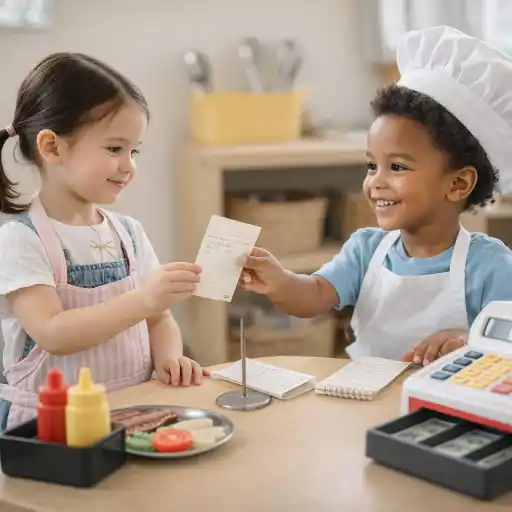
The experience also gives children a reason to listen carefully and remember details. A server might ask, “What would you like?” then record the choice and bring the ticket to the cook. The cook reads or interprets the ticket, asks for clarification, and prepares the pretend meal. This back-and-forth creates a natural audience and purpose for the writing.
- Print awareness: Children see that menus and tickets have different functions and that written symbols convey meaning.
- Composition: They decide what information to include and how to represent it.
- Oral language: They practice food words, questions, explanations, and turn-taking.
- Social problem-solving: They collaborate, negotiate roles, and resolve mixed-up or incomplete orders.
- Fine-motor practice: They handle writing tools and make marks at a level suited to their current development.
These benefits are strongest when the play remains engaging and children have genuine choices. Educators can model writing a ticket aloud, then step back so children can make their own decisions. The NAEYC discussion of playful, literacy-rich environments highlights menus, order slips, and checklists as examples of print that can bring literacy into dramatic play.
How should adults scaffold writing without taking over?
Children’s writing attempts may look different from adult writing, and that is expected. A ticket filled with lines, circles, drawings, or a few recognizable letters can still hold meaning for its author. Begin by asking the child to explain the message: “What did your customer order?” or “How will the cook know what to make?” Then respond to the idea before offering a suggestion.
Brief modeling can make the writing process visible. An educator might say, “I’m writing ‘soup’ so the cook remembers,” while slowly recording the word. If a child wants help, write a word on a separate note, point out a familiar letter, or invite the child to draw the food beside their marks. Avoid insisting that each child copy the same words or produce a conventional spelling.
- Accept drawing, scribbling, letter-like forms, invented spelling, pointing, or dictation as possible ways to communicate.
- Ask open-ended questions that clarify the child’s intention without turning play into a test.
- Offer a choice: “Would you like to write it, draw it, or tell me what to put on the ticket?”
- Model how to read the ticket back to the customer or cook, and invite children to revise if the order has changed.
- Include menu pictures and, when helpful, words in children’s home languages.
Support should be responsive to children’s interests and abilities. For a child who is still exploring marks, drawing a food picture may be a meaningful contribution; a child ready for more challenge may attempt the initial sound or add a number of items. The goal is participation and communication, not a uniform product. Use a picture-supported restaurant order form as one possible visual model, adapting it to the materials and children in your setting.
How can directors and teachers observe learning and avoid common pitfalls?
Restaurant play offers a useful window into children’s thinking, especially when educators observe without interrupting every interaction. Record brief, objective examples: a child drew three foods and explained the marks to a cook, recognized a picture on the menu, or asked a peer to help write a name. These observations can guide a next step, such as adding order numbers, a “specials” board, or more opportunities for children to make their own menu.
Documentation should capture what a child communicates and what support is helpful, not judge handwriting against an adult standard. A photograph of a ticket, a short note about the context, and the child’s own explanation can make learning visible to colleagues and families. Keep documentation consistent with program privacy practices.
Common pitfalls are manageable. Too many props can clutter a center; overly scripted roles can restrict children’s ideas; and correcting every mark can turn play into a performance. Start with a few useful items, allow children to change the scenario, and join play briefly to model or extend language before returning control to them. Make materials accessible and appropriate for the children’s ages, and supervise play according to your program’s practices. State requirements vary - check your state licensing agency.
- Keep tickets and menus flexible, with room for drawing, marks, and children’s own ideas.
- Rotate or add materials in response to observed interests rather than changing everything at once.
- Invite families to share familiar restaurant words, food names, or menu traditions, while respecting each family’s choices.
Conclusion: How do order tickets give preschool writing a real audience?
Restaurant order tickets give preschoolers a reason to make marks, communicate information, and see how writing helps people work together. A child’s drawing or letter-like marks can guide a pretend cook, making the writing meaningful even before it resembles conventional spelling. Menus, signs, order pads, and role-based conversation also invite children to explore print, language, and cooperation through play.
Begin with accessible materials, model writing when it serves the play, and respond to children’s messages with curiosity rather than correction. Observe what they do and use those moments to plan a gentle next step. When providers create a restaurant where children’s tickets are noticed and used, they make an everyday play scenario a welcoming place to grow as writers.
For additional professional learning, explore these English-language ChildCareEd courses:
Classroom Tools for Emergent Literacy Buy Now $16.00
Science of Reading Foundations in the Pre-K Classroom Buy Now $16.00
Understanding Print Knowledge in Preschool Buy Now $16.00
Reading Aloud and Storytelling Buy Now $16.00
Building Vocabulary Buy Now $16.00
References
- Creating Dramatic Play Areas That Support Literacy Development | NAEYC
- Functional Literacy: Naturally Integrate Writing into Dramatic Play - Play to Learn Preschool
- Restaurant Dramatic Play
- Free Restaurant Dramatic Play Activity
- How Can Child Care Providers Support Early Writing Without Using Worksheets? - ChildCareEd
- How can play help preschoolers learn to read and write? - ChildCareEd
- How Can Dramatic Play Be Used to Support Learning? - ChildCareEd
- Creating a Playful, Literacy-Rich Preschool Environment | NAEYC
- Understanding Print Knowledge in Preschool - ChildCareEd
- Supporting Emergent Writing in Preschool Classrooms: Results of a Professional Development Program
- How Can Food and Kitchen Words Build Early Reading Skills? - ChildCareEd
- Restaurant Dramatic Play Order Form
- CACFP Food Menu - ChildCareEd Buy Now $0.00
- Resources - Classroom Tools for Emergent Literacy - ChildCareEd
- Resources - Classroom Tools for Emergent Literacy - ChildCareEd
- Classroom Tools for Emergent Literacy - ChildCareEd Buy Now $16.00
- Classroom Tools for Emergent Literacy - ChildCareEd course page
- What Printables Should Every Preschool Classroom Have on Hand? - ChildCareEd
- Restaurant Dramatic Play Kit - Pre-K Pages
- Environmental Print Ideas, Activities, Games and More!
- CDA Preschool Credential with Portfolio Review
- Writing Training Goals & Objectives
- What Makes Me Special: An Overview of Autism and ADHD
- CDA Bridge Bundle: Family Child Care without Portfolio Review
- CDA Bridge Bundle: Infant/Toddler without Portfolio Review
- CDA Bridge Bundle: Preschool without Portfolio Review
- Texas Director Credential
- Access for All: Inclusion and the ADA
- CDA Certification en Español: Recursos y Consejos para Educadores Bilingües
- 💛🧩 ¿Cómo puedo hacer que mi enseñanza sea inclusiva para los niños con autismo?
- 👶 ¿Cuáles son las proporciones y grupos requeridos en Dakota del Norte? 🏫
- CDA GRATIS
- Requisitos Para Ser Maestra Principal En Un Daycare: Lo Que Necesitas Para Empezar
- Recursos en Español sobre el Sueño Seguro del Bebé
- Proceso CDA: Entrenamiento, Portafolio, Examen y Visita de Verificació
- 10 Ejemplos de Cómo la Cultura Influye en el Desarrollo Infantil
- ¿Qué preguntas aparecen en el examen CDA para preescolar?
- Proporciones de Cuidado Infantil y Tamaños de Grupo por Edad en Maryland (Guía Rápida para Centros y Hogares)
- Proporciones de Cuidado Infantil y Tamaños de Grupo por Edad en Nueva Jersey (Guía Rápida para Centros y Hogares)
- Proporciones de Cuidado Infantil y Tamaños de Grupo por Edad en Virginia (Guía Rápida para Centros y Hogares)
- Cómo Trabajar en el Cuidado Infantil en Carolina del Norte: Requisitos y Pasos
- Cómo Ser Maestra de Preescolar en Illinois
- Cómo Ser Maestra de Preescolar en California
- Cómo Ser Maestra de Preescolar en Maryland
- Celebrando la amistad en el cuidado infantil durante el Día de los Mejores Amigos
- Canciones, juegos y preguntas de círculo para niños
- Cómo simplificar la capacitación para sus empleados de daycare
- How Can Restaurant Order Tickets Give Preschool Writing a Real Audience?
